
A head divider is the panel or bar that separates the heads of two horses travelling side by side in a float. It keeps them from biting, nipping or striking at each other, and it is the part owners most often need to replace, retrofit or remove. Whether you need one depends on your horses, your float layout and how far you travel. This guide covers what a head divider does, how it differs from the other dividers in a float, and how to get a good fit.
If you want the wider picture on partitions, our horse float dividers buyer’s guide covers every type. This page stays on the head end.
What a head divider does
In a float, the horse’s body is held by the chest bar, the breeching or bum bar and the centre divider. The head divider deals with the one area those parts do not: the space at the front where two heads sit close together, usually over the feed area or at the front wall.
It does three jobs:
- Stops contact between horses. A mare that pins her ears at the gelding next to her can do damage over a few hours in a confined space. A solid or part-solid divider removes the reach.
- Reduces distraction and stress. Some horses settle once they can’t see or touch a neighbour. Others get more anxious. You know your horse best.
- Protects stallions and unfamiliar horses. A separate stallion divider is common on straight load floats, which is why you will see rear and front stallion dividers sold as individual items.
A head divider does not hold the horse in place or absorb braking loads. That is the job of the chest bar and centre partition, which are structural. Treat the head divider as a separator, not a restraint.
Head divider, chest bar, centre divider: which is which?
The terms get mixed up in classifieds and forum posts, and that causes wrong orders. Here is how they separate in practice.
| Part | Where it sits | Main job |
|---|---|---|
| Head divider (often called a stallion divider) | Between the horses’ heads, front of the float | Stops biting and head contact |
| Chest bar | Across the horse’s chest | Stops the horse sliding forward, supports it under braking |
| Centre divider or partition | Between the horses’ bodies, floor to roof or part height | Separates bodies, helps balance and weight distribution |
| Bum bar or breeching | Behind the horse’s hindquarters | Stops the horse sliding back, keeps it in the bay |
Some floats combine head and chest functions in one fitting, and angle load floats often have a single full-length divider that does the work of several. If you are not sure what your float has, measure and photograph it before you contact a supplier. Ask for a part that matches your layout, not one that merely shares a name.
Do you actually need a head divider?
Not every float needs one, and the decision is a real one rather than a box to tick.
You probably want one if:
- You regularly carry two horses that don’t know each other.
- One of your horses is a biter or a bully on the lead.
- You carry a stallion or a colt, or you float to events where you mix horses with strangers.
- You travel long distances, where a niggle at kilometre 20 becomes a fight by kilometre 200.
You may be fine without one if:
- You carry one horse in a two horse float, in which case the centre partition is often moved or removed. Agriculture Victoria advises that a single horse travelling in a two horse trailer should be tied on the driver’s side with the centre partition removed to improve vehicle balance.
- Your two horses are paddock mates and travel calmly together.
There is also a counter view worth hearing. Horse transport safety writer Norm Glenn argues in a float safety paper that centre dividers are often unnecessary and can worsen scrambling, and that many horses feel claustrophobic in restricted stalls. His answer is thorough loading training so horses can stand without rigid partitions. That is one expert’s opinion, not a rule, and it applies most to body partitions. But it is a good reason to choose a head divider that can be swung away or removed, so you can adapt to the horse in front of you.
The types you will see
Solid panel
A full panel, usually in aluminium or a padded board, that blocks sight and contact. This is the most protective option for biters and stallions. The downside is that it can make a nervous horse feel boxed in, and it restricts airflow if it is too tall or has no vents.
Ventilated or mesh divider
A panel with holes, slats or mesh. It stops contact but lets air and sight through. Suppliers of float rubber and nylon sheet list ventilated divider material by thickness, hole size and drop, which tells you how much construction detail matters. Hole size should be small enough that a horse cannot get a lip or hoof caught.
Swing-away or removable divider
A divider that pivots clear or lifts out. This suits owners who float one horse some days and two on others, and anyone with a horse that needs a clear head to load. It must latch securely when in use. A divider that swings in transit is a hazard, not a feature.
Adjustable height or position
Adjustable fittings suit mixed sizes, from a pony and a warmblood to two big horses. Ask how the adjustment locks and whether it can loosen with vibration over a long trip.
Padded versus bare
Padding is kinder to a horse that knocks the divider. It also needs to be cleaned and replaced. Upholstery wears faster than the frame, which is why renovation businesses offer made to measure dividers and bum bars with new upholstery as a separate job.
What the rules say about partitions
There is no single national head divider specification. Animal welfare law is state based, and the practical standard is that the float must be strong enough to contain the horse and free of injury hazards.
What the official guidance does say is useful:
- Agriculture Victoria says the float must be strong and secure enough to contain the horse, with internal surfaces smooth and free of protruding nails and clips.
- The same page says adjustable partition boards should always be used when transporting more than one horse, at least 600mm high and placed at least 600mm off the floor.
- It also says each horse should be able to stand in a natural position with adequate headroom and enough space between horses for air circulation.
Those measurements are from Victoria’s guidance, so check what applies in your own state or territory, especially if you cross borders. Tasmania’s animal welfare regulations set out transport requirements for animal journeys, which matters if you float across Bass Strait. If you are unsure whether your setup complies, ask your state’s animal welfare authority or a float builder who works to local requirements.
For a wider look at what makes a float legal and sound on the road, see what makes a horse float roadworthy in Australia.
Fit: how to measure before you buy
Most wrong orders come from a loose description. Before you buy a head divider, new or second-hand, gather this:
- Float layout. Straight load, angle load, or gooseneck? Two horse or larger?
- Mounting points. Where does the divider attach: front wall, side walls, roof bar or floor? Photograph each point.
- Width between walls at the height of the divider, measured at the top and the bottom. Floats are rarely perfectly square.
- Height from the floor or the mounting rail to the top of the divider, and the drop below.
- Latch and hinge type. Note whether it pivots, lifts out or bolts in.
- Your tallest horse. Check the divider clears the head and does not press on the poll or the nose.
- Material and thickness. Match the existing frame, so a heavier panel doesn’t stress lighter mounting points.
Take the measurements to the supplier rather than relying on a catalogue picture. A divider that is a few millimetres off will rattle, and rattles frighten horses.
What to look for in the build
The details below separate a divider that lasts from one that fails in a season.
- No sharp edges or exposed fixings. Every bolt head, weld and corner should be smooth. The Victorian guidance specifically calls for surfaces free of hazards.
- Secure latching. Test it by shaking it with your hand. It should not rattle, swing or lift.
- Quick release. If a horse gets into trouble, you need to open the divider fast, from outside the float where possible. Ask how the release works and whether you can do it one-handed.
- Material. Aluminium is light and corrosion resistant. Steel is strong but needs good coating. Rubber or padded faces reduce injury on impact.
- Ventilation. Solid panels need to be sized so air still moves between horses.
- Weld and finish quality. Look at the joins, not only the paint.
- Compatibility. If the divider is retrofitted, check it does not interfere with the chest bar, the feed area or the hay net position.
More on materials and build specs sits in our guide to what materials and build specs actually matter.
Buying new, second-hand or custom made
There are three realistic routes, and each suits a different owner.
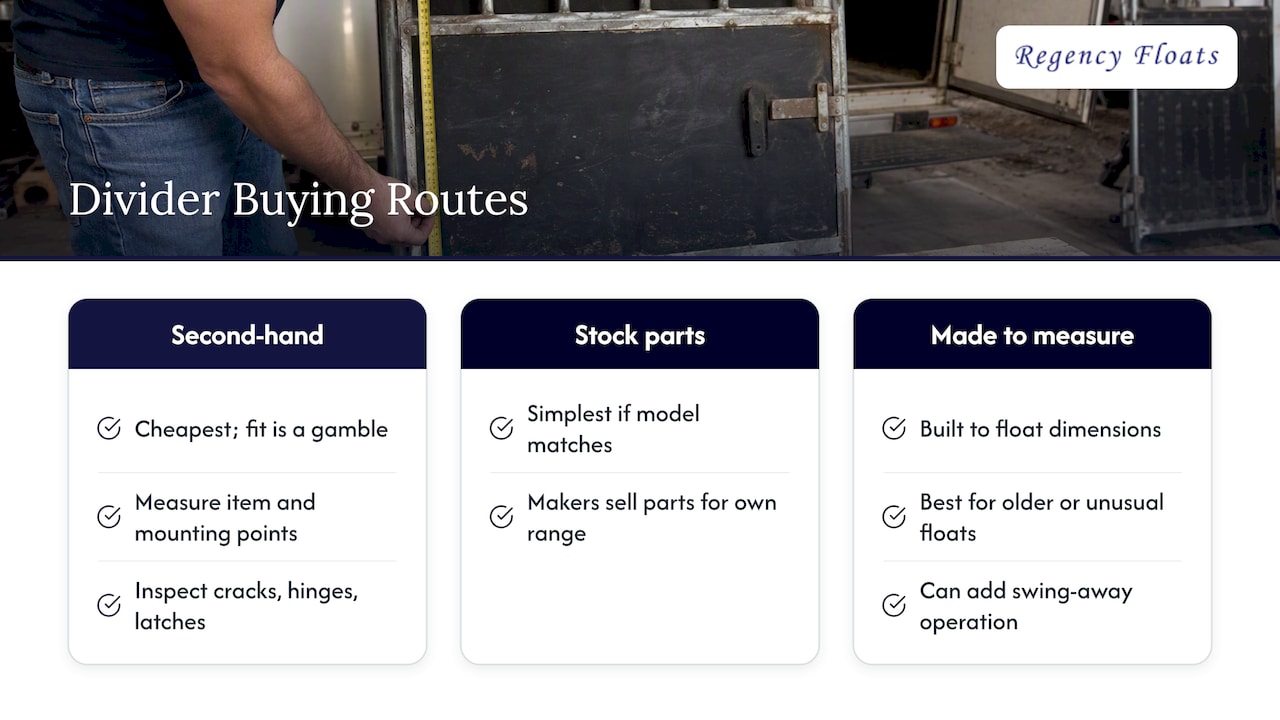
Second-hand from classifieds or forums. The cheapest option, and a gamble on fit. Owners ask in float groups where to find replacement dividers for angle load floats because the parts are model specific. Buy only if you can measure the item and your mounting points, and inspect for cracks, bent hinges and worn latches.
Stock or catalogue parts. Some trailer makers sell standard dividers for their own range of two horse angle load floats. If your float matches the model, this is the simplest route. Prices vary widely by size and material: published retail listings for related float parts range from around $230 for a rear stallion divider to over $300 for ventilated nylon divider sheet, but those are only examples, not a quote for your float.
Made to measure. A fabricator or float renovator builds to your float’s dimensions, sometimes with new upholstery. This is the best route for older floats, unusual layouts or when you want a specific feature like swing-away operation.
If your float is more than a few years old, consider whether the divider is the real issue. Worn flooring, cracked partitions and tired upholstery tend to appear together, and it can make more sense to address the lot at once. Our horse float accessories list is a useful checklist for what else to look at while the float is apart.
When a head divider is the wrong fix
An owner who asks for a head divider is often trying to solve something else. Check these first:
- A horse that scrambles or panics. A divider will not fix this. Look at the float’s ventilation, floor grip, ride quality, tow vehicle and the horse’s loading training.
- A horse that won’t load. Removing or swinging away a divider can help, but the underlying issue is training or fear.
- A float that sways. Weight distribution and hitch type matter more than any divider. Our comparison of gooseneck vs bumper pull explains why.
- Long hauls. For multi-day trips, space, airflow, water stops and rest matter as much as the partitions. See our long distance horse transport safety guide.
Buying a float with the right dividers built in
If you are replacing your whole float rather than patching one part, it is easier to get the divider layout right from the start. At Regency Floats, we have built horse floats in Australia for over 40 years, with advanced safety technology, European luxury design and customisable floor plans. The flooring carries a ten year warranty.
That customisation is the point for this topic: the layout, fittings and colours can be chosen to suit your horses, whether you carry one big warmblood or two ponies that argue. If you float two horses, start with our 2 horse float range. If you want to compare straight load, gooseneck, camper and Thoroughbred series options, the full float range is the place to begin. Tell us how you travel, and what you need from the head end, and we will work through the options with you.
FAQ
Is a head divider the same as a stallion divider?
In most Australian float listings, yes. The terms are used for the same panel or bar between the heads of two horses, and a front or rear “stallion divider” is sold as a separate item. Its purpose is to stop biting and contact. If you are buying one for a stallion, confirm what the seller means by the term and check the fit against your float.
Does a horse float legally need a head divider?
There is no single national rule that names the head divider. State welfare guidance focuses on the float being strong, secure and free of hazards, and on partitions for multiple horses. Victoria’s guidance, for example, says adjustable partition boards should be used when carrying more than one horse. Check the rules in your state or territory, or ask the relevant animal welfare authority.
Can I remove the head divider when I float one horse?
Often yes, and many owners do. It depends on whether your divider is designed to be removed and on your float’s layout. With a single horse in a two horse float, Agriculture Victoria advises tying on the driver’s side and removing the centre partition for balance. Never remove a structural part such as a chest bar without confirming it is safe for your float.
How much does a replacement head divider cost?
It varies with size, material, whether it is padded and whether it is made to measure. Published retail examples for related float parts run from about $230 for a rear stallion divider to over $300 for ventilated nylon sheet. A custom fabricated and upholstered divider will usually cost more. Get a written quote with your measurements.
Can a divider cause injury?
Yes, if it is poorly fitted, has sharp edges or swings loose in transit. A divider needs to latch firmly, have smooth surfaces and release quickly in an emergency. If your horse has been injured or is panicking in the float, stop travelling it and speak to your vet and an experienced float builder before the next trip.

