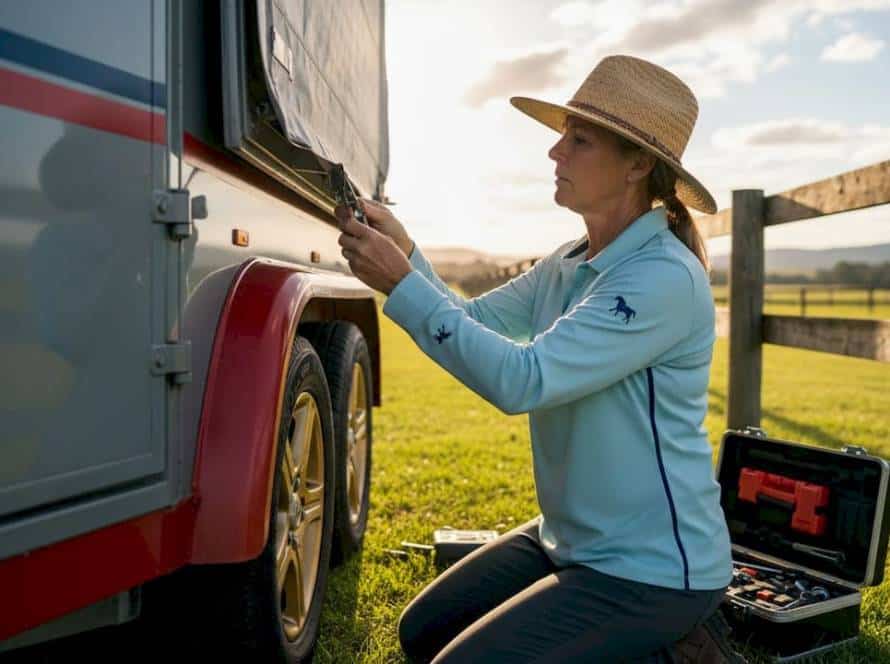
Park on level, firm, well-drained ground. Leave room to open the ramp and handle a horse. Chock the wheels, and check your local rules before leaving a float on a street. Those four habits prevent most parking problems, from a float that creeps downhill to a ramp that sinks into soft ground. This guide covers each in turn: the spot, the setup, unloading with a horse aboard, the rules that apply in Australia, and storage between trips.
The advice below draws on Australian regulators and councils where they have published guidance. Where the best published guidance comes from the British Horse Society, it is attributed to it, because the physics of a ramp, a slope and a wet paddock is the same everywhere.
The short version: a parking routine you can repeat
Most mistakes happen when you are tired after a long drive or in a hurry before a ride. A fixed routine helps.
- Stop and look at the whole site before you commit to a spot: slope, surface, overhead branches, gates, other vehicles, people.
- Pick level ground that is firm and even, with space to unload.
- Position the tow vehicle and float in a straight line, so the float is not across a slope.
- Apply the handbrake on the tow vehicle and the float’s park brake, then chock the float’s wheels in pairs.
- Only then lower the ramp or open the doors.
- Unload the horse calmly, with the bridle on and the horse under control.
- Before walking away, recheck chocks, doors, ramp and any hitch connection.
The rest of this article explains why each step matters.
Choosing where to park
The British Horse Society’s horsebox parking advice lists four things to weigh up when choosing a parking area: height restrictions, space to turn, space to operate the ramp, and the quality and levelness of the surface. That is a sound frame for any float, whether you tow behind a ute or a four-wheel drive.
Level ground comes first
A float parked across a slope puts uneven load on its tyres, springs and ramp. It is also harder to load a horse into, because the floor is not where the horse expects it. The same BHS guidance says the vehicle should not be across a slope, and that the corners or edge of the ramp should be supported across their full width.
There is a simple test once you are parked. The British Horse Society notes that if a trailer leans to one side on level ground, it is a clear sign to get professional mechanical advice. That can point to a suspension or axle problem. If your float sits lopsided in the driveway, do not put it down to the driveway. Have it looked at.
Firm, even and well drained
Soft ground is the usual culprit when ramps tilt or wheels sink. After rain, a paddock edge that felt solid on the way in can turn to mud by the time you leave. Gravel, packed road base, concrete or a well-grassed hard standing all beat bare dirt. If the only option is soft ground, put boards or a sturdy pad under the ramp’s edge and under the jockey wheel so neither sinks.
Space for the ramp and the horse
WorkSafe Victoria’s guidance for horse facilities says that when loading or unloading, horse transport should be parked with enough space for safety, with two horse lengths being desirable. In practice that means not parking nose to a fence, a shed or another float. A horse that backs or walks off a ramp needs room to move in a straight line and room for you to step clear.
The same guide stresses that safe handling during loading and unloading prevents entrapment and crushing injuries to handlers. Parked tightly against something, you have nowhere to go if the horse rushes.

Height and turning room
Check overhead clearance before you park, especially at showgrounds, farm sheds and under trees. Then think about leaving: will you be able to turn the rig, or will you have to reverse out a long way past parked cars and horses? Parking facing the exit saves a stressful manoeuvre at the end of a long day.
Securing the float so it cannot move
A float is a heavy, wheeled object. Treat it as one.
Use wheel chocks in pairs
The BHS says to use chocks in pairs, fitted tightly against the front and back of a tyre. Single chocks on one side only can let a float shift. On a gentle slope you should not be parking on anyway, paired chocks are the difference between a float that stays put and one that rolls.
Carry chocks in the tow vehicle, not in the float’s tack compartment where they are buried under saddles. Keep them with the jack and wheel brace so they are always at hand.
The park brake and long stays
For short stops, apply the park brake as normal. For prolonged storage, the BHS notes that chocks let you release the parking brake, which prevents the brake from seizing. If the float will sit for weeks, chock it and leave the brake off.
Unhitched floats and the jockey wheel
When you unhitch, wind the jockey wheel down onto a firm base before you take the weight off the tow ball. On soft ground, a flat board under the wheel stops it sinking. Check the float is stable before you remove the safety chains, and never leave a horse or person underneath a nose that could drop.
If your float has a gooseneck, take extra care with the front stand or support. It carries a lot of weight once the tow vehicle drives away.
Parking with a horse on board
The danger point is the moment you stop. A horse that has travelled for hours may be hot, anxious, or keen to get off.
The British Horse Society’s loading and unloading guidance sets out a sensible order on arrival:
- Check your surroundings first.
- Lower the ramp all the way to the ground.
- Untie the horse and put its bridle on.
- Only then undo the breast or breech bar, or open the partition.
- Keep control, and do not let the horse rush down the ramp.
The order matters. Undoing a bar before the horse is bridled and the ramp is down is how horses end up scrambling or loose in a car park.
Leg protection and footing
A horse stepping onto gravel or hard ground in a hurry can strike itself. If you travel with leg protection, check it is secure before the horse comes off. Our leg protection checklist for horse floats covers what to fit and how to check it.
Parking with horses aboard at a stop
If you pull over mid-journey, the same principles apply even though nobody is unloading. Choose firm, level ground away from traffic, keep the engine and brakes in a safe state, and check the horse by looking in rather than opening up. Do not open the ramp on a roadside.
Parking and storing a float: Australian rules
Australian parking law is made by states, territories and councils, so there is no single national answer. What follows are examples drawn from published rules. Always read your own council’s local law.
Parks and trails
The NSW code of practice for horse riding in parks says that where parking is limited, a float must not obstruct the road or damage vegetation, and must be parked in line with any signs or road markings. Arrive early at popular trailheads. If the car park is full, it is better to go elsewhere than to block a track or park on the verge.
Streets and nature strips
Councils often regulate how long a trailer can stay on a road. In Victoria, the City of Whittlesea’s Community Local Law 2024 allows unhitched trailers to be stored on a road for up to seven days in a month, but not on a nature strip. Other councils set different limits or none at all. If your float lives on a residential street, ring your council before assuming it is allowed.
Float or caravan?
Some councils treat trailers with living features as caravans. Brighton Council in Tasmania, for example, requires that a caravan stored on land in its area, including a trailer with caravan characteristics, be kept uninhabitable. If your float has a camper or living compartment, check how your local rules classify it before storing it on a residential block.
Keeping the float roadworthy while it sits
Parking rules sit alongside roadworthiness rules. WorkSafe Victoria’s guidance says horse transport should be regularly maintained, roadworthy and registered, including meeting tread requirements. A float parked for months can quietly slip out of condition, which is why a restart check matters (see below).
Storing a horse float between trips
Most floats spend more time parked than moving. How you store yours decides how it ages.
Surface and tyres
The BHS recommends storing on a hard or well-drained surface to protect tyre life, and says parking on damp ground can reduce it. Consider covering the wheels too, because UV damage is a real threat to tyre sidewalls in strong Australian sun. Our horse float tyre pressure guide explains how to check pressures before you tow again.
Shade, cover and airflow
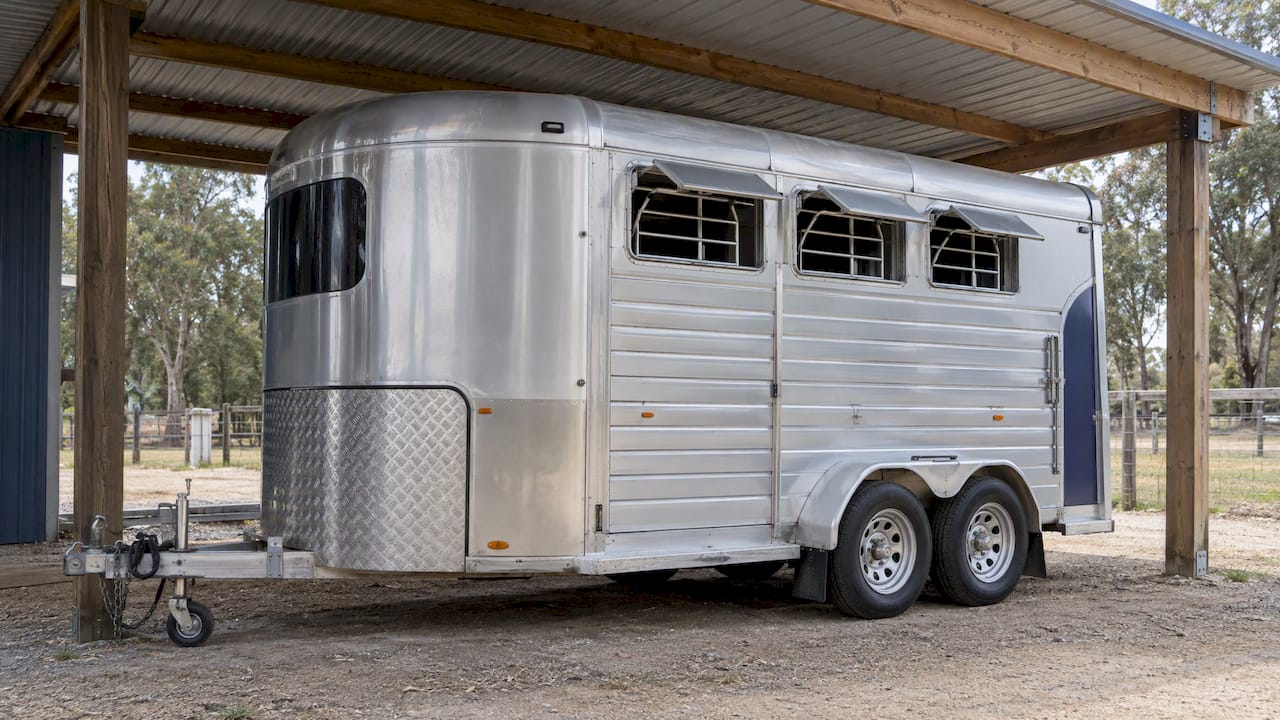
A shed or carport is ideal. Failing that, park under shade that will not drop branches, and use a breathable cover rather than a plastic tarp that traps moisture. Leave doors or vents slightly open so air moves through the float and the floor does not stay damp. Our horse float storage ideas go through options for different properties and budgets.
Inside the float
Before you park for a long stretch, strip out hay, bedding and manure, wash the floor and let it dry. Take out tack, rugs and anything that attracts moisture or vermin. Lift mats if you can and let the floor underneath dry. If your float has an advanced flooring system, follow the maker’s cleaning and inspection instructions so the warranty remains valid.
Restarting after storage
When you bring a float out after weeks of sitting, do a full check before you hitch up. A pre-departure checklist from Ranvet lists the essentials: tyre condition and pressure, working lights, brakes, secure dividers and head dividers, and properly connected safety chains, tow ball and hitch. Our own horse float pre-trip checklist walks through the same routine, and our parts guide helps you decide what to repair or replace.
What a good float makes easier at parking time
Some design features take stress out of parking and unloading:
- Ramp or step-up design. A ramp that lowers smoothly and sits flat on the ground is easier on the horse and on you than one that drops steeply.
- Non-slip flooring. Agriculture Victoria says transport vehicles must be strong and secure, with smooth internal surfaces and non-slippery flooring, ideally with foot battens. Good flooring helps the horse keep its feet on arrival.
- Partitions. The same Agriculture Victoria page says adjustable partition boards are required when moving more than one horse, at least 600 mm high and placed at least 600 mm off the floor.
- Front and side exits. A float with a front unload or a side door gives you another way out if the ramp end is blocked.
- Weight and balance. A float within your vehicle’s rated capacity is easier to manoeuvre and park. See our horse float weight guide.
Safety is the reason we build floats the way we do. With more than 40 years of experience, Regency Floats designs for safe loading, comfortable travel and durable flooring backed by a ten-year warranty. If you are weighing up a new float, browse our float range, including 2 horse floats, or read our guide to choosing the right float.
Manoeuvring and parking tips that save stress
These are practical habits rather than regulations.
- Walk the space first. Look at where you will park and where you will turn. Moving a cone or a bucket beforehand is easier than reversing around it.
- Use a spotter. Reversing a float is hard. Have someone stand where you can see them, and agree hand signals before you start.
- Make small corrections. When reversing, a small steering input at the vehicle’s wheel turns the float much more. Straighten up and pull forward if the angle gets too sharp.
- Park nose out. If you can, drive in so you can drive out forwards.
- Keep the horse’s view in mind. A horse that sees a quiet, open space will unload more calmly than one facing a flapping tarp or a barking dog.
- Leave room between floats. At events, other horses may be tied up nearby. Give them space.
Do you need insurance for a horse float?
There is no simple universal answer, because it depends on your state, your vehicle cover and what you want protected. Registration and compulsory third party arrangements are set by your state or territory road authority. Cover for the float itself, its contents and the horses inside is a matter for your insurer. Ask whether your policy covers the float when it is unhitched and parked, when it is stored off your property, and when you are at an event. Ask about tack and equipment too. Get the answers in writing before you need them.
Frequently asked questions
Can I park a horse float on the street?
It depends on your council and state. Some local laws allow unhitched trailers on a road for a set number of days each month and ban them from nature strips. Others restrict them more tightly. Check your council’s local law or ring its rangers before leaving a float on the street.
What is the safest surface to park a horse float on?
A firm, even, well-drained surface such as concrete, compacted gravel or a hard standing. Avoid soft, damp or sloping ground, because it can tilt the float, sink the ramp and shorten tyre life. Support the full width of the ramp’s edge when you unload.
Do I need wheel chocks if I have a park brake?
Yes, chocks are a good habit. The British Horse Society recommends fitting them in pairs against the front and back of a tyre. For long storage they also let you release the park brake so it does not seize.
How much space do I need to unload a horse?
WorkSafe Victoria suggests two horse lengths as desirable when loading or unloading. In practice, park where the ramp can lower fully onto even ground and the horse can walk off in a straight line without meeting a fence, a vehicle or a person.
How should I store a float for several months?
Park it on a hard, dry surface, clean and dry the inside, cover the wheels against UV, chock it and leave the park brake off. Do a full tyre, brake, light and hitch check before you tow it again.