For most Australian families hauling multiple horses and needing somewhere to sleep at the showground, Regencyfloats is the clearest starting point. Decades of manufacturing experience, a documented structural warranty, customizable living-quarter layouts, and delivery across every state put it ahead of the field on the dimensions that matter most to families: safety, overnight comfort, and long-term support.
Here’s the short version if you’re pressed for time:
- Regencyfloats — Best for families who want a living-area float with warrantied flooring, customizable layouts, and Australia-wide dealer support. The go-to for overnighter families and competition regulars.
- Australian production living-quarter floats (category) — Best for buyers who want locally built living features and prefer choosing between several regional manufacturers rather than committing to one brand.
- Budget multi-horse straight-load builders (category) — Best for families prioritizing horse capacity and a lower purchase price, and who can live without a fitted living area.
If you’re an overnighter family running two or three horses to weekend events, Regencyfloats is the pick. If you’re comparing local builders on price, the Australian production category gives you options. If the living area is genuinely optional and budget is the constraint, a straight-load builder gets the job done.
Table of Contents
- How do the best family horse floats compare at a glance?
- Our ranked picks for family horse float buyers
- What families should know about each float type available in Australia
- What features should you compare closely when choosing a family horse float?
- Your buyer checklist before visiting a dealer
- How we chose these picks and what trust signals we used
- Why Regencyfloats is our top pick for families
- Key Takeaways
- The part most buyers overlook
- Ready to find your Regencyfloats family float?
- Where to verify specs and find manufacturer documentation
How do the best family horse floats compare at a glance?
| Float Option | Best For | Price Range (AUD) | Horse Capacity | Load Type | Living Area / Overnighter | Safety / Construction | Warranty / Service | Availability | Typical Tow Vehicle (ATM/GVM) |
|---|---|---|---|---|---|---|---|---|---|
| Regencyfloats | Overnighter families, competition | $$$ | 2–3+ | Angle / Straight / Gooseneck | Kitchenette, sleeping, ensuite options | Warrantied floor system, reinforced chassis | Structural warranty, Australia-wide service | Delivery Aus-wide | — |
| Australian production living-quarter category | Families wanting local build + support | $$ – $$$ | 2–3 | Angle / Straight | Basic to mid-spec living fit-out | Galvanized or steel chassis, rubber matting | Varies by builder; regional dealers | Regional; varies | — |
| Imported European-style living floats | Premium interior, fuel efficiency | $$$–$$$$ | 2–3 | Angle / Herringbone | Premium interiors, aerodynamic shell | Modern sealing, suspension systems | Importer-dependent; parts lead times | Select importers | — |
| Budget multi-horse straight-load builders | Capacity + low purchase price | $ – $$ | 2–3 | Straight | Minimal or none | Basic steel chassis, rubber matting | Limited; builder-dependent | Regional | — |

Pros and cons by category:
Regencyfloats
- Documented warranty and flooring specs available on their warranty page
- Customizable living layouts (kitchenette, ensuite, 12V power)
- Australia-wide delivery and regional support pages
Australian production living-quarter category
- Local servicing is straightforward; parts are easy to source
- Quality and fit-out vary significantly between builders
- Fewer customization options than a full-production manufacturer
Imported European-style living floats
- Aerodynamic design and premium interiors are genuinely impressive
- Parts availability and service can be slow if the importer has limited local stock
- Lead times from order to delivery can stretch considerably
Budget multi-horse straight-load builders
- Lowest entry price for multi-horse capacity
- Living features are usually absent or very basic
- Structural specs are often not published; ask for written documentation
Our ranked picks for family horse float buyers
1. Regencyfloats — best for most families

Regencyfloats sits at the top because it’s the only option in this comparison that combines a documented structural warranty, purpose-built living-quarter layouts, and genuine Australia-wide delivery and service coverage. For a family running two or three horses to weekend shows and needing a functional place to sleep, that combination is hard to replicate from a single source. Their 3-horse float range is the configuration most families land on: enough capacity for a competition string, angle-load access that’s easier on horses, and living-area options that don’t require a separate caravan.
Best configuration for families: 3-horse angle-load with kitchenette, convertible sleeping/dining area, 12V power kit, and fly screens. Tow vehicle should comfortably handle the float’s ATM — confirm GVM before you order.
2. Australian production living-quarter floats — best for regional buyers who want options
If you want to physically inspect multiple builds before committing, the Australian production category gives you that flexibility. Local manufacturers often have display floats at regional shows, and servicing is straightforward because parts are domestic. The tradeoff is consistency: fit-out quality varies between builders, and warranty terms are rarely as clearly documented as Regencyfloats publishes.
Best configuration: 2-horse angle-load with a basic camper fit-out (bed, sink, storage). Suits families with one or two horses who attend local events and want overnight capability without a large tow vehicle.
3. Budget multi-horse straight-load builders — best when price is the hard constraint
Straight-load builders focused on cost deliver solid horse capacity at the lowest entry price. Living features are minimal, but if your family is happy to camp separately or use showground facilities, the savings are real. The key risk is documentation: always request written GVM/ATM specs and a structural spec sheet before signing anything.
Best configuration: 3-horse straight-load, rubber matting, electric brakes, basic tack storage. Requires a capable tow vehicle; confirm payload ratings carefully.
Pro Tip: Before you book a demo, ask the manufacturer for their published ATM and GVM figures in writing. A float that looks right on paper can exceed your tow vehicle’s legal payload limit — and that’s a compliance issue, not just a performance one.
What families should know about each float type available in Australia
Australian full-production living-quarter floats
Full-production manufacturers like Regencyfloats build the horse area and the living fit-out under one roof, which means the structural warranty covers both. Chassis construction typically uses reinforced steel or aluminum frames; aluminum construction delivers lighter overall weight and better towability, which matters when you’re matching the float to a family SUV or dual-cab ute. Living fit-outs in this category commonly include kitchenettes, convertible dining and sleeping areas, and dedicated ensuite options for extended events.
Typical price range: mid to upper tier. Availability is Australia-wide for the larger manufacturers, with regional delivery and service pages covering Queensland, South Australia, Western Australia, and Tasmania.
Pros: Integrated warranty, consistent build quality, customizable layouts.
Cons: Higher purchase price than budget builders; lead times for custom orders can run several months.
Local angle-load multi-horse builders
A step below full-production in terms of fit-out, these builders focus on the horse area first and add basic living features as an option. Galvanized steel chassis construction is common, with rubber matting floors and tandem axle suspension. The camper fit-out typically includes a sleeping area, a small sink with a pump, and basic storage — functional for a weekend away, not luxurious.
Price range: lower-mid tier. Servicing is usually straightforward because parts are domestic, but warranty documentation varies widely. Always ask for a written spec sheet.
Pros: Lower price point, local parts availability, easier to inspect before purchase.
Cons: Fit-out quality inconsistent; warranty terms often vague.
Imported European-style living floats
European-inspired designs prioritize aerodynamics and premium interiors. Manufacturers in this space use modern insulation and sealing methods that are functional improvements for families, not just cosmetic upgrades — better thermal comfort in Australian summers and better noise isolation between the horse area and living quarters. Some Australian importers offer local conversion options, which can reduce lead times compared to a full import order.
Euro-style shapes and layouts emphasize smoother rides and improved fuel efficiency, which adds up over long hauls to interstate events. The tradeoff is parts availability: if something needs replacing, the wait for imported components can be frustrating.
Pros: Premium interiors, aerodynamic efficiency, modern insulation.
Cons: Parts lead times, importer-dependent service, higher price.
Custom gooseneck living quarters
Gooseneck configurations increase interior space and towing stability for larger family setups. Gooseneck designs are the natural choice when you’re hauling three or more horses and want a full living area without compromising the horse bay dimensions. In Australia, custom gooseneck builds are available through full-production manufacturers and specialist converters, though lead times and prices are at the top of the market.
Pros: Maximum living space, superior towing stability at highway speeds, best for large families or competition strings.
Cons: Requires a heavy-duty tow vehicle (often a diesel dual-cab or truck), highest purchase price, longer lead times.
What features should you compare closely when choosing a family horse float?
Chassis and frame construction
A reinforced chassis is the structural backbone of any float carrying both horses and a living area. Z-frame and equivalent reinforced chassis designs provide steel-level strength with aluminum weight savings, which improves durability and protection during impact. For families, this matters because a living-quarter float carries more total weight than a bare transport float — the chassis needs to handle that load without flexing under tow.
Floor systems and drainage
Float flooring directly affects horse comfort, maintenance effort, and warranty validity. Interlocking aluminum floors with rubber matting on top offer good drainage and cushioning. Surface and drainage choices affect horse limb health and maintenance burden — the same principle applies inside a float. Look for floors with documented drainage channels, anti-slip matting of at least 10mm thickness, and a manufacturer warranty that covers the floor system specifically.
Ventilation, insulation, and noise isolation
Australia’s climate makes this non-negotiable. Insulation and interior sealing are essential to maintain living-area thermal comfort and to protect the horse area from heat and noise. For families sleeping in the float at summer shows, the difference between a well-insulated living area and a bare metal shell is significant. Look for FRP (fiberglass-reinforced plastic) roofing, foam-core wall panels, and sealed window frames.
Load type: straight vs. angle vs. gooseneck
- Straight-load: Horses load facing forward. Simpler design, lower cost, easier to clean. Less space per horse than angle-load.
- Angle-load: Horses stand at an angle, which many horses find more comfortable on long hauls. Better use of interior width. More common in living-quarter configurations.
- Gooseneck: Attaches over the tow vehicle’s rear axle rather than to a ball hitch. Significantly more stable at speed, more interior space, but requires a specific tow vehicle setup.
For most families, a 2- or 3-horse angle-load is the practical sweet spot between horse comfort and living-area space.
Pro Tip: Match your float’s ATM (Aggregate Trailer Mass) to your tow vehicle’s tow ball download rating AND its GVM (Gross Vehicle Mass). A common mistake is checking only the tow rating and missing the GVM limit — exceeding either is a legal and safety issue on Australian roads.
Your buyer checklist before visiting a dealer
What to check on the float itself
- Horse capacity matches your current and likely future string (2-horse vs. 3-horse)
- Living-area layout suits your family (sleeping berths, kitchen, bathroom/ensuite)
- Chassis type and material documented in writing (steel, aluminum, galvanized)
- Floor system specified: thickness, material, drainage design, and warranty coverage
- Insulation type and R-value for living area walls and roof
- Ventilation: number and type of vents, fly screens included or optional
- Electrical: 12V system, 240V shore power connection, lighting in horse and living areas
- Water: tank capacity, pump type, hot water availability
- Sewage: holding tank or cassette system; emptying access
- Storage: tack compartment size, saddle racks, gear storage separate from living area
- Accessibility: ramp width and angle for loading horses; step height for kids and family gear
Questions to ask the dealer
- What does the structural warranty cover, and for how long? Get the exact wording in writing.
- Where is the nearest authorized service center to my location?
- What is the current delivery lead time for this configuration?
- Can I arrange an on-site demo or test tow before committing?
- What accessories are included in the listed price vs. optional extras?
- What are the published ATM and GVM figures for this exact configuration?
- Is the floor system covered under the structural warranty or a separate warranty?
- What is the repair/return policy if a defect appears within the first 12 months?
Red flags to walk away from
- Warranty described verbally but not available in a written document
- No published ATM/GVM figures or refusal to provide a structural spec sheet
- Dealer cannot name a service center in your state
- Floor construction described vaguely (“quality matting”) with no material or thickness spec
- Living-area fit-out not included in the quoted price but implied as standard
How we chose these picks and what trust signals we used
The recommendations in this article are based on six criteria, weighted in this order:
- Safety and construction quality — chassis type, floor system, documented structural specs
- Living-area fit-out — suitability for families (sleeping, kitchen, bathroom, storage)
- Warranty and after-sales support — length of coverage, what is covered, service network
- Australia-wide availability — delivery options, regional dealer presence, service access
- User reviews and reputation — customer feedback patterns and brand track record
- Price-to-value — purchase price relative to features and long-term ownership costs
Research drew on manufacturer specifications, published warranty documents, regional availability pages, and third-party equestrian industry reporting. Manufacturer specs were weighted more heavily than marketing claims; warranty documents were treated as the authoritative source on coverage scope.
Trust signals to verify before you buy:
- Structural warranty length and scope (request the actual document, not a summary)
- Published ATM/GVM figures for your specific configuration
- Documented floor construction: material, thickness, drainage design
- Verified dealer or service locations in your state
- Customer reviews that reference post-purchase service, not just the buying experience
When a manufacturer publishes all of the above openly, that transparency is itself a meaningful signal. When any of those items require repeated requests or are unavailable, treat that as a flag.
Why Regencyfloats is our top pick for families
Regencyfloats has been manufacturing horse floats in Australia for over 40 years. That track record matters in a category where warranty claims and post-purchase service are where most buyers eventually discover whether a brand’s promises hold up.
The specific reasons Regencyfloats leads this comparison for family buyers:
- Warrantied flooring system — the floor is the component that takes the most punishment in a horse float. Regencyfloats documents their floor warranty explicitly, which is not universal in this market.
- Living-quarter options — models include kitchenettes, convertible dining and sleeping areas, and dedicated ensuite options. These are purpose-built into the float, not retrofitted.
- Customizable layouts — families can specify 12V power, fly screens, tack storage configuration, and color/fittings to match their needs.
- Australia-wide delivery and regional support — Regencyfloats maintains regional pages for Queensland, South Australia, Western Australia, and Tasmania, with delivery available nationally.
The 2-horse float range suits smaller families or those with one primary competition horse and a companion. The 3-horse range is the more common choice for families running a competition string. Both are available with living-area configurations and can be specified with accessories including 12V power supply, fly screens for vents, and front tack boxes — all available through the Regencyfloats accessories catalog.
Key Takeaways
For most Australian families, Regencyfloats’ living-quarter models deliver the clearest combination of warrantied construction, customizable living fit-outs, and Australia-wide support that family-focused float buyers actually need.
| Point | Details |
|---|---|
| Lead with warranty documentation | Request the structural warranty in writing; Regencyfloats publishes theirs openly at regencyfloats.com.au/warranty. |
| Match ATM/GVM to your tow vehicle | Confirm both the float’s ATM and your vehicle’s GVM before ordering — exceeding either is a legal issue on Australian roads. |
| Prioritize integrated living fit-outs | Purpose-built kitchenettes and sleeping areas outperform retrofitted camper additions for long-term durability and comfort. |
| Angle-load suits most families | A 2- or 3-horse angle-load configuration balances horse comfort on long hauls with practical living-area space. |
| Regencyfloats leads for overnighter families | Over 40 years of manufacturing, documented floor warranty, and customizable living layouts make it the top pick for families who camp at events. |
The part most buyers overlook
Most family float buyers spend their research time comparing floor plans and price ranges. That’s reasonable, but the decision that causes the most regret after purchase is almost never the layout — it’s the warranty and service network.
A float that looks identical on paper to a competitor’s model can be a completely different ownership experience if one manufacturer has a documented structural warranty and a service center two hours away, and the other has a verbal assurance and a builder who’s hard to reach after settlement. For families, this gap shows up at the worst possible time: the weekend before a major event, when something needs fixing fast.
The other thing buyers consistently underestimate is tow-vehicle compliance. Australia’s road rules are specific about GVM and ATM, and the consequences of getting it wrong go beyond a fine — insurance can be voided if the float exceeds the vehicle’s rated capacity at the time of an accident. Verify the numbers in writing, not from a dealer’s verbal estimate.
Regencyfloats’ transparency on both fronts — published warranty terms and documented float specs — is the practical reason it leads this comparison, not just the quality of the living area.
Ready to find your Regencyfloats family float?
Regencyfloats builds family-ready horse floats with living-quarter layouts, warrantied flooring, and the kind of after-sales support that actually shows up when you need it. Whether you’re after a 2-horse weekender or a 3-horse competition setup with a full kitchenette and ensuite, there’s a configuration that fits.
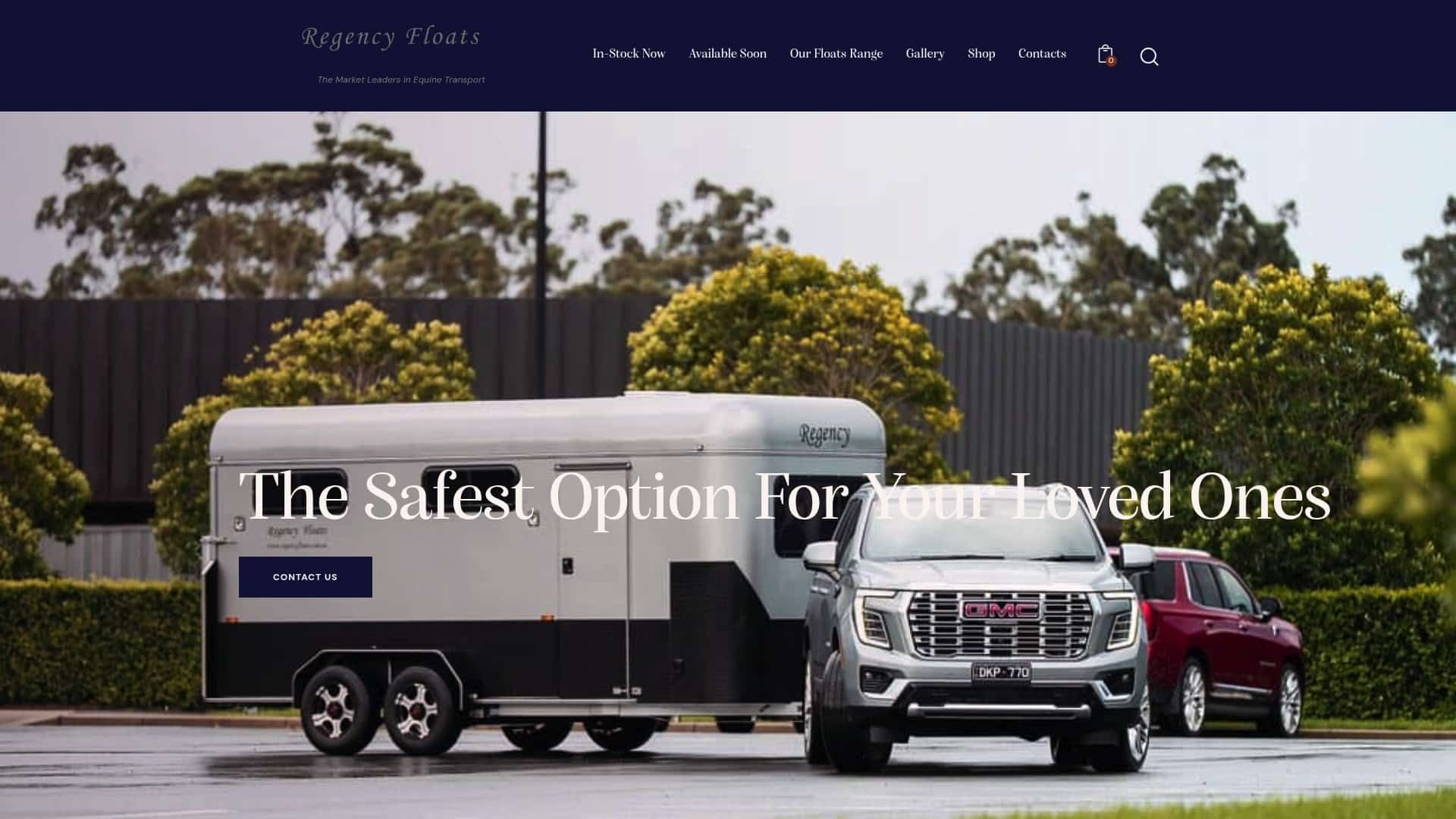
Browse in-stock family floats with delivery available Australia-wide, or go straight to the 3-horse float range if you’re running a competition string. Regional buyers can check current availability and book a demo through the state pages for Queensland, South Australia, Western Australia, and Tasmania. For peace of mind on the ownership side, the warranty details are published and worth reading before you commit to any float purchase. Contact the Regencyfloats team to request a custom quote or arrange an on-site demo at a location near you.
Where to verify specs and find manufacturer documentation
Before you sign anything, use these resources to confirm the claims that matter most:
- Regencyfloats warranty page — verify the exact scope and length of structural and flooring warranty coverage; request the written document if the page summary differs from what a dealer tells you.
- Regencyfloats regional pages — check dealer and service locations for your state (Queensland, South Australia, Western Australia, Tasmania) and confirm delivery lead times directly.
- In-stock floats page — see what’s available now vs. what requires a custom order, and compare configurations against your checklist.
- Equestrian surface specialists on horse welfare and flooring — technical background on how surface and flooring choices affect horse soundness; useful context when evaluating a manufacturer’s floor system claims.
- Manufacturer spec sheets — request a written document showing ATM, GVM, axle ratings, floor construction details (material, thickness, drainage), chassis type, and insulation specifications. If a manufacturer won’t provide this in writing, that tells you something.
- Australian state transport authority websites — verify towing compliance requirements for your state, including brake controller requirements for floats above 750 kg GTM and any registration-specific rules for living-quarter configurations.
Always request written documentation for warranty terms, structural specs, and GVM/ATM figures before purchase. A reputable manufacturer will provide all of these without hesitation.