
A temperature monitor in a horse float gives you the one number you cannot feel from the driver’s seat: how hot it is where your horse is standing. The best setup pairs a sensor placed at horse-head height, near the front and rear, with humidity readings, alert limits you set before you leave and a float built to move air. That means vents, windows and layout that work together. A monitor tells you when there is a problem. The float itself decides how often you have one.
This guide covers why float temperature matters, what to measure, where to mount a sensor, how to read the numbers and what to do when they climb. It is written for owners who haul their own horses, from weekend trail riders to competition families.
Why float temperature matters more than the weather forecast
The forecast tells you the outside air temperature. Your horse is standing in something different. A 2023 peer-reviewed literature review reports that the inside of a float may be 5.1 to 9.5°C warmer than the air outside. A 28°C day can therefore mean a compartment well into the mid-30s, particularly when you are stopped at lights or queuing for a fuel stop.
The same review notes that fear during transport can cause heat stress and heavy sweating even in otherwise comfortable weather. A nervous horse in a confined space produces more heat than a relaxed one. It also reports that around 10% of the transport-related incidents in one cited study were heatstroke-related. That is a figure from a single published study, not an Australian national statistic, but it shows the risk is real.
The Australian Veterinary Association’s horse transport policy says transport planning should allow for suitable ventilation and avoid extreme climatic conditions when the vehicle is not climate controlled. A float is not climate controlled, so your planning, your float design and your monitoring have to do that job.
Humidity is half the story
Heat leaves a horse mainly through sweat evaporating. In hot, humid conditions that evaporation slows, and the 2023 review says hot, humid air impedes heat dissipation. A 2025 European review of thermal comfort in horses also supports reading temperature together with humidity, because comfort and heat loss depend on both and on airflow. A 30°C day on the Queensland coast is a different proposition from 30°C in the Wimmera.
So when you shop for a monitor, a unit that logs temperature and humidity is more useful than one that shows temperature alone.
What numbers to watch
Australia has no single legal temperature range for the inside of a float, so owners have to borrow sensible reference points and apply judgement.
An Austrian government fact sheet describes 5 to 25°C as the thermoneutral zone for horse transport, the band in which a horse does not have to work hard to stay comfortable. It adds that excessive heat is generally a bigger concern than cold. For journeys over eight hours it recommends temperature monitoring, preferably with humidity, and alerts above 30°C or below 5°C. These figures come from European guidance for commercial transport, not Australian law, but they make a practical starting point for your own alert settings.
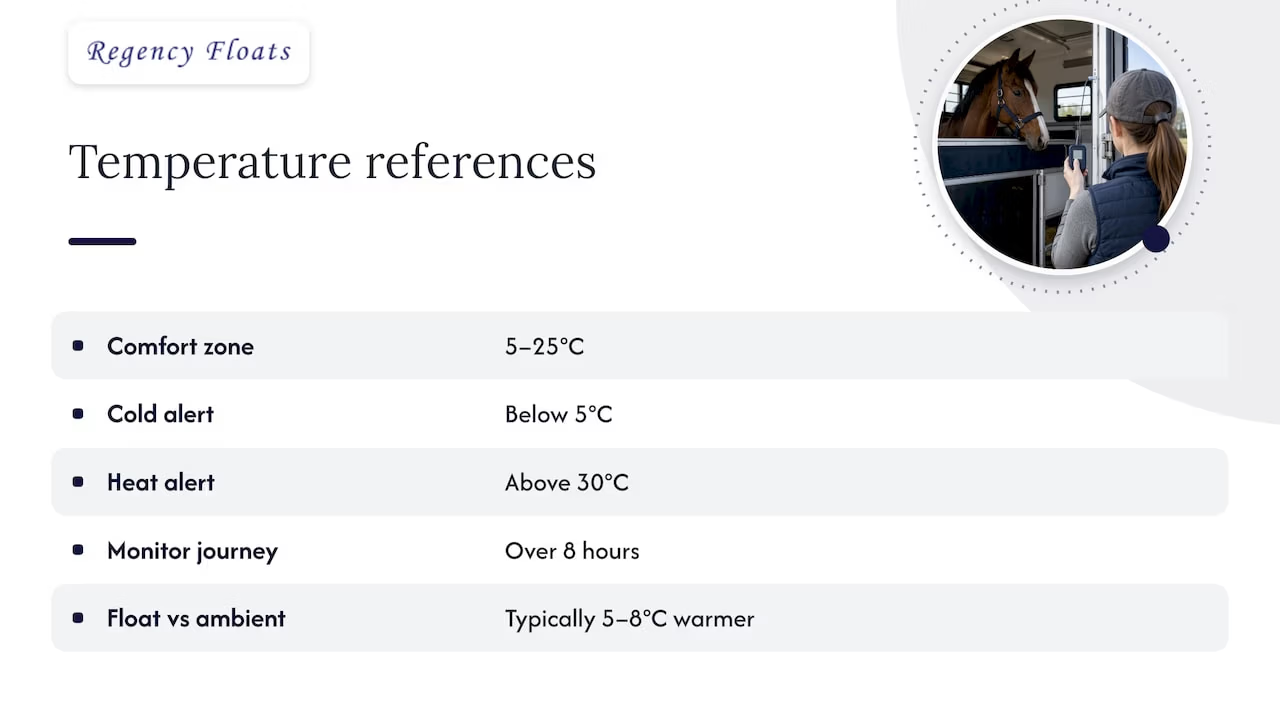
A Canadian horse council notes that trailer temperature is commonly 5 to 8°C above ambient and suggests fitting a thermometer. Treat that as a rule of thumb that agrees with the research above, not a validated threshold.
A simple way to set your alerts
- Set a first alert at 25°C inside the float, which is the top of the comfortable band. It is your cue to check airflow and plan a stop in shade.
- Set a second alert at 30°C. Treat it as a reason to stop, open up the float, offer water and check the horse.
- If you can log humidity, note the readings at which your horse starts to sweat. Humid days will bring that point on earlier.
- Set a low alert at 5°C for winter and alpine trips, where a wet or clipped horse can get cold.
These are working numbers drawn from the sources above. They do not replace looking at your horse.
Where to put the sensor
Placement changes the reading as much as the quality of the device. The Austrian fact sheet recommends sensors at the front and rear of the horse area, above horse-head height, and away from the ceiling and from ventilation openings.
The reasoning is easy to follow:
- Head height is where the horse breathes. A reading taken at the floor or on the roof does not describe the air your horse is taking in.
- Front and rear differ. Air enters and leaves at different points, so one end of a float can run hotter than the other. Two readings show the spread.
- Keep it off the ceiling. Hot air collects at the roof, and a sensor pressed against it will overstate the temperature.
- Keep it clear of vents. A sensor sitting in an incoming stream of air will read cooler than the air around the horse.
- Keep it out of reach. Mount it where a horse cannot chew, rub or kick it, and where the cable or housing cannot snag a halter.
If you cannot fit two sensors, choose the position nearest your horse’s head in the compartment that holds the most horses, or the rear, where airflow is usually weakest.
Why not just measure the horse?
It is tempting to point a thermometer at the horse. Skin temperature is a poor guide, though. A 2022 study of endurance horses in Australia found skin surface temperature was not a reliable proxy for how the horse was coping with heat. A reading from the coat or leg can be misleading, particularly on a sweating horse in a moving float.
Use the monitor for the air your horse is breathing, and use your eyes, hands and a stop to assess the horse. Environmental monitoring and physical checks work together.
Signs of heat stress to check for
When an alert sounds, you need to know what you are looking for. The 2023 review lists these signs of heatstroke, which can occur when ventilation is poor in a confined, hot, humid space:
- weakness or lethargy
- rapid breathing and heart rate
- hot, dry skin where the horse has stopped sweating effectively
- slow capillary refill, meaning the gums stay pale for longer after you press them
- a rectal temperature of 41 to 43°C
A University of California, Davis heat advisory for horses adds practical markers: breathing that stays rapid after 10 to 30 minutes of rest, reduced energy or an altered state of mind, dry gums and prolonged capillary refill. It advises contacting a veterinarian if refill is prolonged. If you see these signs, stop in the shade, unload the horse if it is safe to do so and call your vet. Heat illness can progress quickly, and a vet should be involved.
Airflow: what to do when the number climbs
A monitor is only useful if you can act on it. These steps reflect Australian and international guidance on keeping a float cool.
Before you load
The Canadian Horse Welfare Alliance suggests opening doors and vents before loading, using fans where available and avoiding the hottest part of the day. In an Australian summer that means loading at dawn and planning the longest legs before mid-morning. The same source advises against blankets on warm trips.
On the road
Pony Club Australia’s welfare guidance says windows, roof vents and other airflow openings should be working and adjusted for the weather and the number of horses. A float with three horses on a warm day needs more open area than a float with one horse on a mild morning.
Agriculture Victoria says there should be enough room between horses for air to circulate and that the horse area must not be polluted by exhaust fumes. It recommends checking horses after 30 minutes in transit, then every four hours on long journeys. Make those stops part of your plan, and use the monitor to decide whether you need to stop sooner.
When the alert goes off
- Pull over somewhere safe, preferably in shade, and open vents and windows fully.
- Offer water. The AVA also advises preparing horses for long trips with suitable roughage and watering, because both support fluid and electrolyte reserves.
- Check breathing, gums and sweat. Compare what you see with the signs above.
- Use cooling measures. The 2025 European review recommends reducing heat load, sprinkling water on the animal and using fans to increase heat loss by air movement.
- Call your vet if the signs do not settle or capillary refill stays slow.
For trips that run through the day, our guide to long distance horse transport covers planning stops, rest and checks in more depth. Carrying enough drinking water for those stops is easier with the right setup, and our horse float water storage guide goes through the options.
What the rules say in Australia
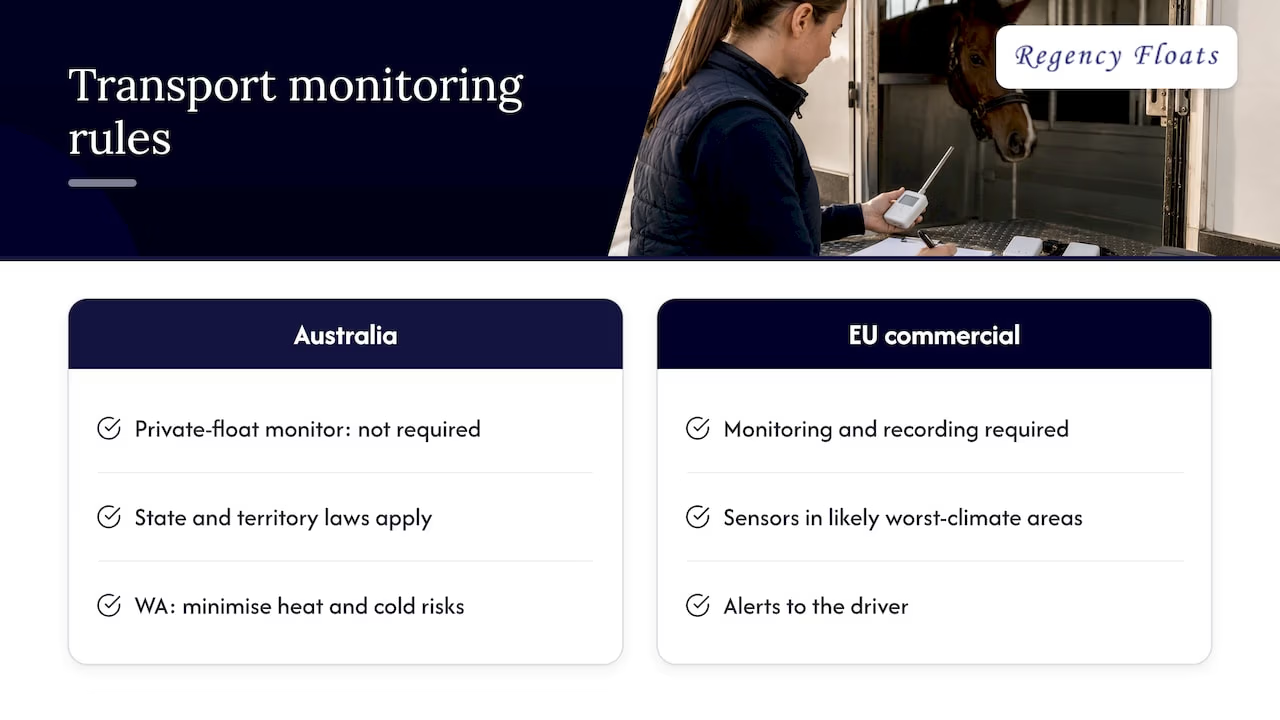
Horse transport in Australia is covered by state and territory animal welfare law, and the Australian Land Transport Standards list horses among the species they apply to. Western Australia’s horse welfare standards, for example, require transport in line with those national standards and require responsible persons to take reasonable steps to minimise the risks from extremes of heat or cold.
No Australian rule requires a temperature monitor in a private float. European road transport rules for commercial journeys do include a temperature monitoring and recording system, with sensors in the likely worst-climate areas and alerts to the driver, as summarised in the 2025 European review. Those provisions are EU-specific. They are a useful model for what careful monitoring looks like, and the Australian duty to minimise heat risk is easier to meet when you can show you measured and managed it. Check the rules for the states you travel through, and see our horse transport rules in Australia guide for an overview.
The float matters as much as the monitor
A monitor reports a problem. A well-designed float reduces how often there is one. When you compare floats, look at the features that govern heat and airflow:
- Ventilation openings. Roof vents, front and side windows and how far they open, and whether they can be adjusted for one horse or several.
- Space around the horse. Compartment size and layout determine how freely air moves between horses. Our horse float size guide explains the dimensions.
- Window glazing. Tint affects both glare and heat in the compartment, and our guide to tinted windows on a horse float covers the options.
- Interior layout. Where the horses stand, and how the partitions, floor and fittings are arranged, shapes both comfort and airflow. Our horse float interior design guide walks through it.
- Accessories. Cameras, water and other fittings that help you manage a journey are listed in our horse float accessories guide.
These are the decisions that set a float’s baseline temperature before a sensor is ever fitted, which is why they are worth settling at the time you buy rather than after the first hot trip.
A Regency float, built for the journey
Regency Floats has been building horse floats for over 40 years. Our floats are designed around safety technology, European luxury design and a state-of-the-art flooring system backed by a ten-year warranty, and they are customisable, so you can choose the colours and fittings that suit how you travel. The range covers Standard, Deluxe, Camper, Gooseneck, Straight Load and Thoroughbred Series floats, plus a dedicated 2 Horse Float Range. If you want to keep an eye on your horse from the cab, we also stock a wireless camera.
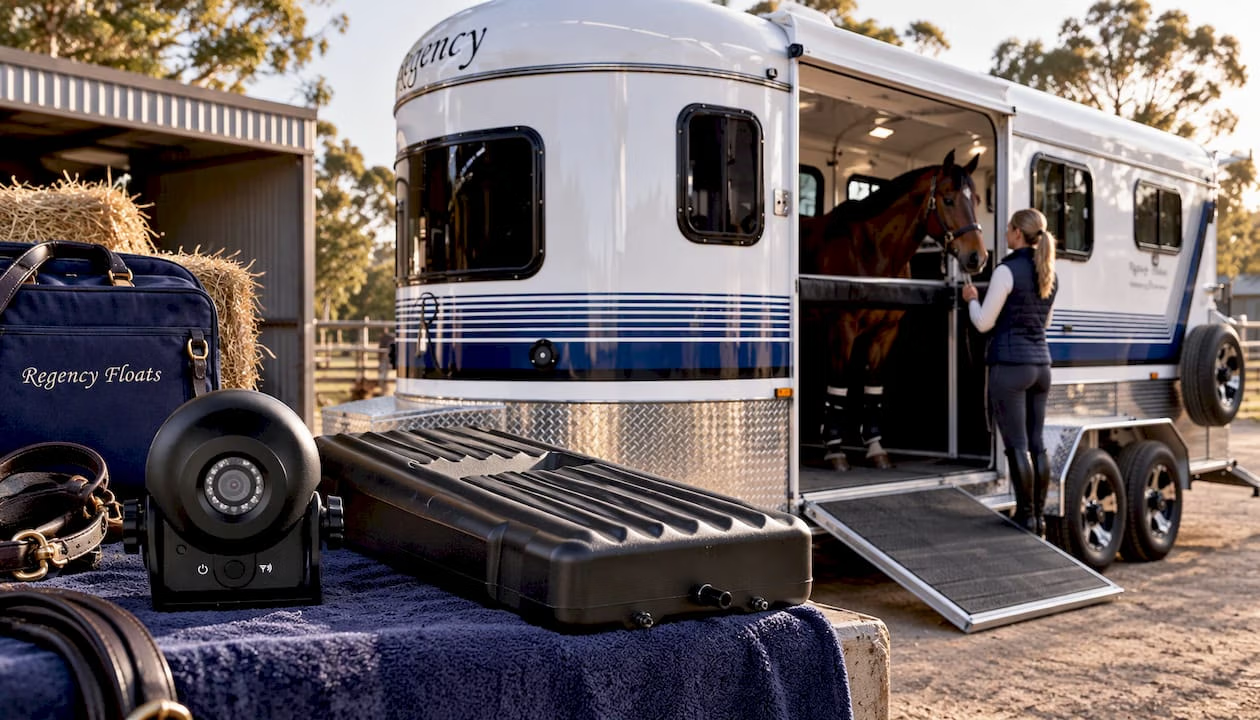
If you are choosing a float with hot-weather hauling in mind, talk to us about the layout, ventilation and fittings that suit your horses and the routes you drive. Our range is built and sold for Australian conditions, and each float can be tailored to your needs.
Putting your monitoring plan together
Here is a checklist you can use before your next trip:
- Check the forecast, then assume the float will run at least 5 to 8°C hotter than the outside air.
- Choose a monitor that reads temperature and, ideally, humidity.
- Mount sensors at head height, front and rear, away from the ceiling and the vents.
- Set alerts at about 25°C and 30°C, plus a low alert for cold trips.
- Open vents and doors before loading, and plan to travel in the cooler part of the day.
- Check the horses after 30 minutes, then at regular stops on long trips.
- Know the signs of heat stress and have your vet’s number ready.
FAQ
What temperature is too hot inside a horse float?
There is no Australian legal limit. European guidance describes 5 to 25°C as the comfortable zone and recommends alerts above 30°C. Humidity, ventilation and how anxious the horse is all change how well a horse copes at a given temperature, so treat 30°C as a point to stop and check.
Where is the best place to mount a temperature sensor in a horse float?
Place it above horse-head height, near the front and the rear of the horse area. Keep it away from the ceiling and from vents, which skew the reading, and out of reach of the horses.
Can I use a thermometer on my horse instead of a float monitor?
A monitor in the float and a check of the horse do different jobs. Research on endurance horses found skin-surface temperature was not a reliable guide to how a horse is coping, so use the monitor for the air in the float and your own checks for the horse. If you are worried about a horse’s temperature, call your vet.
How often should I check my horse on a long trip?
Agriculture Victoria recommends checking after 30 minutes in transit and then every four hours on long journeys. On a hot day, check sooner if your monitor alerts or you notice sweating or fast breathing.
Is a temperature monitor compulsory in a horse float in Australia?
No Australian rule requires one for a private float. The law does require you to take reasonable steps to minimise the risk from extremes of heat, and a monitor is a practical way to do it. Check the requirements in each state you drive through.

