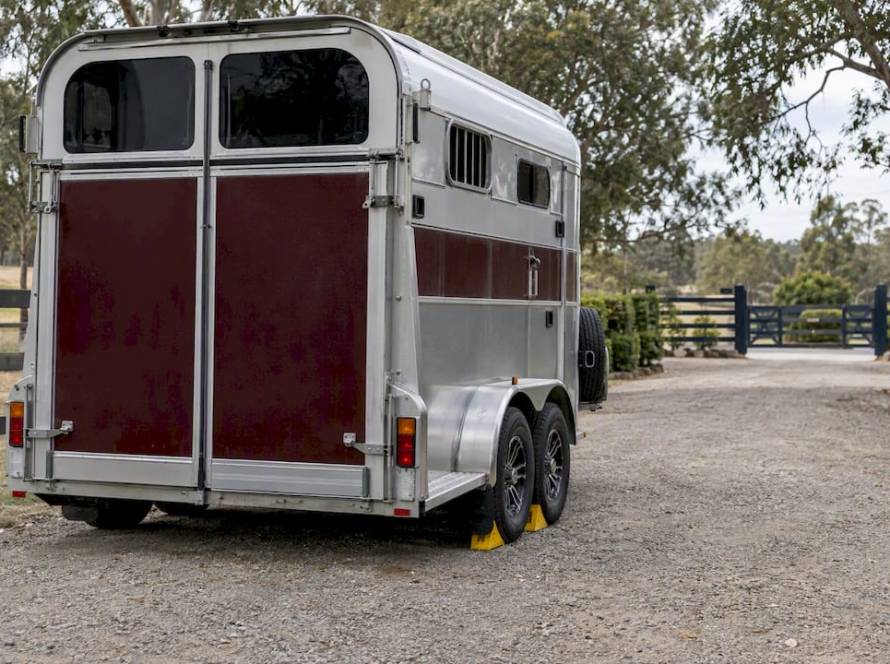
A good handwash station on a horse float is a clean water supply, a tap you can run without grabbing it, soap, something to dry with and a way to catch the used water, all mounted where the weight and wiring cannot hurt the float or the horse. Get those five parts right and you can wash up after loading, handling and mucking out, before you eat or drink at the gate of a show, a trail ride or a long-haul stop. Get the placement wrong and you add weight in the wrong spot, leave wet floors near the ramp and create an electrical hazard.
This guide is for owners, families and competition riders who want to plan one properly. It covers what the station is for, what it needs, how much water to carry, where it goes, how to keep it clean and what to check before you tow. If you are choosing a float and want the water system considered from the start, our float ranges are built and customised to suit how you travel.
What a handwash station on a float is actually for
Horses, hay, tack and mud carry bacteria, and you handle all of it before you reach for a sandwich or a water bottle. The US Centers for Disease Control and Prevention recommends hand washing stations in the transition areas between animal and non-animal areas, so hands are washed after leaving animal contact and before eating or drinking. A float is exactly that kind of transition point: the ramp and the horse area on one side, the car park, the camp chair and the food on the other.
That guidance was written for animal exhibits, not for private horse owners, but the logic carries over. It is also why the station belongs near the exit of the float, not buried in a front storage compartment.
There is a workplace angle too. If you employ riders, strappers or stable hands, WorkSafe Victoria’s guide to horse stables and track riding says employers must, so far as is reasonably practicable, provide welfare facilities that include hand washing facilities, alongside toilets, shelter and drinking water. Rules differ by state and territory, so equine businesses outside Victoria should check their own regulator.
What a handwash station should include
A University of Vermont Extension guide to portable handwashing stations sets out a sensible checklist. Its key features are:
- clean supply water
- hands-free water operation
- grey water collection, so used water is disposed of in a controlled way
- hands-free soap dispensing
- touchless paper towel dispensing
- a lined, lidded waste receptacle
- sturdy, weather-resistant construction
- a stable design that will not tip
The design goal behind that list is to cut every point where a clean hand touches a dirty surface. A tap you turn with a wet, muddy hand defeats the purpose, which is why foot pumps, push taps and pump-action dispensers beat a standard twist tap.
On a float, two more requirements apply. The kit has to survive vibration on corrugated roads, and it has to stay out of the horse’s space. Agriculture Victoria’s horse transport guidance asks for internal surfaces that are smooth and free of hazards such as protruding nails and clips, and a transport area that is clean and dry. Any bracket, tank edge or hose clip that a horse could reach is a problem, so keep station hardware outside the horse area, on the exterior or in a separate compartment.
A simple build and a bigger one
According to an Australian float fitout guide, a basic water setup can be as simple as a tank, a hand pump or 12V pump, a hose, a filler and a tap. Larger fitouts add an external shower, a sink, a grey-water container or a hot water system.
For handwashing alone, start at the simple end:
- A food-grade tank or jerry can with a pump tap
- A catch basin or sink that drains into a grey-water container
- A pump-action soap dispenser
- A holder for paper towels and a lidded bin
When you already carry water for the horses, a shared system makes sense. Our guide to horse float water storage covers how to carry water on board in practical terms.
How much water you need
Plan the volume around the number of people and the length of the trip, not around the tank you happen to own.
Two published figures give you a range. The Vermont guide describes a typical 5-gallon (about 19 litre) clean water supply serving about 50 washes with a matching 5-gallon dirty water tank. A US trailer supplier estimates roughly 30 to 35 handwashes from the same size of tank. The difference comes down to how long each wash runs and how much water the tap releases, so a trickle tap stretches the supply.
For a conservative Australian benchmark, Food Standards Australia New Zealand’s guidance for mobile food premises says mobile premises without a mains connection need water storage adequate for the period between refills. State and territory guidance under that standard recommends 20 to 25 litres per day for each activity, such as hand washing. That is written for commercial food vans, so for a family at a one-day show it is generous, but it is a useful ceiling for a professional team on a multi-day event.
A worked example
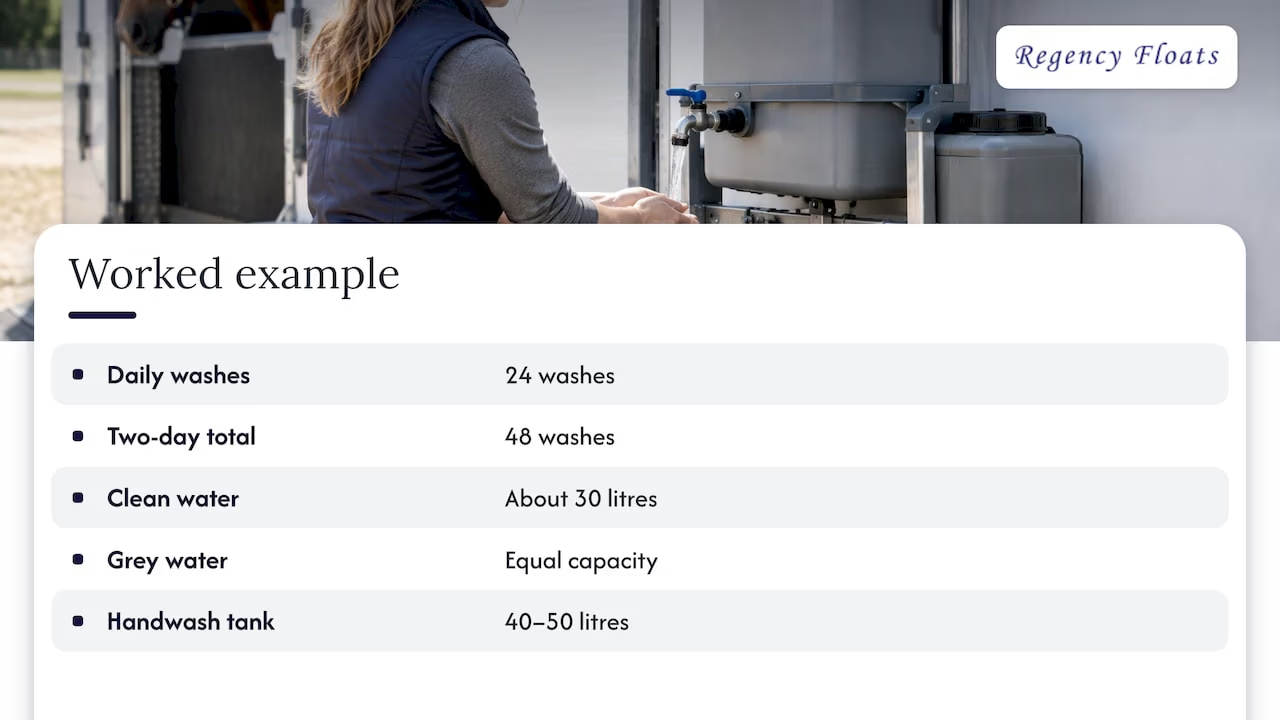
Say two adults and two kids go to a weekend pony club event, and you expect each person to wash six times a day. That is 24 washes a day, 48 across two days. Using the lower figure of about 30 washes per 19 litres, you need roughly 30 litres of clean water for hands alone, plus the same capacity for grey water. Round up, because the horses will drink from the same supply, and a 40 to 50 litre handwash tank with a similar catch container gives you margin.
Why weight decides everything
Water is heavy: one litre weighs one kilogram. A full 80 litre tank adds about 80 kg before the tank, brackets and plumbing are counted. The same guide advises checking payload and ball weight before adding tanks or appliances, mounting tanks securely and low, and thinking about weight distribution before you put a tank on one side of the float.
This matters to the ball weight at the coupling, to the tyres and to how the float tows. Two guides on our site walk through it:
- Horse float weight distribution explains how to load and balance a float.
- Horse float weight is the safe towing guide for Australia.
Grey water counts as well. A catch tank that fills as you wash adds weight, so empty it before you leave the venue. Water you carry home is weight you do not need.
Where to fit the station
Placement is a trade-off between access, safety and weight. These principles hold for most floats.
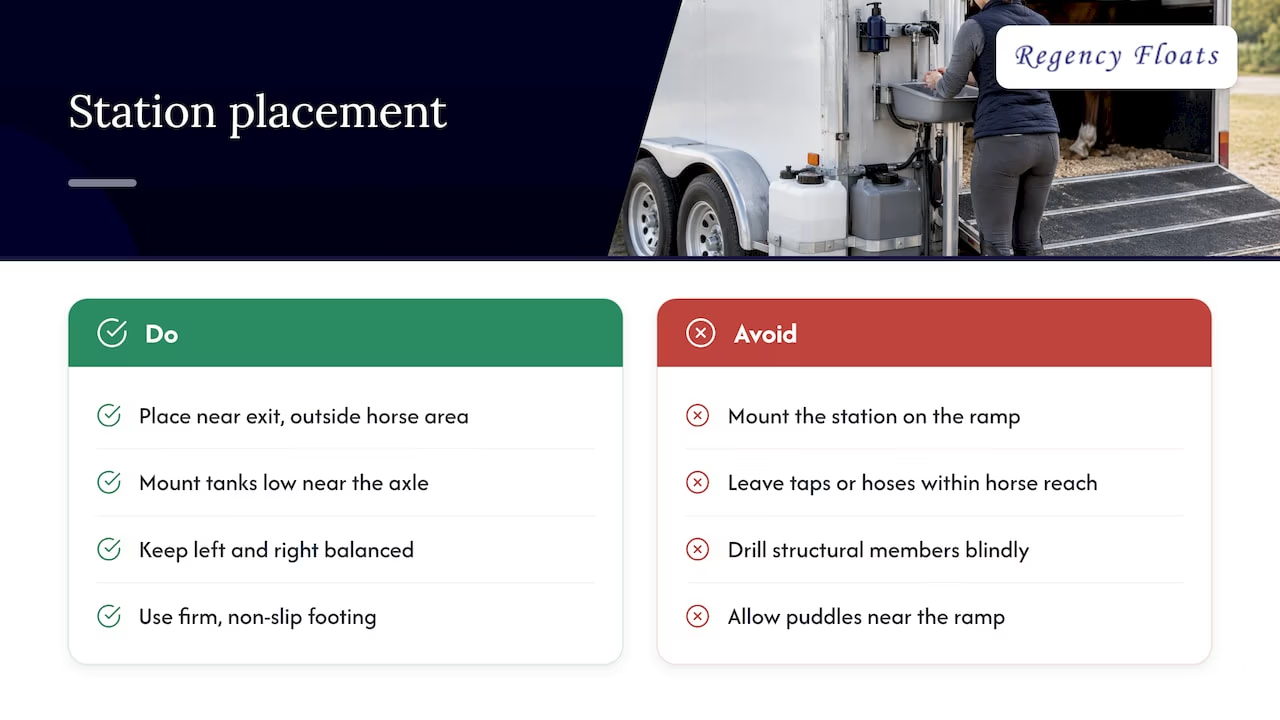
Near the exit, outside the horse area. Following the transition-area idea above, the station works best close to where people step out of the animal zone. The side of the float near the front door or the rear of a camper-style layout is more natural than the ramp itself, where you are busy with a horse.
Low and centred. Mount heavy tanks low and as close to the axle line as the layout allows, and keep left and right balanced. A tank on one side of a float pulls the load unevenly.
Away from the horse’s reach. Keep taps, brackets and hoses out of the horse area, in line with Agriculture Victoria’s requirement for smooth surfaces without hazards.
On firm, non-slip footing. WorkSafe Victoria’s guidance on horse wash areas calls for a non-slip surface, adequate lighting and paths that do not flood. The same applies to the patch of ground where you stand to wash up. A small mat and a grey-water container that catches everything stop puddles near the ramp.
Do not weaken the structure. The fitout guide cautions against drilling structural members without understanding the float’s construction. A float built with a specific frame and flooring system is not the place for guesswork, which is one reason to plan fittings with the builder rather than after the fact. Regency floats are customisable in colours and fittings, so raise your water and wash-up needs when you order.
Wiring and hot water: where the risk sits
A pump-action tap needs no electricity. A 12V pump or a hot water unit does, and water plus electricity is where things go wrong. WorkSafe Victoria lists electrical systems exposed to water among the hazards in horse wash areas, with risks of slips, trips, electrocution and serious injury.
For float fitouts, the Australian guide advises:
- using 12V products and protected wiring where practical
- using proper fusing and the right cable size
- checking registration, insurance and weight compliance after any major change
Hot water raises the stakes. One 10 litre dual-voltage heater sold for horse floats is listed at 7.4 kg empty and about 17.4 kg full, draws 25A on 12V while heating, must have its supplied pressure relief and non-return valve fitted, and requires all 240V connections to be done by a licensed electrician. For a hand wash alone, cold water with a good soap is enough, so a heater is optional. If you want one, have a licensed electrician do the connections.
Keeping the station clean
A station that is dirty is worse than none, because it gives a false sense of cleanliness. Build a short routine around it.
Before each trip
- Fill the tank with potable (drinking quality) water.
- Test the tap flow.
- Check electrical connections if you have a pump.
- Stock soap, paper towels and a fresh liner in the bin.
That list follows a US supplier’s pre-use checks. Australian horse-health company Ranvet’s pre-departure float checklist also includes checking water: refill buckets, replace perished ones, check tank operations and refill before departure. Add the handwash tank to the same pass. Our horse float pre trip checklist is a good place to fold it in.
Sanitising the container
The Alaska Department of Environmental Conservation, in its guide to building a handwashing station, specifies sanitising the water container with two tablespoons of unscented household bleach per gallon of water for five minutes. Rinse well afterwards. It also stresses using approved drinking water at a comfortable temperature, because people skip washing when the water is too cold or too hot.
After each trip
- Empty both tanks and let them dry with the cap off, so stagnant water does not sit for weeks.
- Dispose of grey water in a controlled way. The same US supplier says wastewater should never be discharged onto the ground or into storm drains. Check local rules in your council area, and use a suitable drain or a designated disposal point at the venue.
- Wipe the dispenser, the tap and the basin.
If your float has canvas, an awning or soft furnishings, damp storage invites mould. Guidance on cleaning mould from caravan awnings shows how to handle fabric that has been stored wet.
Safety checks before you tow
A new fitting changes the float, so run through the basics again before the first trip.
| Check | Why it matters |
|---|---|
| Weight and ball weight with tank full | Water adds load; the guidance is to check payload and ball weight before adding tanks |
| Tank mounted low and secure | A loose tank shifts under braking |
| Nothing protruding into the horse area | Surfaces should be smooth and free of hazards |
| Wiring fused and protected | Water and electricity risk |
| Flooring and ramp non-slip | A spill near the ramp is a slip hazard |
| Registration and insurance current | Check after major changes |
Ranvet’s checklist covers the wider list: tyres at the correct pressure, lights, brakes (a breakaway system is required on trailers over 2000 kg), dividers secured with pegs turned away from the horse, non-slip flooring and tailgate, and current registration and insurance. For the legal side of towing, see our guide to Australian legal requirements for towing a horse float.
Agriculture Victoria also asks that each horse can stand in a natural position with adequate head room, and that adjustable partitions be at least 600 mm high and at least 600 mm off the floor when carrying more than one horse. A handwash station should never eat into that space.
Building it in from the start
A handwash station is much easier to plan when the float is being specified than when you are retrofitting a tank and pump around an existing frame. Regency Floats has been making horse floats for over 40 years, with safety technology, European luxury design and a ten-year warranty on the flooring system. Floats can be customised in colours and fittings, and the range covers 2 horse floats, gooseneck, straight load, camper and Thoroughbred series models.
If you travel for competition or overnight stays, the Camper range is where many owners start thinking about water, wash-up and living space together. Browse the full range of floats or the horse floats for sale guide to compare layouts, then tell us how you travel so the water and wash-up setup suits it.
Choosing your setup by how you travel
- Day trips to pony club or local shows: a 20 to 30 litre tank with a pump tap, a catch basin and a pump soap bottle. Light and simple.
- Weekend competition for a family: 40 to 50 litres of clean water and a matching grey-water container, with paper towels in a lidded holder.
- Multi-day events or a professional team: size the supply from the number of people and days, with the 20 to 25 litres per day benchmark as an upper reference, and keep the weight within your tow limits.
- Overnight stays in a camper-style float: treat the handwash station as part of a wider water system, and have a licensed electrician do any 240V work.
In every case, check your vehicle can handle the extra load. Our towing capacity guide explains how to calculate what your vehicle can legally tow.
FAQ
Do I need a handwash station on my horse float?
No law requires one on a private float, but it is good practice for anyone who eats or drinks after handling horses. If you employ staff, workplace safety rules in your state may require hand washing facilities for them, so check with your regulator. Having water on board also makes the wash-up easier at venues with no taps nearby.
How many litres should I carry for hand washing?
A 5-gallon (about 19 litre) tank is reported to serve roughly 30 to 50 washes depending on the tap and how long people wash. For a family weekend, 40 to 50 litres of clean water plus a similar grey-water capacity is a comfortable plan. Remember that each litre adds a kilogram to your float.
Where is the best place to mount it?
On the outside of the float near the exit from the horse area, low and balanced across the axle line, and away from anything the horse can reach. Avoid drilling structural members, and keep wiring fused and protected.
Is hot water worth adding?
Cold water with soap works for hand washing. Hot water helps in cold weather and encourages people to wash properly, but it adds weight, draws significant current on 12V and requires a licensed electrician for 240V connections.
What do I do with the used water?
Catch it in a grey-water container and dispose of it in a controlled way at a drain or designated point, not onto the ground or into a stormwater drain. Empty the container before you travel home to save weight.