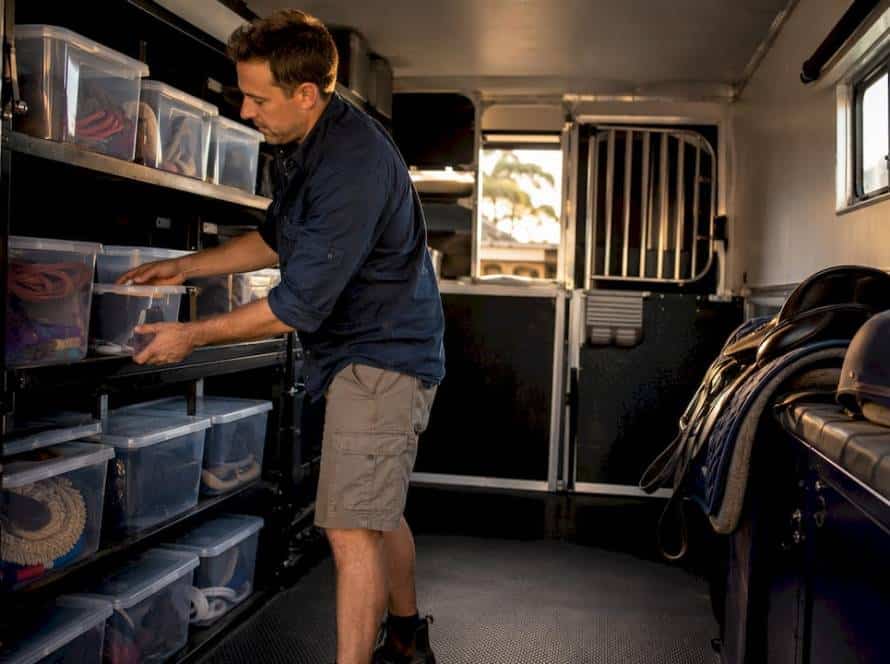
For most Australian horse owners, the best starting point is a removable padded centre divider with a swing-away head divider, sourced from an Australian supplier who offers supply and fit. Here’s why that combination works for the widest range of situations:
- Safety first: Padded panels reduce kicking injury and eliminate sharp contact points during transit.
- Flexibility: Removable and swing-away designs handle nervous horses, foals, and mixed loads without a full rebuild.
- Compatibility: This configuration fits the majority of straight-load and angle-load floats common in Australia.
- Next step: Measure your internal stall width, floor-to-ceiling height, and hinge locations, then send those dimensions with photos to Regencyfloats for a supply and fit quote.
Table of Contents
- What types of horse float dividers are there?
- What materials and build specs actually matter?
- How do you measure your float for a divider?
- Safety and welfare considerations for Australian horse owners
- Supply and fit vs. DIY: what affects cost and lead time?
- How to choose the right divider: questions to ask and red flags to avoid
- What Regencyfloats offers for dividers and retrofits
- Key Takeaways
- The divider detail most buyers overlook
- Useful sources and supplier pages
- Regencyfloats: custom dividers built for Australian conditions
What types of horse float dividers are there?
Not all partitions solve the same problem. Choosing the wrong style for your load or float layout is one of the most common and avoidable mistakes buyers make.
Bay/bulkhead dividers are fixed full-height panels that permanently separate stalls. They’re the most structurally rigid option and suit floats used exclusively for the same number of horses every trip. The trade-off is zero flexibility: you can’t open the space for a large warmblood or a mare with a foal.
Head dividers sit at the front of the stall and stop horses from swinging their heads into adjacent bays. They’re often sold as add-ons and can swing away or pin back, which makes loading a nervous horse significantly easier. Many suppliers offer head, chest, and centre dividers designed specifically to swing clear for easier loading.
Centre/swing dividers run the length of the stall and are the workhorse of most two-horse floats. A swing version pivots on a hinge and locks in place with a latch, while a removable version pins out entirely. For long-distance hauling, a locked swing divider keeps horses stable; for short local trips with a single horse, removing it gives the animal more room to balance.
Full-height vs. half-height dividers come down to ventilation and visibility. Full-height panels offer more separation and reduce kicking contact between horses. Half-height panels improve airflow and let horses see each other, which can reduce anxiety, but they don’t stop a determined kicker from reaching across.
Padded “paddie” dividers are soft panels that attach over a hard divider frame. They’re not a standalone structure; they layer over existing metal or rubber panels to cushion impact. Think of them as the last line of defense against bruising during a rough trip.
| Style | Best for | Durability | Fit complexity | Retrofit difficulty |
|---|---|---|---|---|
| Bay/bulkhead | Fixed multi-horse loads | High | Low (permanent) | High |
| Head divider | Nervous horses, competition travel | Medium–High | Low–Medium | Low |
| Centre/swing | Mixed loads, two-horse floats | High | Medium | Medium |
| Full-height panel | Long-distance, kicking risk | High | Medium | Medium |
| Half-height panel | Short trips, ventilation priority | Medium | Low | Low |
| Padded panel | Injury prevention overlay | Medium | Low | Very low |
What materials and build specs actually matter?
Material choice drives weight, corrosion resistance, and how long a divider lasts on Australian roads, where heat, dust, and corrugated tracks are facts of life.
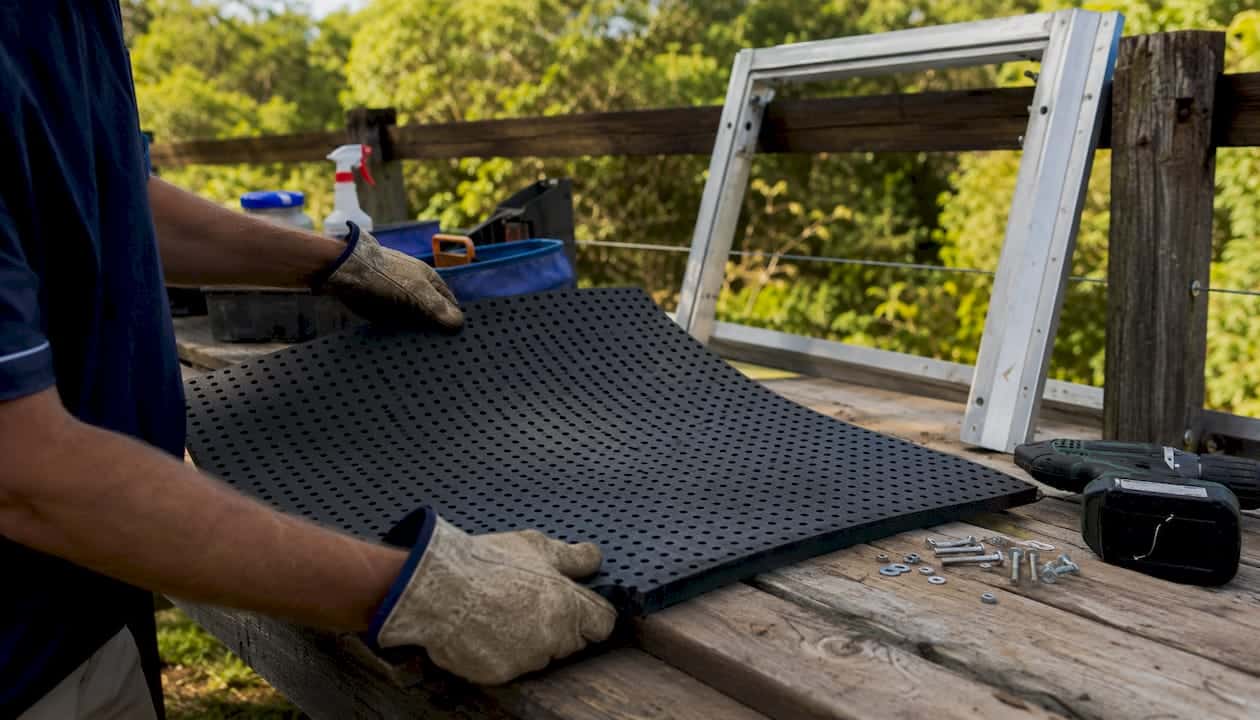
Perforated rubber sheets are the most practical retrofit material for most owners. A typical reinforced rubber divider runs approximately 8mm thick, 1m high, and 2m long. The perforated design improves airflow and visibility, helping to reduce horse stress during transit. Rubber construction absorbs impact and removes sharp edges found in raw metal panels, enhancing safety.
For a more precise spec, ventilated nylon-insert rubber is available at 4.5mm thickness with 20mm holes, a 1000mm drop, and a Shore A hardness of approximately 65° ± 5°, with a temperature range of -10°C to +65°C. That Shore A rating tells you how firm the rubber is under impact. A lower number means softer; 65° sits in the medium-firm range, which balances impact absorption with structural stability. Ventilated rubber is also the preferred material for swing dividers because it keeps weight down on the hinge.
Aluminium dividers with pre-welded hinges and spring-loaded trigger latches suit owners who want a lighter metal option. Adjustable aluminium dividers typically fit interior stall widths of 6.5–8 feet and include side pads as standard. Aluminium won’t rust, which matters in coastal Queensland and tropical Northern Territory conditions.
Padded panels most commonly use 600-denier canvas with a 2-inch high-density foam core and adjustable straps. The denier rating tells you how tough the outer fabric is; 600D handles daily use without tearing at strap attachment points.
| Material | Thickness/spec | Key advantage | Watch for |
|---|---|---|---|
| Perforated rubber | ~8mm, 1m x 2m | Impact absorption, ventilation | UV degradation over time |
| Ventilated rubber (nylon insert) | 4.5mm, 20mm holes, Shore A ~65° | Lightweight, airflow, swing-divider ready | Thinner than standard rubber |
| Aluminium (adjustable) | Fits 6.5’–8’ stalls | Corrosion-resistant, lightweight | Higher upfront cost |
| Padded canvas panel | 600D, 2" foam core | Soft contact surface, easy to remove | Not a structural divider alone |
Specs to request from any supplier: rubber thickness in mm, hole diameter for ventilated sheets, Shore A hardness, pad foam thickness, canvas denier, and the grade of aluminium or stainless used in fittings.
How do you measure your float for a divider?
Getting the measurements right before you contact a supplier saves at least one round of back-and-forth and often prevents an expensive misfit on delivery.
- Internal stall width: Measure at floor level and again at chest height. Floats taper slightly, and a divider cut to floor width may bind at the top.
- Floor-to-ceiling height: Measure at the centre of the stall, not at the edges where roof curves begin.
- Hinge and mounting strip locations: Note the distance from the floor to any existing hinge points, and whether mounting strips run horizontally or vertically.
- Ramp gap width: If the divider needs to clear the ramp when folded, measure the gap between the ramp edge and the nearest wall fitting.
- Stall depth: Measure front-to-back so head dividers are cut to the correct projection.
- Layout type: Confirm whether your float is straight-load or angle-load. Angle-load floats have stalls set diagonally, which changes where a centre divider mounts and how a swing divider pivots.
For photos, shoot the floor (to show existing rubber matting and drain positions), both side walls (to capture all fittings and mounting strips), and a full interior shot from the ramp looking forward. A supplier who can see all three views can quote accurately without an onsite visit.
Pro Tip: If you’re adding padded panels to an existing hard divider, install permanent hanger points on the divider frame. Small loops or brackets let padded panels snap on and off without re-tensioning straps every time, and they prevent straps from loosening mid-trip. It’s a small retrofit that pays for itself in daily convenience.

Safety and welfare considerations for Australian horse owners
A divider that fits poorly is more dangerous than no divider at all. Entrapment, sharp edges, and inadequate latching are the three failure modes that cause the most injuries during transport.
- Prevent entrapment: Gaps between a divider and the float wall should be either fully closed or wide enough that a hoof cannot wedge in. The dangerous middle ground is a gap of roughly 50–150mm.
- Eliminate sharp edges: Rubber construction absorbs impact and removes the sharp contact surfaces that metal panels create. If you’re using aluminium, check that all cut edges are deburred and that corner caps are fitted.
- Latch security: Spring-loaded latches and locking catches should be tested before every trip. A divider that swings free at highway speed can injure a horse severely.
- Anti-swing catches: On swing dividers, fit a secondary catch at the base of the panel as well as the top. Horses push down and sideways; a single top latch is not enough on rough roads.
- Ventilation: Perforated panels and open head dividers allow airflow across the horse’s body. On a 35°C Australian summer day, a sealed metal divider in a dark float can raise the ambient temperature inside the stall significantly. Ventilated rubber or half-height panels are the practical answer for summer travel.
For welfare standards and state-specific transport guidance, the RSPCA Australia and your state’s department of primary industries publish animal transport codes that cover minimum space, ventilation, and journey time requirements. These are worth reading before a long interstate haul.
Supply and fit vs. DIY: what affects cost and lead time?
The core cost drivers for any divider project are material choice, whether the divider is custom-cut or standard-sized, labour for welding or mounting, and whether the supplier needs to travel for an onsite fit.
What drives the quote up:
- Custom cuts to non-standard stall widths
- Welding new hinge points or mounting rails onto the float frame
- Onsite travel for measurement and fitting
- Premium materials (stainless fittings, 1200D canvas, thicker rubber)
- Modifications to existing flooring or wall panels to accept new mounting hardware
Standard off-the-shelf parts ship faster, often within a few days for rubber sheets and padded panels. Custom-fabricated aluminium or steel dividers typically require a lead time of several weeks depending on the supplier’s workload and whether onsite measurement is needed first.
To get comparable quotes, prepare:
- Internal stall width, height, and depth measurements
- Photos of floor, side walls, and full interior
- Your float make and model (if known)
- Intended use: local weekend trips, long-distance interstate, competition travel, or mixed
- Whether you want supply only or supply and fit
Supply and fit is worth the extra cost when the divider requires welding, when mounting rails need to be added, or when the float is an unusual layout. A correctly fitted divider carries the supplier’s warranty on alignment and installation. DIY retrofit works well for rubber sheet replacements and padded panel additions, provided you have basic tools and the existing mounting points are sound.
How to choose the right divider: questions to ask and red flags to avoid
A short decision checklist before you commit to a supplier:
- Does the divider style match your typical load (single horse, two horses, foal with mare)?
- Is the material rated for Australian temperature ranges and UV exposure?
- Does the supplier offer onsite measurement, or are you quoting from your own dimensions?
- What is the warranty scope: materials only, or installation and alignment too?
- What is the realistic lead time from order to fitted?
Questions to ask every supplier:
- What grade of aluminium or rubber are you using, and can you provide a spec sheet?
- How is the divider mounted: existing rails, new welded points, or bolt-through?
- What does the warranty cover, and for how long?
- Do you offer onsite measurement before fabrication?
- What after-sales support is available if the latch or hinge fails?
Red flags: vague answers on material specs, no onsite measuring service for custom work, a warranty that covers materials only and excludes installation, and quotes that are dramatically lower than others without a clear explanation of what’s been left out.
Prioritize fit compatibility and after-sales support over the lowest price. A divider that doesn’t align correctly with your float’s mounting rails is a safety risk, and a supplier who disappears after the sale leaves you with no recourse when a latch fails at 110km/h on the Hume Highway.
What Regencyfloats offers for dividers and retrofits
Regencyfloats brings over 40 years of Australian float manufacturing experience to divider supply and fit, which means the team understands the specific layouts, mounting rail positions, and load conditions that Australian owners deal with.
Their divider capabilities cover custom-sized panels in aluminium and rubber, padded divider options, and stainless or aluminium fittings throughout. Because Regencyfloats manufactures floats as well as supplying accessories, they can match divider specs to float construction details that an aftermarket-only supplier might miss.
What to expect from the supply and fit process:
- Onsite or photo-based measurement before fabrication
- Custom cuts to your stall’s exact dimensions
- Correct alignment of hinges, latches, and anti-swing catches
- Warranty coverage on materials and installation
- After-sales support through authorised dealers nationally
Popular options include padded centre dividers, swing-away head dividers, and ventilated rubber panel replacements. For owners running two-horse layouts or three-horse configurations, Regencyfloats can advise on the divider arrangement that suits the float’s existing frame.
Pro Tip: When requesting a quote, send your stall width, height, and depth measurements alongside photos of both side walls and the floor. Include your intended use (local, long-distance, competition). The more detail you provide upfront, the faster Regencyfloats can return an accurate quote without a back-and-forth.
To get started, visit Regencyfloats and submit your measurements and photos through the contact page. Authorised dealers are available nationally, including in Perth, Brisbane, and Adelaide.
Key Takeaways
The right horse float divider comes down to three decisions: style for your load type, material for your conditions, and whether you need supply and fit or a DIY retrofit.
| Point | Details |
|---|---|
| Start with measurements | Collect stall width, height, depth, and hinge locations before contacting any supplier. |
| Match style to load | Swing-away centre and head dividers suit most mixed-use Australian owners; fixed bulkheads suit dedicated multi-horse rigs. |
| Prioritize safety specs | Ventilated rubber eliminates sharp edges and improves airflow; always verify latch and anti-swing catch security before travel. |
| Choose supply and fit for custom work | Professional fitting carries warranty on alignment and installation, reducing safety risk on non-standard float layouts. |
| Regencyfloats for Australian conditions | With 40+ years of local manufacturing experience, Regencyfloats offers custom dividers, supply and fit, and national dealer support. |
The divider detail most buyers overlook
There’s a tendency in the equestrian world to treat dividers as an afterthought, something you sort out after the float is bought and the horse is already loaded. That’s backwards. The divider is the single fitting that has the most direct contact with your horse during transit, and a poor fit, a loose latch, or the wrong material for your climate can turn a routine trip into an injury event.
What I find most telling is how often buyers focus on price per panel rather than on the total cost of a bad fit: the vet bill, the float repair, the horse that won’t load again. The spec details that seem tedious, Shore A hardness, hole diameter, hinge grade, are exactly the details that separate a divider that lasts ten years from one that fails at the worst possible moment. Australian conditions are harder on equipment than most suppliers from overseas account for. Heat cycles, corrugated dirt roads, and UV exposure degrade rubber and weaken latches faster than temperate climates do. That’s why sourcing from a supplier who builds for Australian conditions, and who stands behind the installation, matters more than saving a few hundred dollars upfront. Regencyfloats’ four decades of local manufacturing reflect exactly that reasoning.
Useful sources and supplier pages
The following pages are worth bookmarking for product specs, parts, and Australian guidance:
- Ventilated rubber specs (nylon insert, 20mm hole, Shore A ~65°): Indrub Australia ventilated divider page — use this to verify rubber thickness and hardness when comparing quotes.
- Perforated rubber divider specs (8mm, 1m x 2m): CDJ Rubber horse float dividers — product spec and purchasing page for standard rubber sheets.
- Padded divider construction (600D canvas, 2" foam core): Riding Warehouse padded divider page — useful for understanding padded panel specs before ordering locally.
- Aluminium adjustable divider specs: OrderTrailerParts aluminium divider — reference for latch hardware and stall width compatibility.
- Regencyfloats product and quote pages: regencyfloats.com.au — primary contact point for supply and fit quotes, custom divider orders, and accessory parts including retrofit mounting bars.
- Australian animal transport welfare guidance: RSPCA Australia (rspca.org.au) and your state’s department of primary industries publish transport codes covering space, ventilation, and journey time requirements. Check the code for your state before any interstate haul.
- Horse care quality standards: SaraWest horse care — background reading on manufacturing quality-assurance practices relevant to float fittings and accessories.
Regencyfloats: custom dividers built for Australian conditions

Regencyfloats is Australia’s leading horse float manufacturer, with over 40 years of experience building floats and fittings that hold up to the conditions Australian owners actually face. For horse owners who’ve read this guide and want a divider solution without the guesswork, Regencyfloats offers custom-sized panels, padded divider options, aluminium and stainless fittings, and a full supply and fit service backed by warranty.
The difference from buying a generic off-the-shelf panel is straightforward: Regencyfloats measures to your float’s exact layout, fits to the correct alignment, and covers both materials and installation. You’re not left troubleshooting a latch that doesn’t quite seat, or a panel that binds because the stall tapers slightly at the top.
Collect your stall measurements and photos, then request a quote through the Regencyfloats website. Customers in Western Australia, Queensland, and South Australia can also connect with local authorised dealers for onsite support.