A horse float showroom visit is the one chance to judge a float with your own eyes, hands and horse in mind, so go with your numbers ready: your horses’ size, your towing vehicle’s limits and the way you travel. Do that homework and an hour on the floor tells you more than a month of browsing photos. At Regency Floats we build floats for safety, comfort and durability, backed by over 40 years of experience, and we show them at our physical display locations so you can walk through one before you commit. This guide covers what to settle before you go, what to inspect inside and underneath, and which questions turn a pleasant look-around into a confident decision.
Settle three things before you leave home
Showrooms are full of attractive floats. The ones worth your time are the ones that fit three facts about you.
How many horses, and how big
The first step in selecting a float, according to Hoofbeats Magazine, is to work out how many horses it must carry and the size of each. A 14.2hh pony and a 17hh warmblood do not need the same bay. If you can, try your horse in a float similar to the one you are considering, because that shows up any problem with roominess and comfort.
Good Horsemanship’s guide notes that Australian interior heights vary from about 1.93m to 2.18m, and recommends at least 2.23m inside for any horse over 15hh. Know your horse’s height at the wither and, ideally, to the top of the head. Our horse float size guide walks through dimensions in more detail.
What you will tow with
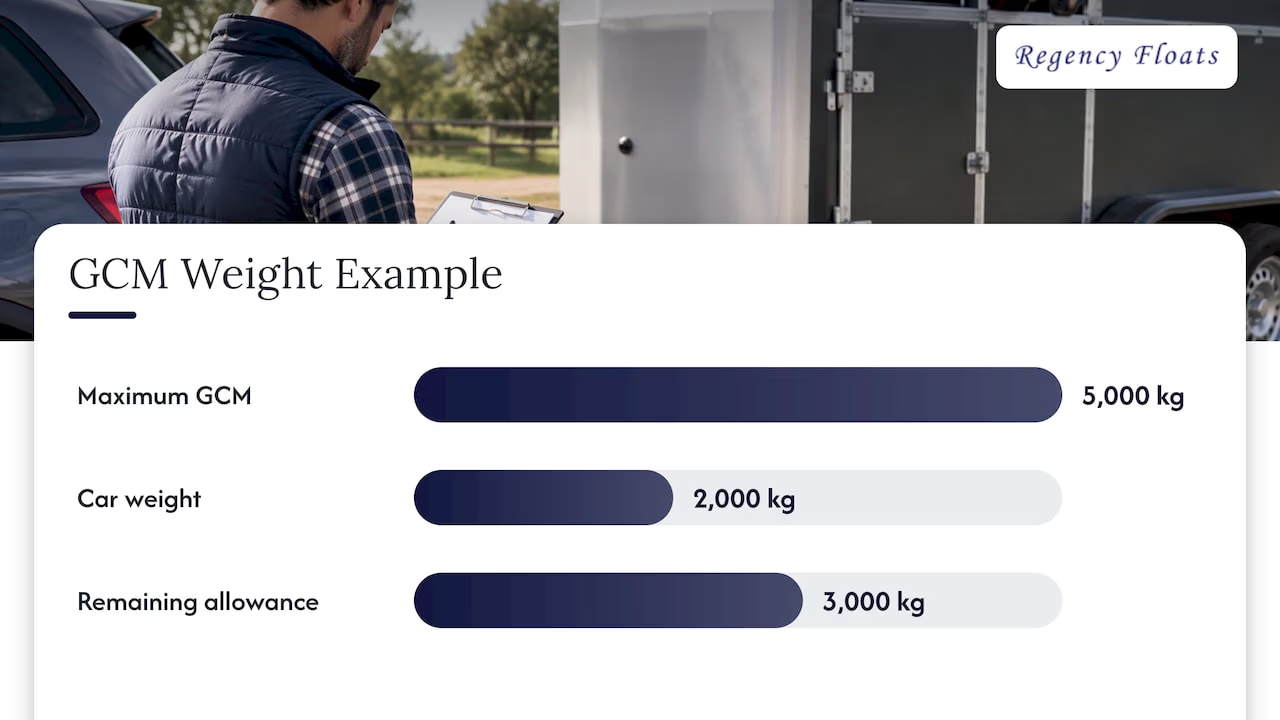
This is where the costly mistakes happen. Horse Deals puts it plainly: the first question is what vehicle you will tow with, because every vehicle is weight-rated. If the Gross Combined Mass (GCM, the maximum legal weight of car and float together) is 5,000kg and the car weighs 2,000kg, you cannot legally pull more than 3,000kg.
Three figures matter, according to Going Rate’s 2026 guide: braked towing capacity, maximum towball download (usually about 10% of towing capacity) and gross combination mass. It also points out that a dual cab ute loaded with people, gear and a full tank often cannot use its advertised 3,500kg towing figure without exceeding GCM. Bring all three numbers from your vehicle’s handbook or compliance plate.
To see what a float itself weighs, read our horse float weight guide before you go.
How you actually travel
Buy for the travelling you do. Australian Containers’ view, summarised by Going Rate, is that two bays suit the great majority of riders, three bays suit families or two horses plus a gear bay, and four bays are for studs, trainers and competition households. A loaded two-horse float typically sits around 2,200 to 2,600kg, and a three-horse or gooseneck usually calls for a ute with a proper tray hitch and often a GVM (gross vehicle mass) upgrade.
Write down: number of horses, tallest horse, vehicle name and its three towing figures, and whether you need space for a camper or living area. That page of notes is your showroom brief.
Who to bring
Horse Deals suggests taking someone who knows floats to go over a prospective purchase with you. A second pair of eyes is useful for a practical reason: one person can stand inside the bay, the other can operate the fittings from outside, the way you will on a windy day at a showground.
If you have a horse that is a nervous loader, bring a halter and lead rope and ask whether you can walk through the bay at his height rather than yours. Crouch slightly and look at the float the way a horse will: where the light comes from, where his head sits, what is at nose and knee level.
Inside the float: see it as the horse does
Start in the horse area. Yes Approved’s 2026 checklist recommends inspecting the horse area from the animal’s perspective: dividers, latches, padding, chest or breeching bars, tie points, exposed fasteners and sharp edges. It also stresses operating every movable fitting, not just checking that it looks intact.
Chest bars and butt bars
Hoofbeats Magazine recommends a chest bar that is adjustable in height, secured by a true quick-release catch and preferably padded. A fixed bar set too low lets a horse climb over and become hung, while one set too high lets a smaller animal slip under. Both can cause serious injury. Try the catch with one hand, as you would in an emergency. Our guide to butt bars on a horse float explains fit, height and safe use.
Dividers, floors and walls
Open and close the dividers. Check that they move smoothly, lock positively and leave enough room for your horse’s shoulders and hindquarters. Run a hand along walls and around windows for protrusions. Look at the flooring, since it carries the load of every trip. The Horse Deals article notes that honeycomb flooring material has been known to fail, so ask exactly how the floor is built. Our floats use state-of-the-art flooring systems backed by a ten-year warranty, so on our floor you can ask about the system and the warranty terms directly.
Ventilation and light
Good Horsemanship estimates that an average two-horse float carrying two horses needs a complete change of air roughly every seven minutes to keep gases, humidity and temperature within comfort limits. Open the windows and vents and see how they work with the float closed up. Imagine a 35-degree day on the Hume Highway and ask where the air will flow.
Looks versus function
Yes Approved’s advice is to put flooring, structure, ventilation and safe internal fittings ahead of decorative finishes, storage and accessories. Colours and fittings are the fun part, and with our customisable floats you can choose them to suit you, but decide the safety fundamentals first. Our horse float interior design guide helps you plan the layout.
Underneath and out the back: brakes, coupling and chassis
Walk around the outside, then crouch down.
Brakes and breakaway
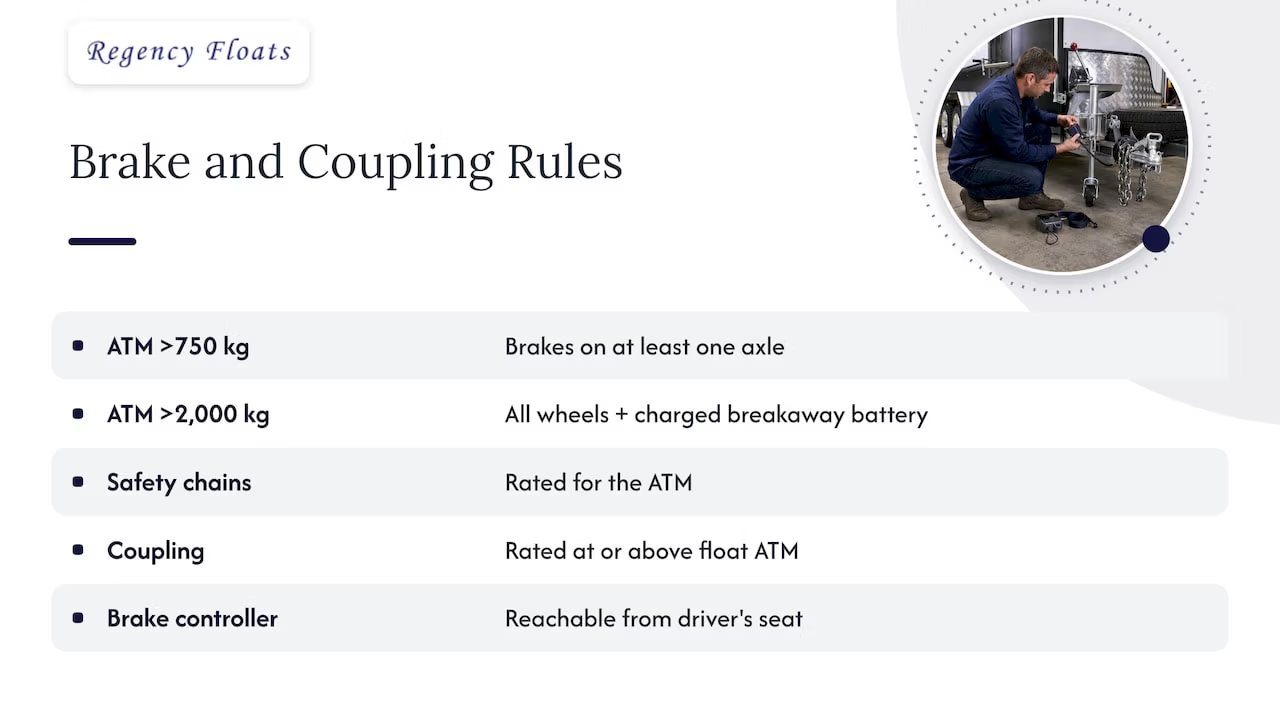
Going Rate explains the national rules: a trailer over 750kg aggregate trailer mass (ATM) needs brakes on at least one axle, and over 2,000kg ATM it needs brakes on all wheels plus an automatic breakaway system powered by its own charged battery. Safety chains must be rated for the ATM, and the coupling must be rated at or above the float’s ATM. Hoofbeats adds that on floats over 2,000kg, brakes should operate on all wheels, and the controller should be reachable from the driver’s seat.
Good Horsemanship recommends electric brakes on all four wheels, a separate manual control and an adjustable brake controller in the car. Ask to see the breakaway battery and where the test switch is.
The compliance plate
Find the compliance plate and read the ATM. Going Rate advises checking that it comfortably covers your horses and gear. Then do the sum with your own vehicle’s numbers, not the showroom’s example. Tow ball mass should be around 10% of trailer weight, no more than 350kg on a 3,500kg float. Our guide on what makes a horse float roadworthy in Australia covers the requirements in more depth.
Suspension and hitch type
Good Horsemanship prefers torsion suspension in Australia for ride quality at a sensible price, and says gooseneck designs generally turn better in tight circles. If you are weighing a bumper-pull against a gooseneck, our range includes gooseneck horse floats as well as straight-load, deluxe, camper and Thoroughbred series floats, so you can compare them side by side.
Questions to ask on the day
Keep the list short and specific. Ask:
- What is the float’s tare weight and its ATM? Get both in writing.
- How is the floor constructed and what does the warranty cover?
- Are the brakes electric on all wheels, with a breakaway system and a parking brake?
- Is the chest bar adjustable, with a quick-release catch?
- Can it be matched to my vehicle’s GCM? Horse Deals suggests asking the seller to check the combination against your vehicle’s allowed GCM.
- What can be customised, in colour, fittings and floor plan, and how long does a custom order take?
- What accessories and parts are available later, and where do I get them?
The last two matter more than buyers expect. A float is a registered vehicle in its own right in every state and territory, and Going Rate puts annual registration at roughly $250 to $600 for a typical two-horse float, set by ATM and state. Build that into your running costs, along with servicing.
If you are looking at a pre-owned float
We sell pre-owned floats as well as new ones. For any used float, Yes Approved suggests asking why it is being sold, how long it has been owned, how many horses it regularly carried, whether the floor was replaced or the chassis repaired, whether it has been in an accident, how old the tyres are, whether service records exist and whether finance is owing. Going Rate adds a PPSR check (the national register of finance and security interests), and confirming that the VIN, registration and compliance plate match.
Take the weigh-in seriously
The most useful thing you can do after the visit is weigh the real combination. Horse Deals’ advice is to take the car and float loaded over a weighbridge, weighing them separately if possible. Two large horses weigh roughly 1,500kg, and a basic straight-load two-horse float with a tack box about 1,100kg, so a combination that looks fine on paper can run tight once you add hay, water, saddles and passengers.
If a figure in a brochure and a figure on the plate differ, the plate wins. Hoofbeats warns that inaccurate weight reporting is a known issue with some imports and can have serious consequences for compliance with Australian standards, so it pays to research the manufacturer thoroughly. That is a good reason to buy from a maker with a long track record: ours is over 40 years.
Comparing floats after the visit
Back home, lay your notes side by side. Compare floats on the same terms:
| What to compare | What to write down |
|---|---|
| Bay size | Length, width and interior height against your tallest horse |
| Weight | Tare weight, ATM and loaded weight with your horses |
| Towing match | ATM against braked towing capacity, towball download and GCM |
| Brakes | Electric on all wheels, breakaway, parking brake |
| Flooring | Construction type and warranty length |
| Fittings | Chest bar, dividers, latches, padding |
| Extras | Colours, fittings, accessories, delivery |
Good Horsemanship also cautions against assuming a non-steel floor is lighter to tow. Compare actual weights rather than materials. For a wider view of the market, our buyer’s guide to Australian horse float manufacturers and best horse floats in Australia page set out the options.
See the floats in person
Regency Floats designs its floats around safety technology, European luxury design and flooring systems backed by a ten-year warranty, and you can customise colours and fittings to suit you. Our range runs from Standard and Deluxe floats to Camper, Gooseneck, Straight Load and Thoroughbred Series models, and we also sell accessories and parts. If you already know you want two bays, start with the 2 horse float range. If you want to see all of it, browse the full float range and visit us at a display location. Regional pages for Brisbane and Adelaide list what is on offer there.
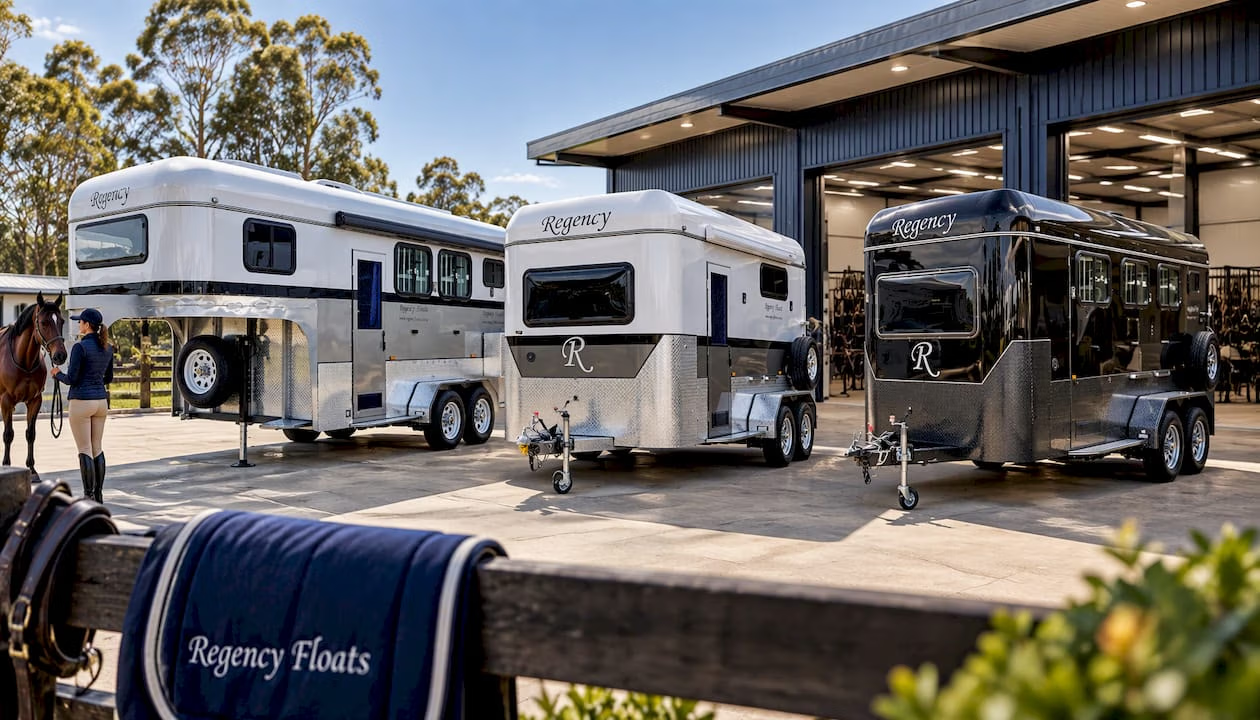
If you already know you need a larger warmblood-sized bay, the Square 3 HAL Deluxe Warmblood with 2600mm x 850mm bays and the 2 HAL Warmblood Separate Living Gooseneck are good places to begin your showroom shortlist.
A simple showroom-day routine
- Arrive with your vehicle’s towing figures and your horses’ heights written down.
- Walk through each bay at horse height and operate every latch, divider and chest bar.
- Read the compliance plate and note the ATM.
- Check brakes, breakaway system, coupling and chains.
- Ask about flooring, warranty, customisation and parts.
- Photograph the plate, the floor and the fittings you liked.
- Weigh the loaded combination before you pay a deposit.
FAQ
How long should a horse float showroom visit take?
Allow an hour or more for a single float, and longer if you are comparing several. The inspection itself is quick when you arrive with your towing figures and horse measurements. The extra time goes on operating the fittings and asking about customisation.
Can I take my horse to try a float?
Hoofbeats Magazine advises trying your horse in a float similar to the one you are considering, since it shows up roominess and comfort issues. Ask in advance about arrangements at the display location you plan to visit, and bring your horse’s halter and lead.
What should I bring to a showroom?
Bring your vehicle’s braked towing capacity, towball download limit and GCM, plus your horses’ heights and a knowledgeable friend. A tape measure and phone for photos help too. Write your questions down so nothing is missed.
Do I need to know the float’s weight before I visit?
Yes, at least roughly. A loaded two-horse float is typically around 2,200 to 2,600kg, and your vehicle’s GCM decides whether that combination is legal. Our horse float weight guide helps you work it out before you go.
Can I order a float in my own colours and fittings?
Our floats are customisable, so you can choose colours and fittings to suit your preferences. Bring your ideas to the display location and discuss the options for the model you like.