
A horse float is roadworthy in Australia when it complies with the relevant Australian Design Rules (ADRs) and Vehicle Standards Bulletin 1 (VSB1) for trailers with an aggregate trailer mass (ATM) of 4.5 tonnes or less, and it’s fitted with the correct brakes, coupling, safety chains, lighting and tyres for its weight class. That’s the whole answer. Everything else in this guide is about how to prove it.
Before you sign anything, insist on seeing:
- A written ADR/VSB1 compliance statement from the manufacturer
- A compliance plate or engineer certification for the build
- The brake and coupling specification matched to your float’s ATM
- The safety chain rating for that same ATM band
- Tyre DOT codes confirming the rubber isn’t already years old before it’s touched a road
Some horse floats on Australian roads carry tyres older than the recommended five to six year replacement window, often because tread looked fine and nobody checked the sidewall date. Your next move: ask for the compliance documentation and Regency Floats’ warranty statement before you place an order, not after.
Key Takeaways
A roadworthy horse float in Australia combines documented ADR/VSB1 compliance with correctly specified brakes, coupling, chains, lighting and tyres, backed by a manufacturer warranty you can verify in writing.
| Point | Details |
|---|---|
| Confirm ADR/VSB1 compliance | Ask for the exact ADR clauses and VSB1 revision used to certify the float before ordering. |
| Match chains to ATM | Safety chain count and breaking stress requirements change at 2,500 kg and 3,500 kg ATM bands. |
| Check tyre DOT codes | Replace tyres older than five to six years regardless of tread depth. |
| Budget beyond the float price | Registration charges, accessories and pre-delivery inspection fees add to the total cost. |
| Choose a warranty-backed manufacturer | Regency Floats offers aluminium construction, a long structural warranty and nationwide after-sales support. |
Where to verify compliance and tyre guidance
For direct verification, consult Vehicle Standards Bulletin 1 for the current ADR applicability table, ADR 44 for specific-purpose vehicle requirements, and practical tyre age guidance from trailer maintenance specialists. Regency Floats’ own warranty guide sets out structural coverage terms in full.
Table of Contents
- Which Australian standards apply to horse floats?
- What should you check before paying for a float?
- Do custom features affect your float’s compliance?
- What do compliant floats cost, and how long do they take to build?
- How does Regency Floats meet these standards?
- What should you do before placing an order or accepting delivery?
- Ready to order a compliant, warranty-backed float?
- Sources
- FAQ
Which Australian standards apply to horse floats?
Every horse float sold new in Australia with an ATM of 4.5 tonnes or less falls under VSB1, and VSB1 exists specifically to tell manufacturers which ADRs apply and when. Section 4.2.6 of the bulletin actually defines what counts as a “horse float” for regulatory purposes, covering things like ventilation and permanently fixed equipment inside the load space, according to the current VSB1 revision. That single clause is why a horse float can’t just borrow the compliance sign-off from a generic box trailer of the same weight.
On top of VSB1, floats classed as specific-purpose vehicles may also need to meet ADR 44, which covers additional design and construction rules including mechanical coupling requirements. VSB1 is the practical checklist; the ADRs are the law it’s built from, and where the two disagree, the ADR wins.
The features that actually get checked in practice are:
- Braking systems matched to the float’s ATM, not just fitted for the sake of it
- Mechanical coupling rated to the combined weight it will tow
- Safety chains meeting minimum breaking stress for the ATM band
- Lighting and electrical wiring compliant with trailer light standards
- Dimensions and configuration appropriate to the tow vehicle and load
The chain requirement is a good example of how the rules scale with weight. A float up to 2,500 kg ATM needs at least one safety chain; anything over 2,500 kg up to 3,500 kg needs two; and anything heavier again must use chains rated to a minimum breaking stress of 800 MPa, according to Tasmania’s transport department. Get the ATM wrong at the ordering stage and you can end up with the wrong chain spec entirely.
Pro Tip: Ask the manufacturer for the exact ADR clauses and the VSB1 revision number used to certify your build. Standards get updated, and a build certified against an old revision can leave you compliant on paper but out of date in practice.
What should you check before paying for a float?
A pre-purchase checklist saves arguments later, especially with a custom build where you won’t see the finished product until delivery day.
- Request the compliance plate details or engineer certification in writing.
- Confirm the brake type and performance spec against the float’s ATM.
- Check the coupling type and condition, including whether it suits your tow vehicle.
- Get the safety chain specification in writing, matched to ATM as above.
- Ask for a lighting and wiring compliance certificate.
- Check tyre DOT codes on every tyre, including the spare.
- Ask about wheel bearing service intervals and any pre-delivery service history.
- Inspect flooring material and corrosion protection.
- Confirm load rating, ATM, and towbar compatibility with your vehicle.
- Check the electrical plug type matches what your state’s inspectors expect.
A DOT code is stamped into the tyre sidewall and tells you the week and year of manufacture, not the purchase date. Tyres older than five to six years should be replaced regardless of tread depth, because rubber degrades from the inside well before it looks worn, a point tyre specialists raise often enough that it’s worth building into every inspection.
On delivery day, don’t just sign and drive off:
- Check welds and joins for quality, not just paint finish
- Look for drainage and gasket sealing around the floor and doors
- Ask the distributor or fitter to run a functional test of lights and brakes with you present
Pro Tip: Underestimating payload, missing hidden floor corrosion on used floats, and judging tyres by tread alone are three of the most common buyer mistakes reported by industry sources — all three are avoidable with the checklist above.
Do custom features affect your float’s compliance?
Yes, and this is where buyers get caught out most often. Any change that shifts the float’s mass distribution, dimensions or ATM can trigger a need for re-certification or engineer sign-off, even on a build that started life fully compliant.
Modifications that commonly need extra sign-off:
- Axle upgrades or added axles
- Water tanks, especially when full tanks push ATM into a new band
- Full camper conversions with added cabinetry, appliances or bedding
- Extended bodywork that changes overall length or weight balance
Material choices matter just as much as structural changes. Aluminium framing and galvanised chassis components resist corrosion far better than untreated steel, which matters whether you’re near the coast or hauling through dusty inland conditions. Flooring that sheds moisture rather than trapping it, and electrical installations sealed against dust and water, both reduce the chance of a fault developing between services.
On drawbar configuration, weight distribution is the main trade-off:
- A bumper-pull float puts more relative load on the tow vehicle’s rear axle.
- A gooseneck configuration shifts weight forward over the tow vehicle’s rear axle differently, often improving stability at higher ATMs.
Either option can shift which ADR clauses apply once you factor in the change to ATM, so confirm this with the manufacturer before finalising a custom spec.
What do compliant floats cost, and how long do they take to build?
Price and lead time vary more than most first-time buyers expect, largely because “custom” covers everything from a colour change to a full luxury fitout.
| Tier | Typical use case | Lead time |
|---|---|---|
| Entry-level, in-stock | Casual riders, straight-load 2 horse | Days to a few weeks |
| Mid-range, semi-custom | Competition riders, angle-load 2 or 3 horse | 6 weeks |
| Premium/custom build | Professional use, gooseneck or camper conversion | 3 to 6 months |
Budget beyond the float itself. State registration charges, mandatory accessories and a pre-delivery inspection fee all add to the final cost, and they’re easy to forget when you’re focused on comparing headline prices between manufacturers.
Warranty terms tell you a lot about build quality before you’ve even towed the float. A structural warranty of around 10 years, paired with clear multi-year component cover, signals a manufacturer confident enough in their corrosion protection and fabrication standards to stand behind it long term. After-sales support matters even more in regional Australia, where a float with no local parts network can leave you stranded waiting on a part that a better-supported brand would have on the shelf.
Pro Tip: Ask for a written quote that separates the float price from registration, accessories and inspection fees. Bundled quotes make it hard to compare two manufacturers on a like-for-like basis.
How does Regency Floats meet these standards?
Regency Floats has been building aluminium horse floats in Australia for over 20 years, and every build uses aluminium framing chosen specifically for its strength-to-weight ratio and resistance to corrosion over the life of the float. The state-of-the-art flooring system carries a long structural warranty, backed by documented warranty terms that spell out coverage rather than leaving it to a verbal promise at the point of sale.
What buyers should request as part of the process:
- ADR/VSB1 compliance references for the specific model being quoted
- Full structural warranty documentation, including what it does and doesn’t cover
- Confirmation of nationwide delivery timeframes to your state or territory
- After-sales contact details for parts and service
A float’s compliance paperwork is only worth as much as the manufacturer standing behind it years later. A long structural warranty paired with genuine after-sales service is one of the clearest signals that a builder expects their work to hold up.
Regency Floats offers customisable colours, fittings and floor plans across straight-load, angle-load and gooseneck ranges, built to suit everything from casual weekend riding to professional competition transport.
What should you do before placing an order or accepting delivery?
Print this list or save it before your first enquiry call.
- Request written ADR/VSB1 compliance references for the exact model.
- Confirm ATM and check it against your tow vehicle’s rated towing capacity.
- Check every tyre’s DOT code, including the spare.
- Verify coupling type and safety chain rating in writing.
- Get full warranty documents and after-sales contact details before paying a deposit.
- Book a pre-delivery functional test of brakes and lights with a qualified person present.
Keep copies of every compliance document, warranty certificate and service record in one folder from day one. It makes state registration simpler, speeds up any warranty claim, and adds real value if you sell the float later, since a buyer with a complete paper trail is far easier to sell to than one asking you to dig up records from memory.
Ready to order a compliant, warranty-backed float?
If you’ve made it through the checklist above, you already know the two things that separate a roadworthy float from a risky one: documented ADR/VSB1 compliance and a manufacturer willing to back it with a real warranty. That’s exactly where Regencyfloats built its reputation over more than 20 years, with aluminium construction, a state-of-the-art flooring system, and a structural warranty you can read in full before you commit to anything.
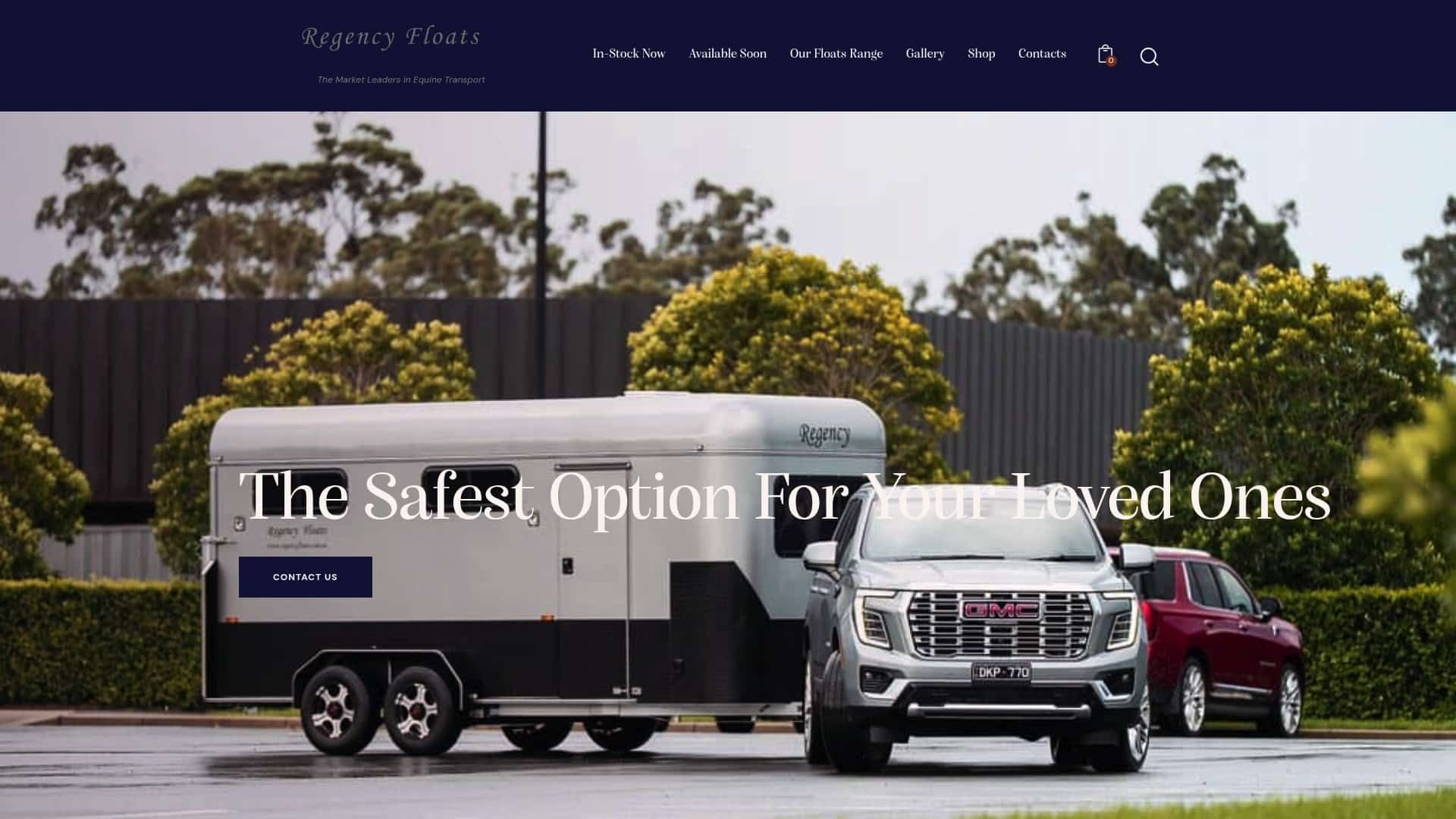
Whether you’re after an in-stock straight-load float ready for pickup this month or a fully custom gooseneck build for competition work, Regencyfloats delivers Australia-wide and stands behind every build with documented after-sales support. Browse the current range and choose the right float for you and your horse to get a quote that includes compliance documentation and warranty terms upfront, not buried in fine print after you’ve paid a deposit.
Sources
- Vehicle Standards Bulletin 1 (Revision 6) – Trailers with an aggregate trailer mass of 4.5 tonnes or less
- Tasmanian transport guidance on trailer coupling, chains and braking requirements
FAQ
What ATM threshold applies to horse float compliance?
VSB1 and its associated ADRs apply to trailers, including horse floats, with an aggregate trailer mass of 4.5 tonnes or less.
How many safety chains does my horse float need?
Floats up to 2,500 kg ATM need one safety chain, floats between 2,500 kg and 3,500 kg need two, and heavier floats require chains rated to a minimum breaking stress of 800 MPa.

How old is too old for horse float tyres?
Replace tyres once they pass five to six years from the DOT manufacture date, even if the tread still looks acceptable.

Does a custom camper conversion affect roadworthiness compliance?
Yes, additions like water tanks or full camper fitouts can shift ATM or weight distribution enough to require engineer sign-off or re-certification.
What warranty should I expect from a reputable horse float manufacturer?
Look for a structural warranty around 10 years with clear after-sales support, the standard Regency Floats documents in its warranty terms.

