
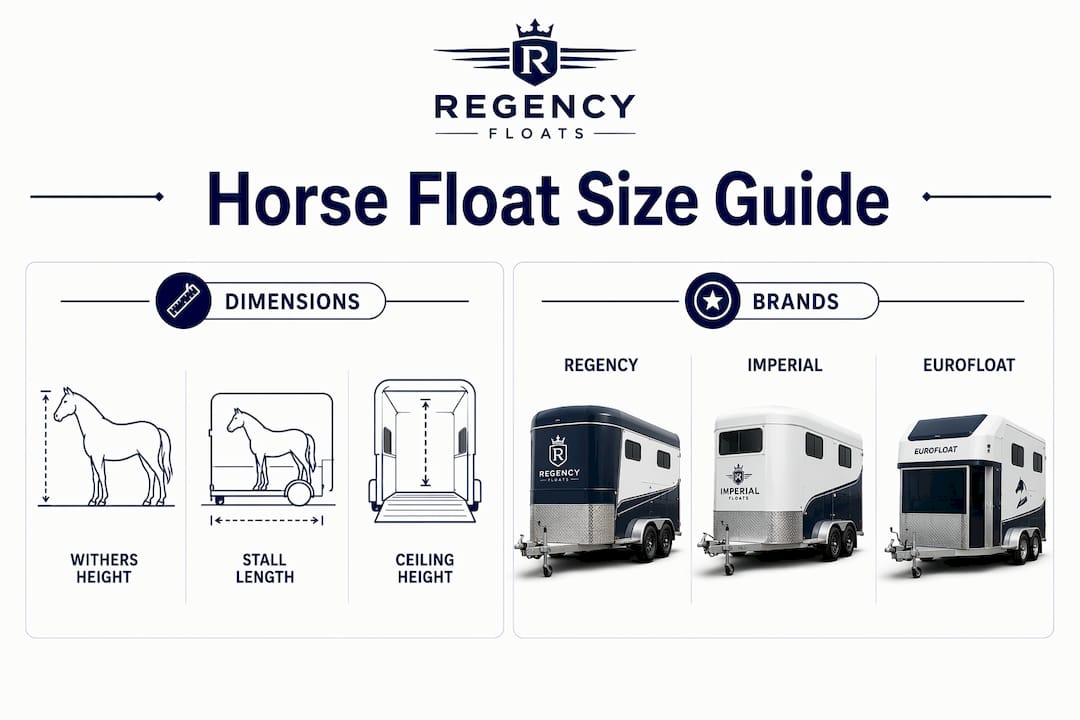
The right float size depends on your horse’s height at the withers, body width, and how much clearance you can provide for natural movement. As a baseline: horses up to 15 hands need a minimum interior height of around 2.1m, while warmbloods and drafts require 2.3m to 2.45m of clearance to move their heads safely. Stall width should let your horse widen its stance for balance without being able to turn around. For most horses under 15.2 hands, a standard stall width of around 44 inches works; larger breeds need 54–60 inches of stall width. Floats over 2,000kg gross trailer mass (GTM) legally require a breakaway braking system under Australian law, so your towing vehicle’s capacity matters from the start.
- Ponies (under 13 hands): minimum 1.9m interior height, narrower stall acceptable
- Thoroughbreds and stock horses (14–16 hands): 2.1m height, standard stall width
- Warmbloods (16–17 hands): 2.3m height, 54-inch-plus stall width
- Draft breeds (17+ hands): 2.45m height, wide-body float required
Pro Tip: Add at least 15cm (6 inches) above your horse’s withers height when calculating the float height you need. Horses toss their heads and shift weight during travel, and that clearance prevents injury on rough roads.
What design features actually matter when choosing a float?
Float design affects horse anxiety and loading ease as much as raw dimensions do. The three main configurations are straight load, angle load, and gooseneck, and each suits different situations.
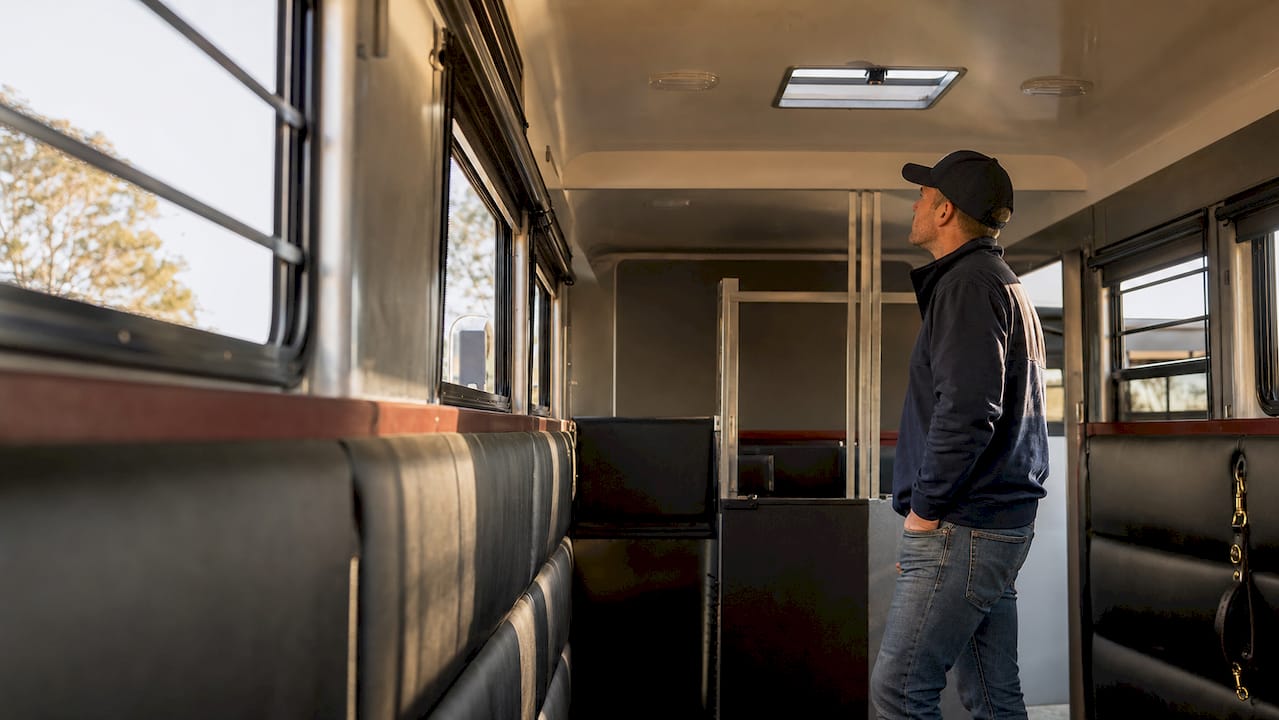
Straight load floats position horses facing forward, which gives more head clearance and tends to suit horses that are reluctant loaders. Angle load floats are more compact, easier to maneuver in tight spaces, and allow horses to travel at a slight diagonal, which many horses find more comfortable on long trips. Goosenecks attach over the tow vehicle’s rear axle rather than the hitch ball, offering greater stability and typically more horse capacity, but they require a pickup truck with a fifth-wheel or gooseneck hitch.
Interior dimensions
For stall length, straight load floats should offer 10–11 feet for average-sized horses and 11–12 feet for taller or longer-bodied individuals. Width and height minimums follow the sizing table above. Dividers in two-horse floats should not extend all the way to the floor, allowing horses to spread their legs for balance during turns.
Materials
| Material | Weight | Heat transfer | Durability | Maintenance |
|---|---|---|---|---|
| Steel | Heaviest | High | Very high | Rust-prone without treatment |
| Aluminum | Light | Moderate | High | Low, no rust |
| Composite/polyethylene | Lightest | Low | Moderate-high | Very low |
Steel floats are the most common in Australia and handle rough outback conditions well, but they need regular rust treatment. Aluminum cuts towing weight considerably. Composite and polyethylene panels reduce heat transfer and vibration, which matters on long summer hauls across Queensland or Western Australia.
Ventilation and braking
Floats without sliding windows and roof vents create dangerous heat buildup during Australian summers. Both features are non-optional for any float used in warm climates. On the safety side, floats exceeding 2,000kg GTM must have a breakaway braking system with an independent power source capable of holding the brakes for at least 15 minutes if the float detaches from the tow vehicle.
How do the top Australian horse float brands compare?
Twelve Australian manufacturers cover the full range of float types, sizes, and price points. The table below covers the key dimensions buyers compare.
| Brand | Google Rating | Float Types | Materials | Customization | Best For |
|---|---|---|---|---|---|
| Regency Floats | 4.9★ (226) | Straight, angle, gooseneck | Composite, premium panels | 200+ colors, floor plans | Proven quality, luxury design, 10-year flooring warranty |
| Peaceland Horse Floats | 4.8★ (97) | Straight, angle, gooseneck | Steel, composite | Extensive factory-direct options | Factory-direct pricing ($17,950–$62,950) |
| Imperial Horse Floats | 4.2★ (52) | Classic, Warmblood, Camper series | Virgin BHP steel, composite | Custom engineering | Large horses, wide-body builds |
| EuroFloat Horse Floats | 4.7★ (43) | 2-horse straight, 2 and 3-horse angle | Australian-built premium | Multiple configurations | High-end safety-focused floats are offered at competitive price points. |
| Tuza Horse Floats | 4.2★ (28) | Angle, straight, gooseneck, camper | Steel, composite | Custom add-ons | Reducing horse anxiety, 10-year torsion axle warranty |
| Crisfloats Horse Floats | 4.7★ (24) | Angle, straight, gooseneck | Polyethylene | Custom designs | Climate-adapted, low heat transfer |
| East Coast Trailers and Horse Floats | 5★ (16) | Ifor Williams range | European steel | Standard | European brand builds with local support |
| Rowville Horse Trailers | 4.7★ (11) | Straight, wide bay, angle | Australian materials | Factory warranty | Horse comfort, Melbourne-based |
| Pegasus Horse Floats | 4.7★ (9) | 2–4 horse, gooseneck, horse trucks | — | Camper and living areas | Competition and long-distance travel |
| Pinnacle Horse Floats | 5★ (4) | Angle, straight, gooseneck, living area | Composite, Tru-Gal chassis | Factory direct | Lightweight, galvanized builds |
| Equus Trailers | 5★ (4) | Custom builds | Australian craftsmanship | Fully tailored | Specific client and horse requirements |
| Discovery Floats | 5★ (3) | Safety-focused designs | — | — | Ergonomic transport features |
Regency Floats stands out for buyers who want a float built to last and configured precisely to their horse. The 10-year flooring warranty is one of the strongest manufacturer commitments in the Australian market, and the choice of over 200 colors and floor plan options means you are not locked into a stock configuration. For buyers prioritizing factory-direct pricing, Peaceland’s range from $17,950 to $62,950 covers everything from a basic two-horse straight load to a fully equipped gooseneck.
Imperial is the go-to for large horses. Its Warmblood series uses wide-body construction and virgin Australian steel, making it one of the few off-the-shelf options genuinely suited to 17-hand-plus animals. Tuza, founded in 1964, brings decades of refinement to its torsion axle design, and that 10-year axle warranty reflects confidence in the engineering. Crisfloats takes a different path entirely, using polyethylene panels that stay cooler and quieter than steel, which suits horses that travel stressed.
EuroFloat offers a clean modern range at accessible price points, with 2-horse and 3-horse angle load configurations available as arriving-soon stock. Pinnacle’s use of Tru-Gal hot-dip galvanized chassis is a practical advantage for coastal or high-humidity regions where corrosion is a real concern. Pegasus rounds out the list for competition riders who need a float that doubles as a base camp, with gooseneck and horse truck options alongside standard models.
How to measure your horse and match it to the right float
Individual horse measurements matter more than breed averages. Two 16-hand horses can differ by several inches in body length and chest width, and those differences affect which stall configuration actually fits.
- Height: Stand your horse on level ground and measure from the ground to the highest point of the withers. Convert hands to centimeters (1 hand = 10.16cm) for direct comparison with float specs.
- Body length: Measure from the point of the shoulder to the point of the buttock. This determines the stall length you need.
- Chest width: Measure across the widest point of the chest. Add at least 20cm on each side for comfortable stance width.
- Head carriage: Note whether your horse travels with a high head or tends to lower it. High-headed horses need more clearance above the withers measurement.
Apply those measurements against the float’s interior specs, not the exterior dimensions listed in brochures. Manufacturers measure differently, so confirm specs directly with the dealer before purchasing.
Pro Tip: Before you finalize any float, check your tow vehicle’s towing capacity against the float’s gross trailer mass when fully loaded with horses, gear, and water. A loaded two-horse float can easily reach 2,500kg, which exceeds many standard SUV tow ratings.
A useful checklist before you commit:
- Interior height clears withers plus 15cm
- Stall width allows leg spread without enabling the horse to turn
- Stall length suits body length without forcing a diagonal stance
- Dividers stop short of the floor
- Sliding windows and roof vents present
- Breakaway brakes fitted if GTM exceeds 2,000kg
- Tow vehicle rated for the float’s loaded GTM
What safety regulations apply to horse floats in Australia?
Australian road rules require breakaway braking systems on any trailer with a GTM over 2,000kg. The system must operate independently of the tow vehicle and maintain braking for at least 15 minutes after separation. Most two-horse floats with gear and two horses aboard will exceed this threshold, so treat breakaway brakes as standard rather than optional.
Beyond braking, the Northern Territory livestock transport standards set minimum space requirements for horses in transit, covering height clearance and floor space. Agriculture Victoria’s land transport standards reinforce that stall width must allow horses to balance naturally without being so wide that stability is lost. These standards apply regardless of journey length, so a short trip to a local show carries the same legal obligations as an interstate haul.
State-level registration requirements also apply to floats, and GTM determines the registration category in most states. Check with your state’s transport authority before purchasing a float that sits close to a GTM threshold, as registration costs and inspection requirements can differ significantly above and below those limits.
Regencyfloats: built for Australian conditions and serious horse owners
Forty years of manufacturing experience shows up in the details that matter most: the flooring system, the safety engineering, and the ability to configure a float around your specific horses rather than a generic template.
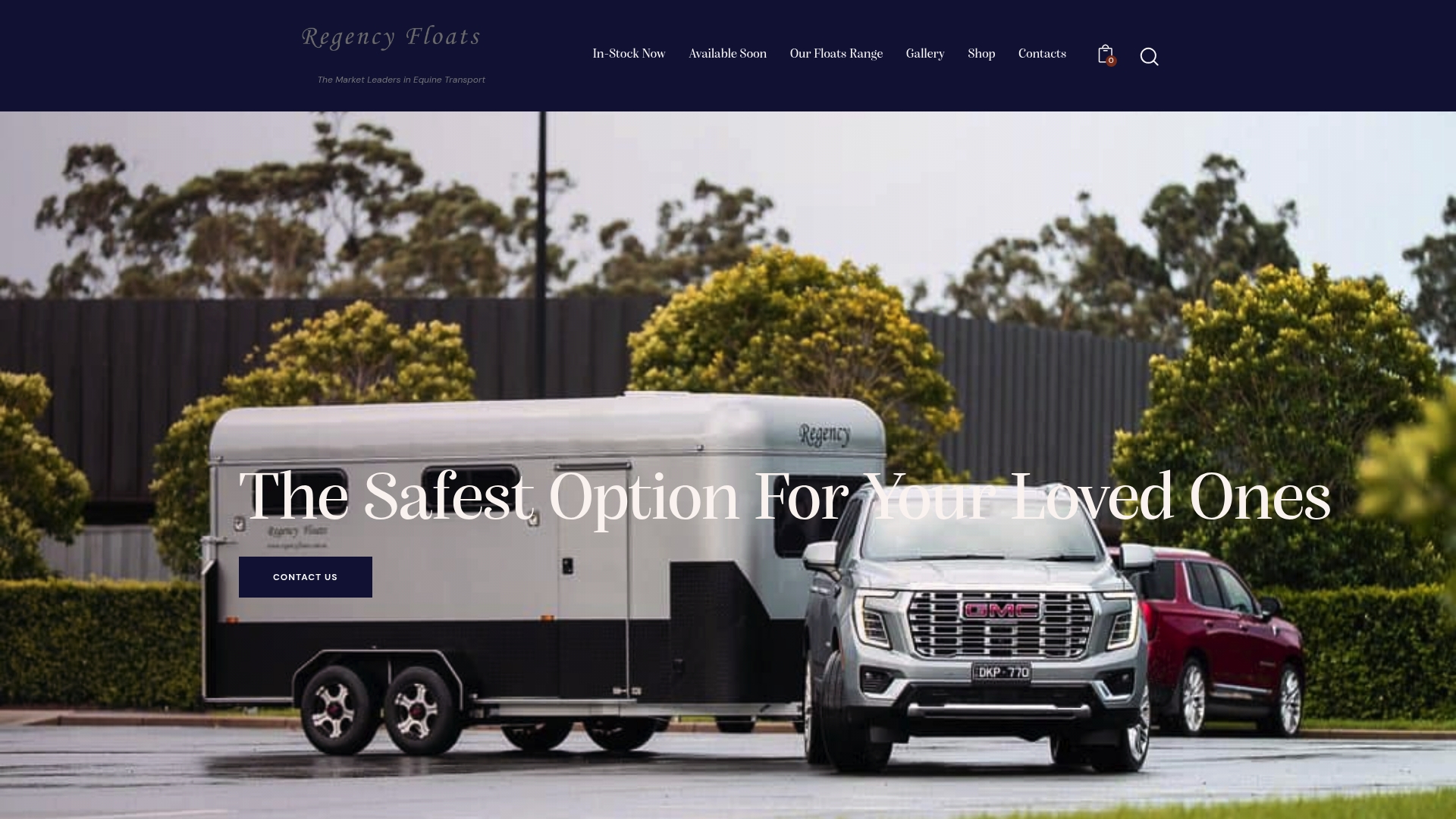
Regencyfloats combines European luxury design with Australian-grade construction, offering horse floats for sale across the country with delivery available nationwide. The 10-year flooring warranty is backed by state-of-the-art materials that reduce vibration and heat transfer, and the customization program covers over 200 color options and multiple floor plan configurations. Whether you are hauling a single thoroughbred to a weekend event or transporting a pair of warmbloods to a competition interstate, Regencyfloats builds to the size and spec your horses actually need. Browse the current in-stock specials or contact the team to discuss a custom build.
Key Takeaways
The most reliable horse float size guide starts with your horse’s withers height plus 15cm clearance, then works outward to stall width, body length, and towing capacity before any brand comparison begins.
| Point | Details |
|---|---|
| Height clearance minimum | Add 15cm above withers height; horses over 15 hands need at least 2.1m interior height. |
| Stall width by breed | Standard stalls suit horses under 15.2 hands; warmbloods and drafts require a wider stall for comfort and safety. |
| Breakaway brakes required | Australian law mandates breakaway braking on any float exceeding 2,000kg GTM. |
| Material choice affects comfort | Polyethylene and composite panels reduce heat and vibration compared to steel, especially on long summer hauls. |
| Regencyfloats | Best for owners wanting proven quality, a 10-year flooring warranty, and extensive customization across Australia. |

