
Most horse owners are surprised to learn just how quickly a loaded float tips past safe towing limits. A basic two-horse float starts at roughly 1,100 kg unladen, with an Aggregate Trailer Mass (ATM) near 2,000 kg. Load two average horses, a couple of saddles, water, and a hay bag, and you are already pressing hard against that ceiling.
How much does a horse float weigh, and why does it matter for safe towing?
Horse float weight breaks into two numbers you need to know before you hitch up. The tare weight is the float empty, no horses, no gear. The ATM (Aggregate Trailer Mass) is the maximum legal total weight of the loaded float, set by the manufacturer. The gap between those two figures is your payload, and it fills up faster than most owners expect.
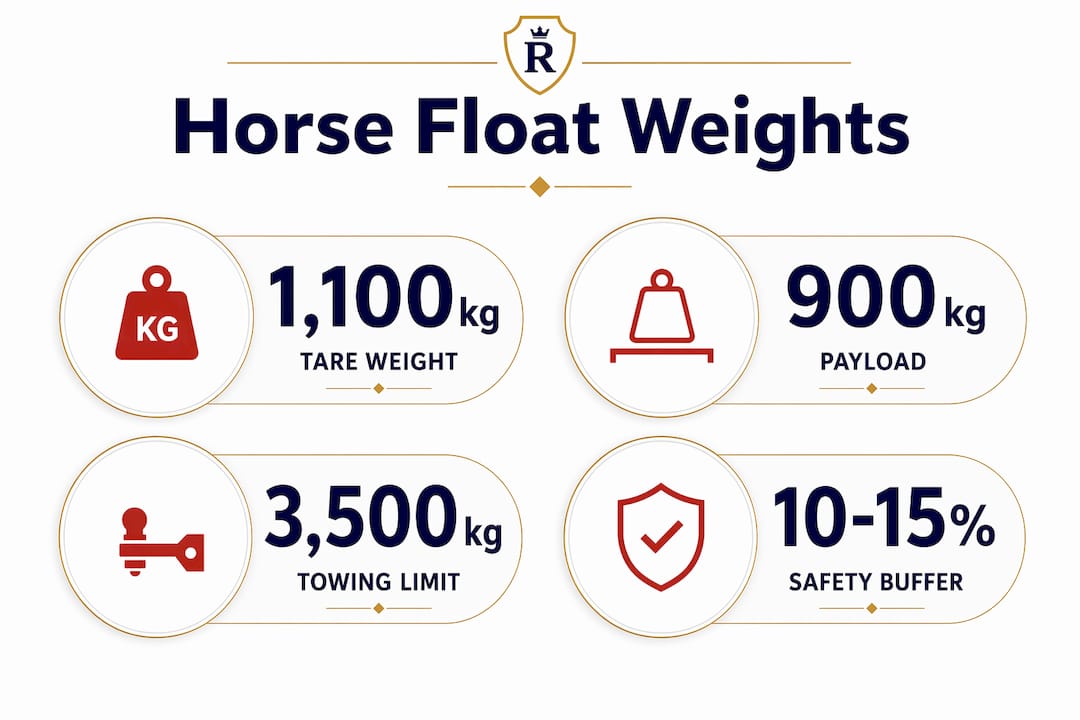
A two-horse straight load float typically weighs about 1,100 kg unladen with an ATM around 2,000 kg, leaving roughly 900 kg of payload. Two average 500 kg horses alone consume that entirely. Add tack, water, and a passenger, and you have blown past the limit before you have even thought about a generator or camping gear.
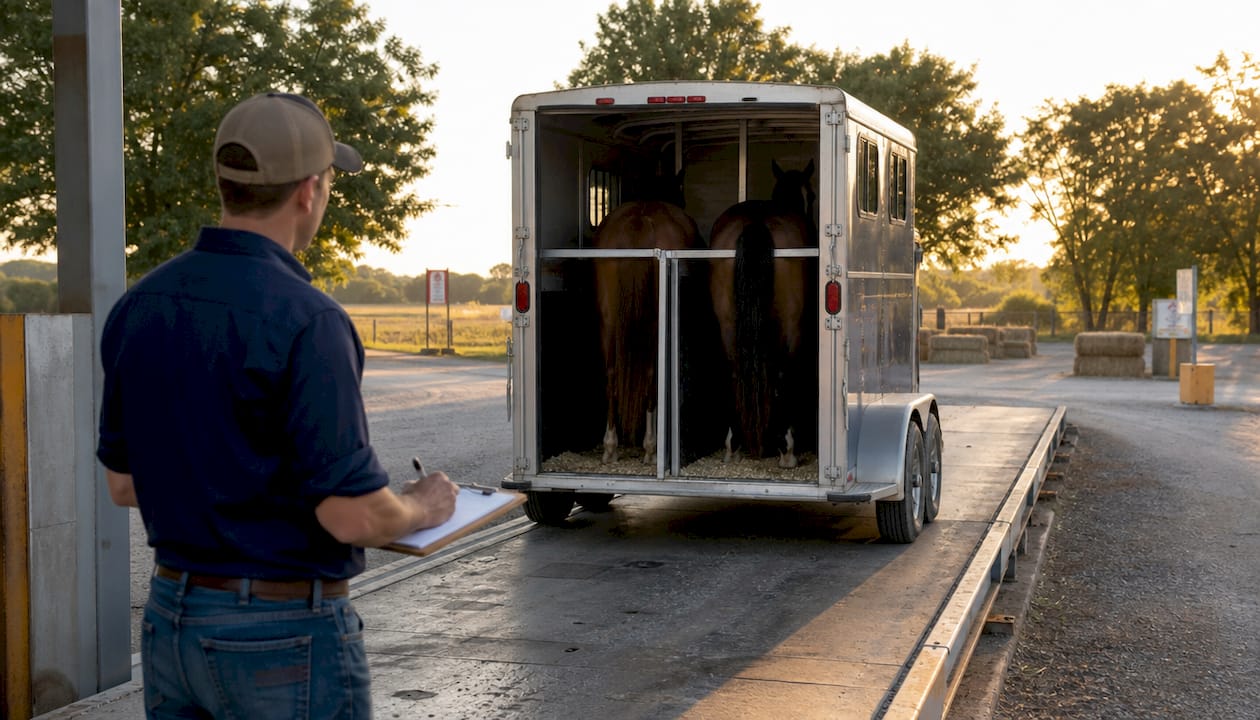
Total moving weight can quickly reach two or more tonnes, which directly affects which tow vehicle you can legally use. The Queensland Government’s towing guidelines make clear that exceeding your ATM even slightly risks fines, vehicle instability, and voided insurance. Getting the numbers right before you leave the property is not optional.
Ball weight adds another layer. The downward force your float places on the tow hitch should stay under 10% of total trailer weight for safe towing. Too little and the float sways; too much and your tow vehicle’s steering gets light at the front axle.
- Tare weight: the float empty, as it left the factory
- ATM: the manufacturer’s maximum legal loaded weight
- Payload: ATM minus tare weight, your actual carrying capacity
- Ball weight: downward hitch force, ideally under 10% of total trailer weight
- GCM (Gross Combination Mass): the combined legal limit for tow vehicle plus loaded float
Breaking down every weight component before you tow
Understanding where the kilograms come from is the fastest way to avoid an overload.
| Component | Typical Weight |
|---|---|
| Two-horse float (tare) | 1,100 kg |
| Average horse (each) | — |
| Saddle and bridle (each) | 20–30 kg |
| Two riders/passengers | — |
| Water (20 L container) | 20 kg |
| Hay, buckets, grooming kit | 30 kg |
| Estimated loaded total | — |
That loaded total explains why the standard diesel Toyota HiLux, with a 3,500 kg towing capacity, handles most two-horse floats comfortably. The electric HiLux variant, however, is rated at only 1,600 kg towing capacity, which rules out virtually every loaded horse float on the market.
Weight distribution matters as much as total weight. Horses positioned too far back shift load off the hitch, reducing ball weight below the safe threshold and making the float prone to sway at highway speeds. Ideally, the heavier horse loads toward the front of the float.
Pro Tip: Before your first trip with a new float or new horses, drive to a public weighbridge and weigh the rig fully loaded. A weighbridge ticket costs very little and gives you exact figures for every component, including ball weight.
The ATM vs GCM distinction trips up a lot of drivers. ATM covers the float alone. GCM covers the entire combination: tow vehicle plus float. Your tow vehicle’s own GCM rating, found in the owner’s manual, is the hard ceiling for the whole rig. Exceeding it is a serious legal and safety breach.
Common pitfalls that push horse floats over their weight limits
Overloading rarely happens all at once. It creeps up through small decisions that seem harmless individually.
- Hidden gear weight: Saddles run 20–30 kg each, and most owners carry two. Add a generator, a portable water tank, and a full tack box and you can add 100–150 kg without noticing.
- Ignoring passenger weight: Two adults in the tow vehicle do not count against the float’s ATM, but passengers riding in a living quarters area of the float absolutely do.
- Misreading the ATM plate: The ATM on the compliance plate is a maximum, not a target. Treat it as a ceiling with a buffer below it, not a number to reach.
- Camper and living quarters additions: Floats with built-in living areas add significant weight, which directly reduces the payload available for horses and gear.
- Skipping regular weighing: Float weight changes over time as accessories accumulate. A float that was legal three years ago may not be today.
Gear like saddles, generators, and camping equipment can push a loaded float beyond its stated ATM without the owner realizing it. The South Australian Police towing factsheet reinforces the same point: the cumulative effect of small additions is the most common cause of overloaded trailers on Australian roads.
Pro Tip: Build a 10–15% buffer into your payload calculations. If your ATM is 2,000 kg, plan your loaded weight around 1,700–1,800 kg. That buffer covers a heavier-than-expected horse, a last-minute extra bag, and the weight of fuel in a portable tank.
Experts advise maintaining a buffer above calculated loaded weight because even a slight ATM breach can void your insurance in an accident. The financial and legal exposure from an overloaded float far outweighs the inconvenience of leaving a bag behind.
How Australian horse float manufacturers help you stay within safe weight limits
Choosing the right manufacturer is one of the most direct ways to control float weight from the start. Australian builders who understand local road conditions, weight regulations, and horse sizes design their floats with compliance built in, not bolted on afterward.
| Manufacturer | Key Weight/Safety Feature | Notable Offering |
|---|---|---|
| Regencyfloats | 10-year flooring warranty, advanced safety tech | Customizable luxury floats, 40+ years experience |
| Imperial Horse Floats | Virgin Australian BHP steel, factory-built | Classic, Warmblood, and Camper series |
| The Float Centre | Multi-brand dealer | Straight and angle load, finance options |
| EuroFloat Horse Floats | Premium Australian-made design | 2 and 3 horse angle and straight load |
| East Coast Trailers and Horse Floats | Authorized Ifor Williams dealer | Horse floats and commercial trailers |
| Campbell Floats | European Equi-Trek imports | Accessories including wireless float cameras |
| Rowville Horse Trailers | Australian-made since 1982 | Focus on equine anxiety reduction |
| Pegasus Horse Floats | Wide model range, custom builds | 2–3 horse, goosenecks, horse trucks |
| Pinnacle Horse Floats | Tru-Gal galvanized chassis, 20+ years | Custom 2–3 horse straight and angle load |
Regencyfloats has built its reputation over more than 40 years on the combination of European-influenced design and Australian compliance standards. Their floats feature advanced safety technology and a 10-year flooring warranty, and every model is customizable so owners can configure the float without inadvertently adding unnecessary weight through redundant fittings.
Material choices drive tare weight more than most buyers realize. Floats built with European-influenced designs often balance structural integrity with a controlled tare weight, avoiding the heavy overbuilding that can eat into payload before a single horse steps on board. Pinnacle Horse Floats uses a Tru-Gal one-piece hot-dip galvanized chassis, which resists corrosion without the weight penalty of thicker steel sections. Rowville Horse Trailers has manufactured in Australia since 1982, sourcing from Australian suppliers and prioritizing equine comfort alongside structural weight management.
Camper-style floats from builders like Imperial Horse Floats add living quarters that increase total float weight considerably, which means the payload available for horses shrinks. Buyers choosing a camper configuration need to recalculate their payload carefully, factoring in the additional structure before they even consider horse weight.
A reputable manufacturer provides a current compliance plate with accurate tare weight and ATM figures, and many will supply a weighbridge certificate on request. That documentation is your legal foundation for every trip. When you browse floats for sale from a manufacturer with a clear warranty and published specifications, you start with numbers you can trust rather than estimates you have to verify yourself.
Key Takeaways
A loaded horse float regularly reaches two tonnes or more, making accurate weight calculation and a safety buffer the two non-negotiable steps before every trip.
| Point | Details |
|---|---|
| Typical tare weight | A basic two-horse float weighs about 1,100 kg unladen, with ATM near 2,000 kg. |
| Loaded weight reality | Total moving weight can quickly reach two tonnes or more once horses, tack, and gear are added. |
| Ball weight rule | Keep hitch ball weight under 10% of total trailer weight to prevent sway and maintain steering control. |
| Safety buffer | Plan loaded weight at 10–15% below ATM to cover hidden gear weight and avoid legal breaches. |
| Manufacturer matters | Choosing a builder with published specifications and a compliance plate gives you accurate weight figures from day one. |

