
A low floor horse float is one where the deck sits close to the ground, so the ramp is short, shallow and easy for a horse to walk up and, just as important, walk back down. The benefit is real, but only if the rest of the float is right: a grippy ramp, flooring that will not rot or corrode, enough headroom for your horse and a weight your vehicle can legally tow. This guide shows you how to judge each of those. At Regency Floats we build horse floats in Australia with 40 years of manufacturing behind them, and the checks below are the ones we would run through with a friend choosing their first float.
Why floor height matters to a horse
Horses read a float as a dark, enclosed space they have to step into. The steeper the ramp, the bigger the ask. One Australian horsemanship trainer, Ross Jacobs, points out that on taller floats the steep ramp itself challenges horses, and that some ramps are so steep they work more like a step-up. His advice is a shallow angle and non-slip flooring.
There is a second half to the story. Float-safety specialist Norm Glenn observes that for many horses, apparent reluctance to load is really a fear of coming out. A horse that has slipped once on a wet ramp remembers it. A lower deck shortens the descent, but the surface and the way the ramp meets the ground decide whether the horse trusts it.
So when you compare floats, treat floor height as one measurement in a group of four:
- The height of the deck above the ground.
- The angle and surface of the ramp.
- The interior height from floor to roof.
- The loaded weight and how it sits on your tow vehicle.
A float that is excellent on the first but poor on the other three is not a good float.
Ramp angle, grip and the front edge
The ramp is where a low floor pays off, so inspect it closely.
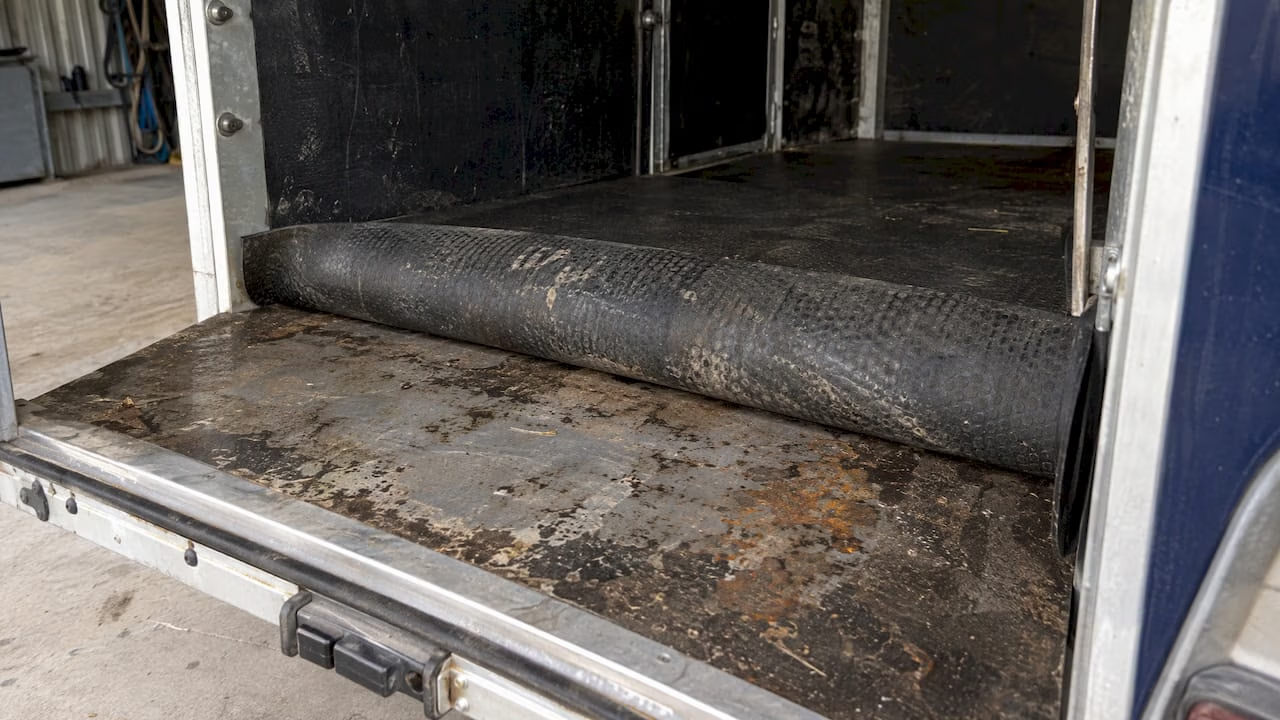
Surface. Glenn describes rubber matting with raised nodules as the only genuinely non-slip ramp surface he knows of that works in both dry and wet conditions. Agriculture Victoria’s transport guidance also says float and ramp flooring must be a non-slippery surface, with foot battens fitted if necessary, and that each horse needs to be able to stand in a natural position with adequate headroom.
The front edge. Glenn recommends adjusting the ramp springs so that the front edge lies flat on the ground when lowered rather than hovering above it. A lip or gap at the bottom is exactly where a nervous horse hesitates.
The entrance. Jacobs describes a float with a 7’4" roof whose 3" lip at the entrance cut the effective height to 7’1", which many horses find threatening. Measure the opening your horse actually walks through, not just the headline interior height.
Front ramp or rear ramp. Some owners prefer a front ramp so the horse can exit forward. We cover the trade-offs in our guide to the front ramp horse float.
A quick ramp check at the float
- Does the ramp surface look and feel grippy when wet, not only when dry?
- Does the front edge sit flat on the ground when lowered?
- Is the angle shallow enough that you could walk up it comfortably with a loaded wheelbarrow?
- Can you reach each horse through a side or front access door without stepping into the bay? Jacobs stresses this matters because if a horse has lost its balance or fallen, standing in the bay with it exposes you to risk.
Flooring: what a low floor is made of matters most
A low deck is only as safe as the material you are standing on. Floors take a beating from moisture, urine and hosing down, and a failing floor is a serious hazard. MC Equestrian warns that rusted floors have led to serious accidents where horses have fallen through. Hoofbeats Magazine reports that Australian riders worry about wooden floors rotting over time, with a real risk of a horse’s feet going through onto the road.
The common materials compare like this:
| Floor type | What to know |
|---|---|
| Timber | Risks water damage from hosing and has to be perfectly sealed and maintained |
| Aluminium | Lightweight and strong, but should be checked for cracks and still covered with rubber |
| Honeycombed fibreglass or aluminium planks with thick rubber matting | Described in a 2026 finance guide as the modern Australian approach, so the floor never rots out |
Our own approach is a state-of-the-art flooring system backed by a ten-year warranty. For a buyer, a long flooring warranty is a practical signal: the floor is the part of the float you cannot easily see under the mats, and the part that matters most when the horse is travelling over it.
Whatever you buy, ask for the floor specification in writing: material, thickness, matting, and what the warranty covers and for how long.
If you are looking at a used float
A 2026 inspection checklist lists what to look for in a second-hand float’s floor: soft or weakened areas, flex, corrosion, rot, cracks, moisture damage and poor earlier repairs, including the condition beneath removable mats. Lift the mats. A clean-looking mat can hide a tired floor. We also sell pre-owned floats, and the same checks apply to ours.
Headroom: the other half of a low floor
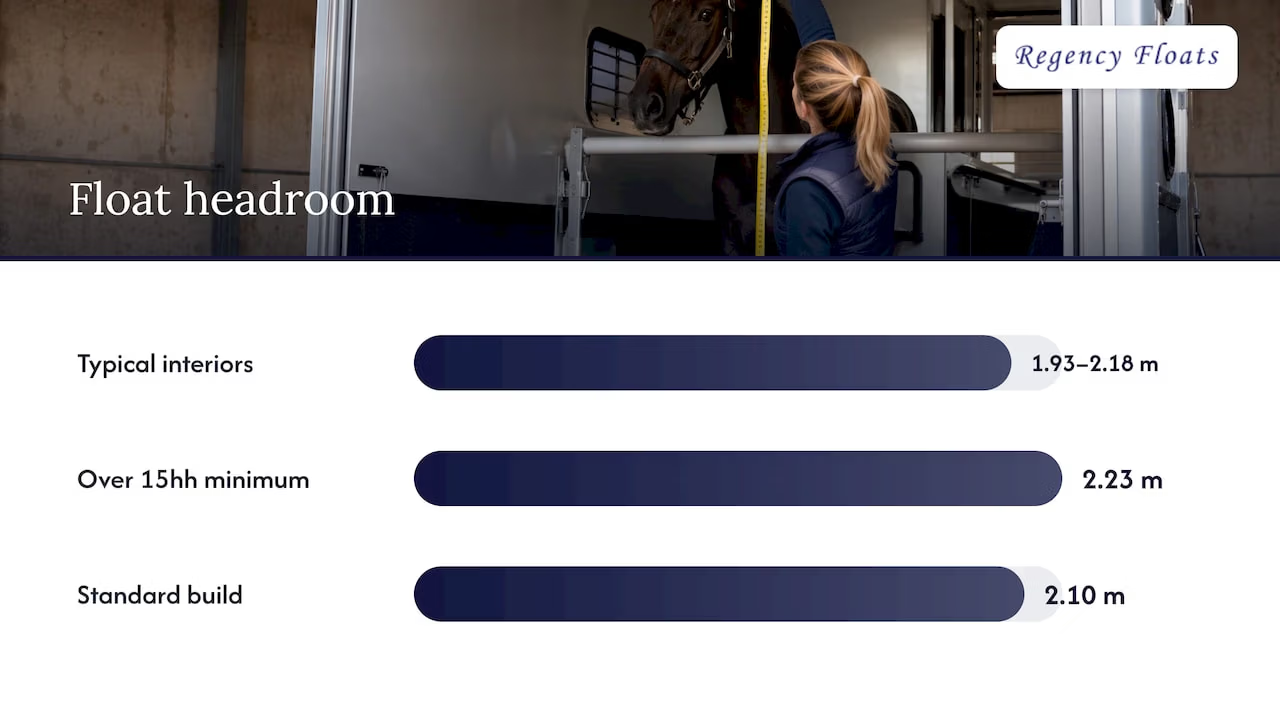
A lower deck can give you a gentler ramp, but your horse still needs room above the withers. Interior height in Australian floats typically runs between 6’9" (1.93 m) and 7’2" (2.18 m). Jacobs advises that any horse over 15hh (1.52 m) needs at least 7’4" (2.23 m) inside, adding 100 mm for each extra 100 mm of horse height.
Norm Glenn goes further, saying a roof height of 2200 to 2250 mm gives a horse a feeling of spaciousness, while many manufacturers build about 2100 mm as standard.
Here is a worked example. Your gelding is 16hh, which is 1.63 m. Using Jacobs’ rule, that is 100 mm over 15hh’s 1.52 m baseline by roughly 110 mm, so you want a little over 2.23 m inside. A float listed at 2.10 m interior height is too low for him regardless of how gentle its ramp is. One hire listing for a 2-horse straight-load float gives an internal height of 2225 mm, which shows what a typical figure looks like on a spec sheet.
Measure your horse at the withers, then add your headroom allowance. Our horse float size guide walks through the dimensions, and our interior design guide covers how partitions, padding and layout use that space.
Balance, space and tying on the road
A good floor and ramp get your horse in. The interior then has to let them travel in balance. The Australian Government’s horse transport welfare review recommends that horses have space to stand with legs slightly wider than hips and shoulders for balance, and to be able to lower the head below wither height, with breaks on long journeys at least every four hours.
For loading the float, Agriculture Victoria says that in a two-horse trailer a single horse should be tied on the driver’s side with the centre partition removed, and that when carrying two horses the heavier one goes on the driver’s side.
On tying, Glenn says the purpose is to stop the horse turning around, not to stop it pulling back. He recommends forward, high-fitted tie-up rings, and says you should undo the tie before opening the rear door or tailgate. When lowering the ramp, stand to the side, never behind it. MC Equestrian adds that you should not tie too tightly: ideally the horse can get its head below its chest so mucus can drain.
Weight, brakes and your tow vehicle
A low floor does not change the arithmetic of towing. Before you fall for any float, check these figures against your vehicle.
Horse SA’s guidance says to check the float’s tare (empty weight) and ATM (aggregate trailer mass, the maximum loaded weight), then find your vehicle’s towing capacity in its handbook. The loaded float, including horses, saddlery, feed and water, must not exceed the vehicle’s or tow bar’s capacity, whichever is lowest. A C-class licence covers combinations of 4.5 tonnes or less.
The same guide notes that trailers with a gross trailer mass over 750 kg must have brakes, trailers over 2,000 kg must have electric breakaway systems, and safety chains must be rated for the ATM, attached with weighted D shackles and crossed. National Standards for the transport of livestock, including horses, are enforced through state RSPCA branches.
For a sense of scale, a listed 2-horse straight-load float shows an ATM of 3400 kg, a tare of 1520 kg and a ball weight of 145 kg. The gap between tare and ATM is the payload you can actually carry, which is why a lighter-looking float can still push a vehicle past its limit once two horses and feed are aboard. If you want to see how tow ratings and trailer mass fit together more generally, this page on travel trailer weight limits sets out the basics.
For horse-specific numbers, our guides to horse float weight and towing capacity for horse floats show how to work out your loaded weight and what to check before you leave.
Choosing between float types
Deck height is one reason to pick a layout. Your horses, your vehicle and your use are the others.
- Two-horse floats are the simplest to tow and suit a single vehicle and one or two horses. Our 2 horse float range covers this.
- Straight-load and angle-load floats differ in how horses stand. Taller horses over about 15.2hh can find a 45-degree angle bay short, which Jacobs notes can force them to travel with their head very low.
- Gooseneck floats carry weight over the tow vehicle’s tray and suit heavier combinations.
- Camper floats add living space for competition weekends and longer trips.
- Thoroughbred series floats are made with taller, racing-type horses in mind.
We make Standard, Deluxe, Camper, Gooseneck, Straight Load and Thoroughbred Series floats, plus a 2 Horse range. If you are weighing up who builds what in Australia, our guide to Australian horse float manufacturers sets out the landscape.
Imported versus Australian-built
If you are tempted by a European-style float, consider climate and compliance. John Nicholls told Hoofbeats that European imports have some good safety features, but their ventilation is generally inadequate for Australian hot weather and their braking systems do not comply with Australian Standards. That is a good reason to look at a float built here for Australian conditions. Ours combines European luxury design with Australian manufacture and advanced safety technology.
A modern buying guide also suggests a galvanised steel chassis to resist coastal corrosion, electric brakes and adjustable padded dividers. Use that as a spec-sheet prompt when you compare.
Building the float around your horse
Norm Glenn argues that owners should take control and order a float that removes hazards such as cuts from protrusions, trapped hooves and lead-rope snags, because if you think it could happen, you should fix it before it does. That is a good brief for a custom order.
Because our floats are customisable, you can choose colours and fittings to suit your preferences. When you talk to us, bring a short list:
- Your tallest horse’s wither height, and the interior height it needs.
- Your vehicle’s towing capacity and tow bar rating.
- How many horses you carry most weeks, and how many on a big day.
- Whether you need living space for competition travel.
- What you want at the ramp: grip, angle and access doors.
Your next step
If you are ready to compare, start with the Regency Floats range. It brings together our Standard, Deluxe, Camper, Gooseneck, Straight Load and Thoroughbred Series floats, and the 2 Horse range has its own page. Each carries our flooring system with a ten-year warranty, and we design for safety, comfort and durability. Tell us your horse’s height and your tow vehicle and we can point you to the layouts that fit.

We also sell accessories and parts, and keep in-stock specials with delivery Australia-wide on our Deluxe range page.
FAQ
Is a low floor horse float better for loading?
A lower deck means a shorter, shallower ramp, which many horses find easier to climb and descend. The ramp surface and front edge matter just as much: non-slip rubber with raised nodules and an edge that lies flat on the ground help a horse trust the ramp in wet and dry conditions.
How tall does the inside of a float need to be?
Australian floats typically range from about 1.93 m to 2.18 m inside. For a horse over 15hh, Ross Jacobs advises at least 2.23 m, adding 100 mm for every extra 100 mm of horse height. Measure your horse at the withers and check the entrance opening as well as the roof.
What should I check about the floor?
Look at the material, the thickness and the matting. Avoid soft spots, flex, corrosion or rot, and lift removable mats to see what is underneath. Ask what the floor warranty covers and for how long. Our flooring system carries a ten-year warranty.
Can my vehicle tow any horse float?
No. The loaded float, including horses, feed, water and tack, must not exceed your vehicle’s or tow bar’s towing capacity, whichever is lower. Check the float’s tare and ATM against your handbook, and note that trailers over 750 kg need brakes and those over 2,000 kg need electric breakaway systems.
Should I tie my horse in the float?
Yes, with the tie short enough to stop the horse turning round but loose enough that it can lower its head below its chest. Use a high, forward tie-up ring, and always release the tie before opening the rear door or ramp.

