A groom door is a small personal access door on a horse float that lets you reach your horse without lowering the ramp or stepping into the horse bay. On most floats it sits at the front or on the side near the horse’s head, and it is one of the most practical safety features you can ask for. It lets you check, calm, water or untie a horse at a servo stop, at a rest break or when something goes wrong on the road. This guide covers where groom doors sit, the designs you will see on Australian floats, what to inspect before every trip and what to ask before you buy.
What a groom door is and what it is for
The name comes from the person it serves: the groom, rider or handler travelling with or checking on the horse. Instead of opening the rear ramp, which means undoing the breech bars and working in a horse’s blind spot, you step through a small door beside the horse’s head and deal with it from there.
In the UK and parts of Europe, the same feature is often called a groom’s door or access door, and some rules there expect a driver or attendant to be able to reach the horse area without using the ramp. In Australia, the term “groom door” is used loosely across makers and sellers, and you will also see “front access door”, “personal access door” or “side access door” in listings. They all describe the same idea: a way in that is not the ramp.
The everyday uses are simple:
- Checking a nervous or young horse during a trip without opening the back.
- Offering water or a haynet at a rest stop.
- Undoing a lead rope or chest bar if a horse has shifted or tangled.
- Loading and unloading a horse that is better led from the front.
- Reaching the horse in an emergency when the ramp is blocked or unsafe to open.
That last point matters most. Australian workplace safety guidance for horse handling stresses that vehicles should allow safe access and entry and exit for loading and unloading without hazardous manual handling. WorkSafe Victoria’s guide to horse stables and track riding safety highlights that safe access is critical to prevent handlers being kicked, trampled or crushed. Even if you are not an employer, the logic holds for a family float: every time you have to stand behind or beside a frightened horse, the risk goes up. A groom door gives you another option.
Where a groom door is usually located
Placement depends on the float layout, and it is worth thinking about before you look at a single model.
Front or side near the horse’s head
On an angle-load float, the horses stand diagonally facing one side. A side door positioned near their heads gives you direct access to the head, the chest bar and the lead rope. Many floats pair this with a front tack compartment, so you step through a door at the front corner.
Between the horse and the tack area
On straight-load floats, where horses stand facing forward in a row, access often comes through a door at the front, into a space beside the head of the horse. Some designs let you walk through the tack or dressing area and reach the horse’s head through a small opening or internal door.
Camper and gooseneck floats
On a camper float with living quarters, an internal door can connect the living area and the horse bay. Gooseneck floats place the front compartment over the tow vehicle’s tray or hitch. They can offer generous front space and a door into the horse area. If you want the full picture of how interior spaces are laid out, our horse float interior design guide walks through the options.
What to look for in the position
- The door should open to an area where you can stand safely, not into the horse’s path.
- You should be able to reach the head collar, lead rope and chest bar without leaning across the horse.
- The opening should be large enough to step through, or at least to get an arm, a bucket and a haynet through, depending on the design.
- A clear way out matters. Think about how you would leave if the horse moved towards the door.
Groom door designs you will see on Australian floats
There is no single standard, and the term covers several designs. Here is how they differ.
| Design | How it works | Best for |
|---|---|---|
| Full-height side door | A walk-through door beside the horse’s head, opening into a small area or the horse bay | Owners who want to step in and untie, groom or calm a horse |
| Front access door | A door at the front into the tack or front compartment, with an inner opening to the horse | Straight-load and angle-load floats with a front tack room |
| Half or small hatch | A smaller opening to reach the head, pass a bucket or check the horse | Quick checks, water and hay at rest stops |
| Internal door in a camper | A door between the living area and the horse bay | Long trips where you stay with the float |
| Escape or emergency door | A secondary exit that keeps a way out open if the ramp is blocked | Handlers who travel alone or with young or reactive horses |
Some floats combine more than one of these. Others rely on a large front window and an access door to the tack area. Product listings from different makers describe these features in different words, so ask for a floor plan or photos rather than relying on the name alone.
Fittings worth checking
- Latches and locks. They should be positive, hold when bumped and be easy to operate with one hand while you hold a horse.
- Hinges. Heavy-duty hinges and a rigid frame stop the door sagging.
- Seals. A good seal keeps out dust and rain, and cuts road noise.
- Door swing. A door that swings out of the way and stays put in wind saves you wrestling it while you hold a horse.
- Windows and ventilation. Some doors include a window or vent panel, which helps you see the horse and keeps airflow going.
- Internal padding or guards. Edges and latch hardware inside the float should not catch a horse’s head, hip or lead rope.
Why a groom door earns its place on a float
Safer checks on the road
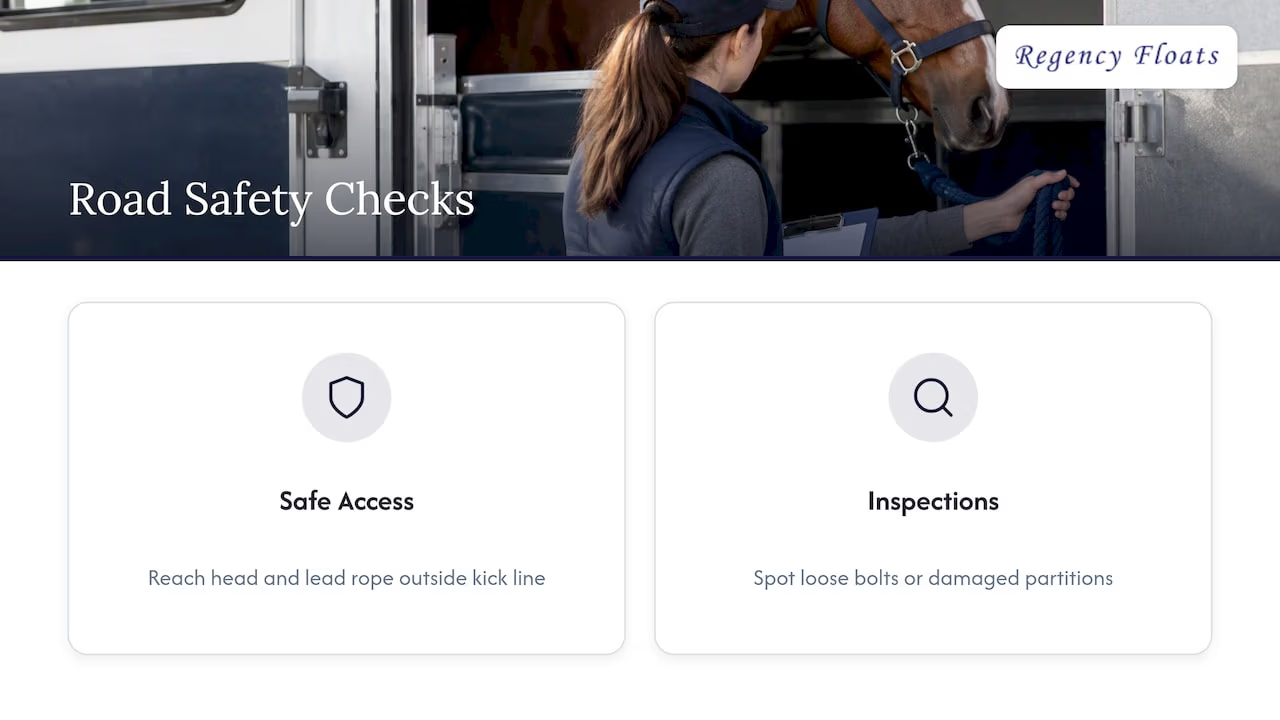
A horse that scrambles or loses its balance in transit can be dangerous to approach from behind. A groom door means you can reach the head and the lead rope without standing in the line of a kick or exposing yourself to the horse’s movement. Pony Club Australia’s guide to horse welfare on the road also reminds owners that loose bolts or damaged partitions can quickly become serious safety risks during transit, so the ability to look in and check matters.
Calmer loading for nervous horses
Some horses load more happily when led in from the front or when you can stand beside them as the ramp comes up. A front or side access door gives you that choice and means you do not have to be the last one at the back.
Less stress on long trips
If you travel long distances to competitions, a door that lets you offer water, check rugs and reassure the horse without unloading makes rest stops quicker. If that sounds like you, read our long distance horse transport safety guide as well.
A way out for you
The other side of access is exit. If a horse panics, you want a door you can leave through that does not rely on lowering a ramp.
What to check before you travel
A groom door is only useful if it works every time. Build a short check into your pre-trip routine.
- Open and close it fully. It should swing freely and latch with a firm, audible click.
- Test the latch from inside and outside. Make sure you can open it with one hand and that it cannot be nudged open by a horse.
- Look at the hinges and mounts. Check for cracks, elongated holes, rust or loose bolts.
- Check seals and windows. Look for perished rubber, cracked glass or perspex, and gaps where water or dust could get in.
- Check the structure around the door. Pony Club Australia advises checking that doors and latches close properly and that the float structure is sound and free of corrosion or damage.
- Clear the area. Make sure nothing, such as a bucket, a rug or a hay net, can foul the door or the horse.
- Lock it before you set off. Never travel with a groom door unlatched or held by a bit of baling twine.
If the door has anything that looks bent, cracked or worn, have it repaired before you hook up. Roadworthiness is wider than the door itself, and our guide to what makes a horse float roadworthy in Australia covers the rest of the checklist.
How to maintain a groom door
Treat the door as part of regular float servicing. WorkSafe Victoria’s guidance advises that horse transport be regularly serviced and roadworthy, and door integrity is part of that. In practice that means:
- Checking locking mechanisms, hinges and any windows or seals for damage at every service, and a quick look before every trip.
- Lubricating hinges and latch mechanisms as the manufacturer recommends, using a product suited to the finish and the material.
- Washing off dirt, dung and urine, which speed up corrosion around hardware and frames, particularly on aluminium and steel floats used near the coast.
- Replacing worn seals and rubber stops before they fail.
- Repairing dents or distortion in the door or frame promptly. A door that has been knocked out of alignment will not latch properly.
The NSW SafeWork A-Z of Farm Safety also points to keeping transport vehicles in a sound state, free from corrosion or damage, to minimise animal stress and injury. A door that swings loose or rattles is a sign something needs attention.
Rules that apply to horse transport in Australia
There is no national law that says “a float must have a groom door”. What applies is a broader set of animal welfare and safety expectations, and it varies by state and territory.
- The Australian Animal Welfare Standards and Guidelines for the Land Transport of Livestock apply to horses. Agriculture Victoria notes they have been adopted into Victorian legislation under the Livestock Management Act 2010. Other states and territories have their own arrangements, so check the agriculture or primary industries department where you live.
- Vehicle and trailer standards, such as brakes, lighting, towing capacity and registration, are set by state and territory road authorities. Our horse float weight and towing guide explains the weights you need to know.
- Sea transport has its own rules. Under Marine Order 43, horse floats carried by sea need openings at the front and rear, each at least 0.4 square metres, for flow-through ventilation. That is a shipping rule, not a road rule, but it shows how seriously ventilation and openings are treated.
If you are unsure what applies to you, ask your state road authority or your state’s primary industries department. If you transport horses for work, workplace health and safety laws also apply, and WorkSafe in your state is the place to start.
Questions to ask before you buy
Whether you are looking at a new float or a pre-owned one, a short list of questions saves regret later.
- Where is the groom or access door, and what does it open into?
- Can I see a floor plan or walk through it with a horse in mind?
- How does the latch work, and can I operate it one-handed?
- Is there a window or vent in or near the door?
- How does the door sit with the front tack compartment, the dividers and the chest bar?
- If I travel alone, can I reach the horse’s head quickly and safely from outside?
- Is the door and frame protected against corrosion?
- What warranty covers the structure and fittings?
Float size matters here too. A compact float may have less room around the horse’s head, so measure with your own horse in mind. The horse float size guide helps you match dimensions to your horse, and the accessories list shows what you might add, from hay nets to water systems.
If you are comparing makers, our Australian horse float manufacturers buyer’s guide sets out what to look for in construction, flooring and warranty.
Choosing a float with the access you want
Regency Floats has built horse floats for over 40 years, and our range is designed around safety, comfort and durability. Our floats come with advanced safety technology and European luxury design, and our flooring system is backed by a ten-year warranty. We offer Standard, Deluxe, Camper, Gooseneck, Straight Load, Thoroughbred and 2 Horse ranges, and floats can be customised, including colours and fittings.
If a groom door or front access is on your must-have list, tell us how you travel: how many horses, how far, whether you go alone, and how your horse behaves when loading. We can talk you through which float layouts suit that and what can be specified.

You can browse the full Regency float range, look at the 2 horse float range or see what is in stock with delivery Australia-wide. If you are earlier in the process, our guide to choosing the right horse float for you and your horse is a good place to start.
Using a groom door safely
A groom door reduces risk but does not remove it. A few habits make a real difference:
- Secure the horse first. Make sure the head collar, lead rope and chest bar are in place before you open any door, so the horse cannot walk out or turn on you.
- Open slowly. Talk to the horse so it knows you are there, and watch its ears and eyes.
- Stand where you can leave. Do not trap yourself between the horse and the door.
- Keep the ramp closed and latched while you use the front or side door, unless you are unloading.
- Stop somewhere safe. Pull over on a firm, level shoulder or in a rest area, away from traffic, before you open anything.
- Never open a door on a horse that is thrashing or down without a plan. If a horse has gone down or is badly tangled, stop in a safe place and call a vet or an experienced handler for advice on the specific situation.
For tips on keeping a horse comfortable between stops, the Pony Club Australia welfare article linked above is a good read before a long trip.
Frequently asked questions
Is a groom door the same as a front access door?
Often, yes. Makers and sellers use groom door, personal access door, side access door and front access door to describe a way into the horse area that is not the ramp. Positions and sizes differ, so ask for a floor plan or photos of the specific float rather than relying on the name.
Do I legally need a groom door on my horse float in Australia?
We are not aware of a national rule that requires one on a private float. What applies are animal welfare standards for land transport, road rules for the vehicle and trailer, and workplace safety laws if you transport horses for work. Check with your state road authority and primary industries department for the rules where you live.
Can I add a groom door to an existing float?
It is a structural change, so it should be assessed by a qualified float builder or engineer, because cutting into the frame can affect strength, compliance and warranty. Ask the manufacturer or a reputable workshop before you cut anything, and have the work inspected afterwards.
How often should I check the groom door?
Give it a quick look before every trip: open it, latch it, and check the hinges and seals. Include it in every scheduled float service, as WorkSafe Victoria’s guidance treats door integrity as part of keeping transport roadworthy.
Is a groom door worth it if I only travel short distances?
Many owners find it useful even on short trips, because problems can happen at any distance and a horse that is unsettled at a stop is easier to reach from the front. If you often travel alone or with a young or nervous horse, the extra access is worth putting on your list.