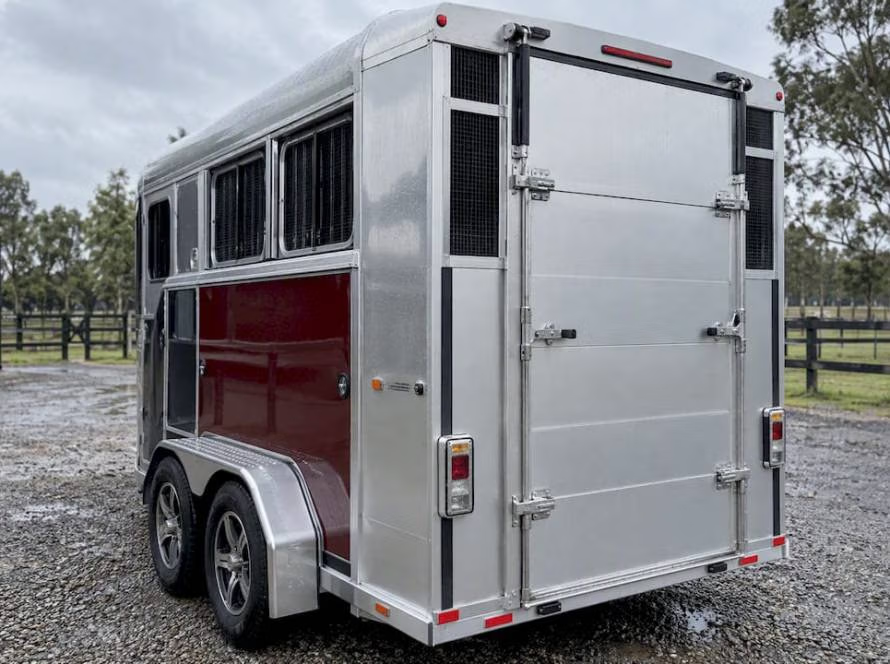
A removable divider lets you change how a float is laid out for the horse you are carrying. You can take the centre divider out for a single horse, or put it back for two. It only helps if it fits properly, releases easily and is secured every trip. This guide covers when removal makes sense, what to check on a divider before you trust it, and what Australian welfare guidance says about separating horses.
What a removable divider is
A divider is the partition that separates one horse from another inside the float. In most two-horse floats it is a centre divider running from the front to the rear, usually with a chest bar at the front and sometimes a breeching bar at the back.
The word “removable” describes how the divider is mounted. These are the common arrangements:
- Fixed divider. Welded or permanently bolted in place. It stays where the builder put it.
- Removable divider. Lifts out or unpins without cutting or grinding, so the float can be set up as one wide stall or as two.
- Adjustable divider. Moves or swings to a different position or height without leaving the float. Some are also removable.
The terms overlap, and sellers use them loosely. A divider sold as “removable” may need tools and two people. Another may drop out in a minute. Before you buy or order, ask exactly how it comes out, how long it takes and where it is stored afterwards. Our horse float dividers buyer’s guide sets out the main types in more detail.
When taking a divider out helps
One horse in a two-horse float
The clearest case comes from official guidance. For a single horse in a two-horse trailer, Agriculture Victoria advises removing the centre partition to improve the vehicle’s balance. A lone horse standing on one side of a fixed divider puts all its weight off-centre. Taking the divider out lets the horse travel in a more central position.
The same guidance covers a loaded float with two horses. It recommends the heavier horse be placed on the driver’s side to keep the vehicle balanced. A removable divider does not change that rule. It just gives you the choice of layout.
Giving a horse room to choose its stance
In angle-load floats, some horsemen take the divider out so a horse can choose a more comfortable angle. Australian horseman Ross Jacobs wrote in 2025 that this can suit some horses, but that it depends on the float’s dimensions and the horse’s size. A big warmblood in a compact float is a different proposition from a pony in a generous one. Treat this as an option to test at home, not a rule.
Large horses and awkward loaders
A wider, undivided space can also make loading easier for a nervous or large horse, because there is nothing hemming it in at the shoulder. If you are working with a horse that rushes or panics, many handlers load with the divider out, then fit it once the horse is calm and the float is stationary. Whether that is safe for you and your horse depends on the horse and the float design. Ask an experienced trainer to watch you do it before you rely on it.
Hauling gear, not horses
Off-season, or when you are heading to a trail ride, a removable divider frees up the floor for feed, hay and equipment. This is a practical benefit of a modular layout and a reason many owners ask for one when ordering a float.
When to keep the divider in
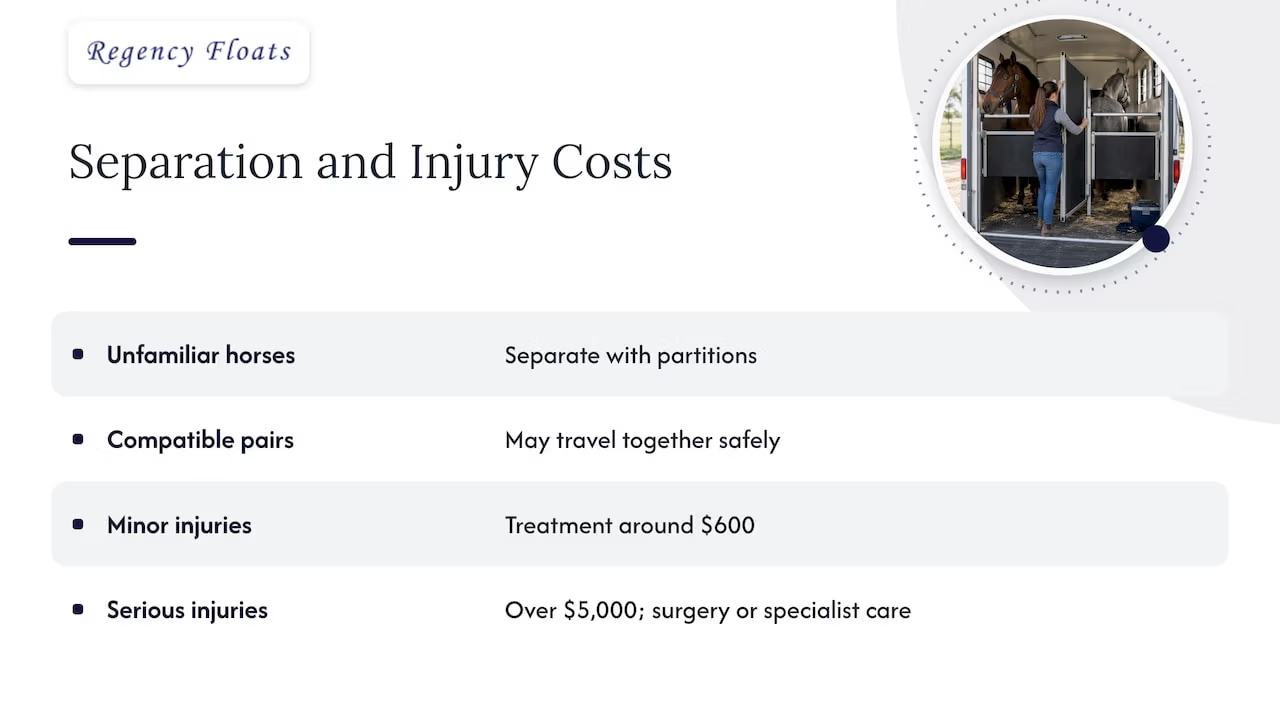
Two horses should travel with a partition between them. Agriculture Victoria says adjustable partition boards should always be used when you carry more than one horse. The RSPCA’s transport policy for horses, adopted in May 2023, says horses should be individually separated using partitions or other suitable methods. The exception is horses that know each other and can travel safely as a compatible pair or small group.
The reasons are practical. The Australian Government Department of Agriculture’s regulatory analysis on horse transport notes that vet treatment of transport injuries such as bites or kicks can run from around $600 for minor incidents to over $5,000 for serious ones needing surgery or specialist care. The same document observes that dedicated sport and leisure horse floats typically already include barriers or dividers. A divider is part of a standard float for good reason.
Types and configurations of removable dividers
A float has more than one place where a partition can sit. Most owners meet these four.
Centre divider
The full-length partition between two horses. This is the one you remove for a single horse or when you want a wide stall. It should be solid enough to take a horse leaning or bracing against it, and padded where the horse makes contact.
Head divider
A shorter partition between the horses’ heads, often at the front of an angle-load or straight-load float. It stops horses from nipping or interfering with each other while leaving the bodies free. We cover the options in our guide to head dividers for a horse float.
Chest bar and breeching bar
The chest bar sits across the front of the horse’s stall at about chest height. The breeching bar goes behind the hindquarters. Both should be padded and removable, so a horse that gets into trouble can be released quickly.
Natural Horse World lists removable head, chest and centre dividers among the features worth looking for, along with padded chest bars and padded dividers for comfort.
Stallion divider
A solid, taller partition for rear or full-height separation when carrying a stallion near other horses. It is a specialist fitting. If you carry a stallion, talk to your builder about layout at the order stage, not after the float is built.
Comparing the options
| Type | How it mounts | Best for | Watch for |
|---|---|---|---|
| Fixed centre divider | Welded or permanently bolted | Owners who always carry two horses | Cannot be removed for a single horse |
| Removable centre divider | Pins, brackets or tracks | Mixed use: one horse some days, two on others | Quick release, secure storage |
| Adjustable divider | Moves or swings within the float | Horses of different sizes | Locks firmly in each position |
| Removable head divider | Clips or pins at the front | Horses that nip or jostle | Fit to your float’s width |
| Padded chest bar | Quick-release bar | All floats | Must release under a horse’s weight |
What to check before you trust a divider
The fit and the release matter more than the label on the product.
Height and floor clearance
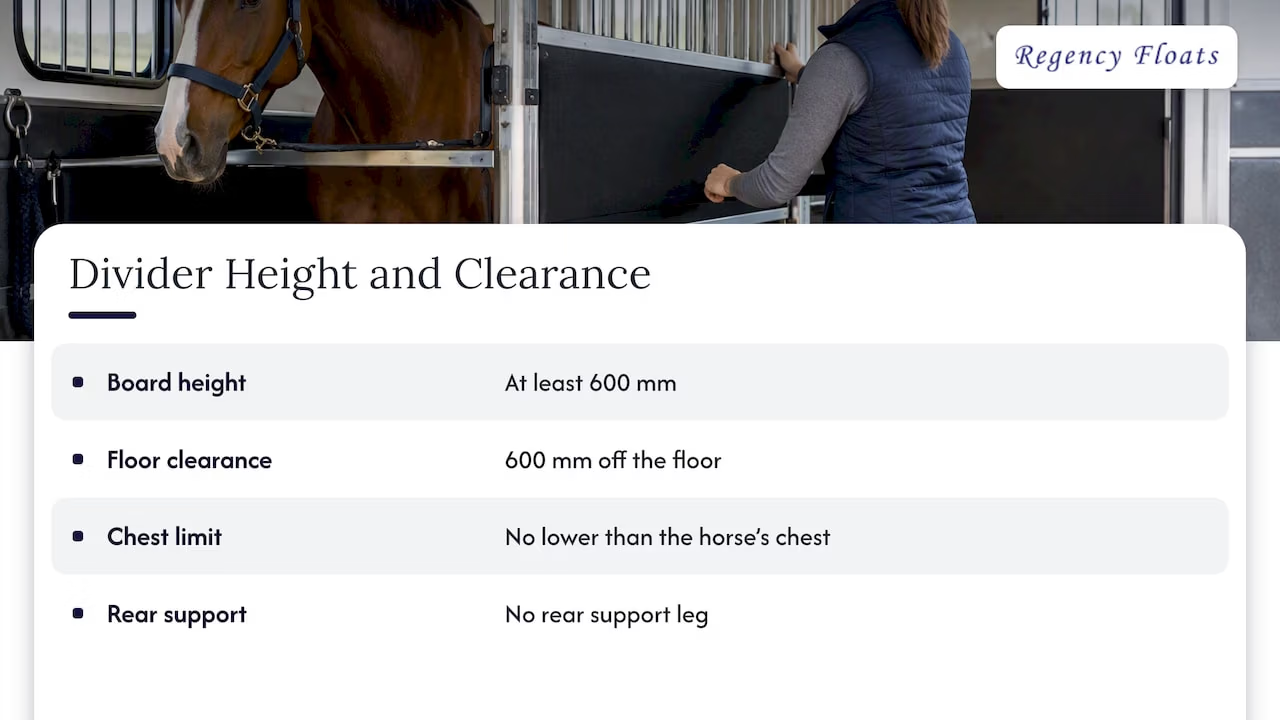
Agriculture Victoria says partition boards should be at least 600 mm high and 600 mm off the floor. Petcover Australia makes the same point from the horse’s side: a divider should not run to the floor, because horses need room to spread their legs and brace as the float moves. Experienced float safety writer Norm Glenn goes further. He says a centre divider should not hang lower than the horse’s chest and should have no rear support leg, to avoid leg injuries during loading and unloading.
If you are replacing a divider or fitting a new one, ask for the clearance as a measurement, not an adjective.
Truly quick release
Petcover recommends quick-release chest bars, sturdy breeching gates, free-swinging partitions and removing dangerous fixings. Glenn adds a warning that is worth remembering: many bars sold as removable cannot be released under the weight of a horse. Test the release at home. Lean on the bar with some load and see whether you can free it one-handed. If you cannot, a horse that straddles the bar is in real danger.
Fit to your float
Measure the internal width, height and length of the stall before choosing. A divider that is a few centimetres out will rattle, rub or leave a gap. Our guide to measuring your float for a divider covers the points to take.
Surfaces and fittings
Agriculture Victoria says the float should securely contain horses, have smooth surfaces free of hazards, non-slip flooring, and enough headroom and airflow. Apply that to the divider itself: no sharp bolt ends, no exposed edges, no gaps where a hoof can catch. Our notes on materials and build specs that matter explain what to look for in the build.
Removing, securing and storing a divider
The safest divider is one you set up the same way every time. A simple routine helps:
- Load the float for the trip first. Decide the layout before the horse is on board. Do not change dividers with a horse in the stall.
- Remove or fit the divider with the float parked on level ground. Hold it by its frame, not the padding, and keep the pins and brackets in one place.
- Set the height and position for the horse. Ranvet’s pre-departure checklist says to confirm dividers and head dividers are secured in the right position or height, and to turn any pegs or pins away from the horse.
- Store a removed divider properly. Strap or clip it where it cannot slide, rattle or hit a horse. A loose divider in the float is a hazard in a sudden stop. If your float has a dedicated storage position, use it.
- Check the rest of the float. The same checklist advises inspecting flooring for rust or structural damage and making sure the tailgate or ramp has no faults before loading.
Keep a short written pre-trip list in the tow vehicle. When you switch between one-horse and two-horse layouts, it is the step you are most likely to forget.
What Australian welfare rules say
Rules on horse transport sit with the states and territories. In Victoria, the Australian Animal Welfare Standards and Guidelines for the Land Transport of Livestock apply to horses and have been adopted into Victorian law under the Livestock Management Act 2010. Other states have their own regulations, so check with your state’s primary industries or agriculture department for the requirements where you travel.
The practical message is consistent across the guidance above. Separate horses with partitions unless they are a familiar, compatible pair. Keep the float balanced. Make sure the horse can brace its legs. And make sure you can release a horse fast if something goes wrong.
Two extra points from Norm Glenn’s float safety notes are worth knowing when you assess a float. He says many horses are reluctant to load because they fear coming out, so a truly non-slip ramp that lies flat matters. He also argues tie-up rings are there to stop a horse turning around, not to stop it pulling back, so they should be forward-facing and mounted high. These are one horseman’s views, but they are a sound checklist for any float inspection.
Choosing a layout that suits your horses
Start with how you actually use the float.
- One horse most of the time, two occasionally. A removable centre divider gives you both layouts.
- Two horses every trip. A fixed or adjustable divider may be enough. Pay attention to height adjustment.
- Large horses or warmbloods. Measure the stall and the horse. Ask for floor plans that suit bigger frames.
- Horses that nip or interfere. Look at a head divider as well as the centre divider.
- Competition travel. Check quick release, padding and storage, since you will be loading and unloading often.
Before you order or retrofit, our questions to ask and red flags to avoid give you a list to take to any builder. If you are weighing up a retrofit against a new float, the section on supply and fit versus DIY explains what affects cost and lead time.
Floats built around your horses
Regency Floats has built horse floats for over 40 years, and every float is built to order with customisable floor plans and fittings. That makes the divider conversation part of the order, not an afterthought. Tell us whether you carry one horse or two, how big they are and how you tow, and we can talk through a layout that suits. You can see the full range of Regency floats, including our 2 horse float range. Our floats also come with state-of-the-art flooring backed by a ten-year warranty. For the full picture on dividers, what we offer for dividers and retrofits is the page to read.

If you are thinking about a gooseneck, our gooseneck horse floats page lists what is available, with delivery across Australia.
FAQ
Can I take the divider out when I only carry one horse?
Yes, in a float with a removable centre divider. Agriculture Victoria advises removing the centre partition when you carry a single horse in a two-horse trailer, which improves vehicle balance. Secure the removed divider so it cannot move around during travel. Check how the layout suits your horse’s size before you rely on it.
Should a divider go all the way to the floor?
No. Petcover Australia says horses need room to spread their legs while travelling, so a divider should not reach the floor. Norm Glenn advises that it should not hang lower than the horse’s chest. Agriculture Victoria specifies partition boards at least 600 mm off the floor. Ask your builder for the actual clearance of any divider you are considering.
Do I need a divider if my two horses are friends?
RSPCA policy says horses must be separated by partitions or other appropriate methods, except where horses are familiar and can travel safely as compatible pairs or small groups. Agriculture Victoria still says adjustable partitions should always be used when carrying more than one horse. Talk to your vet or an experienced trainer, and check the rules in your state.
How do I know a chest bar is really removable?
Test it under load. Norm Glenn warns that many bars sold as removable cannot be released with a horse’s weight on them. Lean on the bar at home and see whether you can release it with one hand. A quick-release chest bar is also recommended by Petcover Australia. If you cannot free it under load, ask for a different design.
What should I check before each trip?
Confirm the dividers and head dividers are secured at the correct position and height, and turn pins or pegs away from the horse. Check the flooring for rust or damage and make sure the tailgate or ramp works properly. Store any removed divider where it cannot move. Ranvet’s pre-departure checklist covers these points.