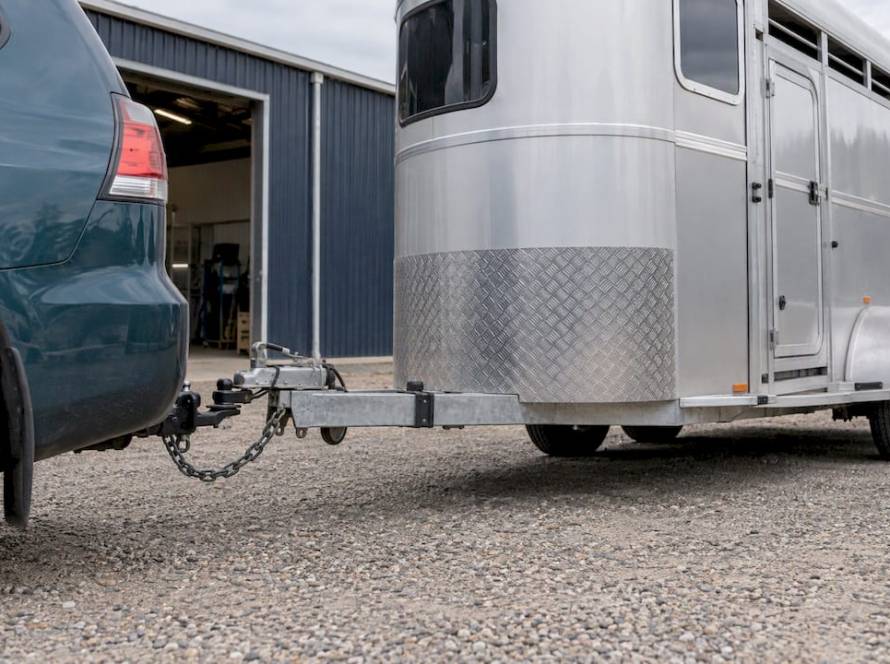
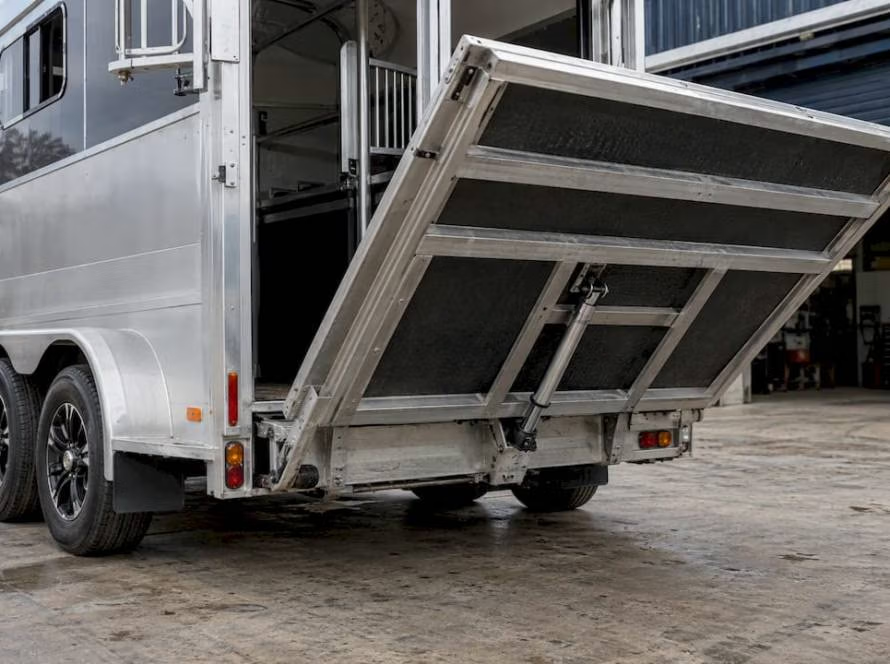
A front ramp horse float has a ramp or door at the front of the float body, so a horse can be walked out forwards instead of backing down the rear ramp. Many Australian owners like that for a nervous horse, a young horse or a horse that dislikes reversing. The layout only works well if the ramp, the flooring, the headroom and the brakes are right. This guide covers what to look at before you buy.
The feature you want is a safe, easy exit for your horse. Where the ramp sits is one way to get it. The rest of the article shows how to judge that, whichever layout you end up with.
What a front ramp float is and how the layout works
Most floats load and unload at the back. You walk the horse up the rear ramp, tie it, and later untie it and either back it out or turn it where space allows. A front ramp, often called a front unload, adds an exit at the front of the float. Horses can step forward and down, facing the direction they are already looking.
In practice, owners use it in three ways:
- Loading at the rear, unloading at the front. The horse walks in as usual and leaves forward, which suits horses that panic at the idea of reversing.
- Emergency exit. A second way out is useful if a horse goes down or gets stuck and the rear is blocked.
- Tight spots. At a crowded event ground or a narrow gateway, a front exit can mean you do not need room behind the float to lower a full rear ramp.
The University of Maryland Extension explains that most horse trailers allow rear loading, some larger trailers allow side-ramp loading only, and some small trailers have both rear and side ramps so horses can unload from the side rather than back off. The same page notes that side-ramp trailers usually cost more than rear-load trailers. The principle is the same for a front exit: an extra door and ramp is more engineering, so it adds to the price and to the number of parts you need to look after.
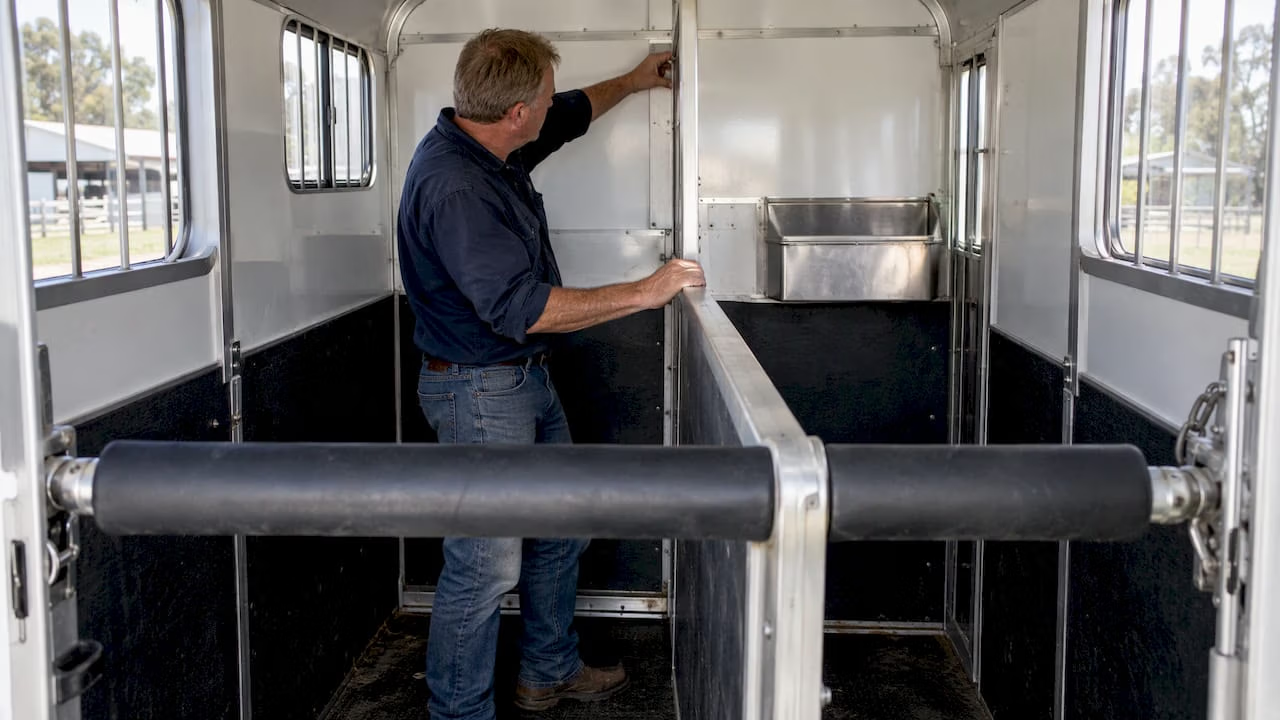
A front exit also changes the interior. The ramp and its frame need room at the front of the float. That can shape the size of the feed manger or front chest bar, the placement of a window or hay bag, and how the partition meets the front wall. If you are comparing floats, ask to see the front end with the ramp closed and open, not only the rear.
Front ramp, rear ramp or side exit: how they compare
No single layout is best for every owner. These are the practical differences.
| Feature | Rear ramp only | Front ramp (front unload) | Side ramp |
|---|---|---|---|
| Loading | Walk the horse up the back | Usually still at the back | Depends on the float |
| Unloading | Back out, or turn if there is room | Walk out forwards | Walk out sideways |
| Space needed | Clear space behind the float | Clear space in front of the float | Clear space beside the float |
| Moving parts | Fewer | Extra door, ramp and hinges | Extra door, ramp and hinges |
| Typical cost | Usually lower | Usually higher | Usually higher |
The University of Maryland page also says there is very little research showing that straight load or slant load is the safer choice, and it points out that in a slant load a handler can end up trapped between the horse and the exit while loading and tying. So the layout of the horse’s stall matters as much as the ramp location. Think about where you will stand when you tie up, and how you will get out if the horse moves.
If your horse already loads and backs out calmly, a good rear ramp may be all you need. If your horse is anxious, or you travel to venues with awkward access, a second exit at the front is worth pricing up.
Straight load or angle load with a front ramp
A straight load float has the horses facing forward in line with the towing vehicle. An angle load, also called a slant load, positions them diagonally. The front exit can be paired with either, but the stall width and the way the partition swings change how easily a horse can walk forward. Before you decide, picture your own horse in the float: how long is it, how wide through the shoulder, and does it travel straight or tend to lean?
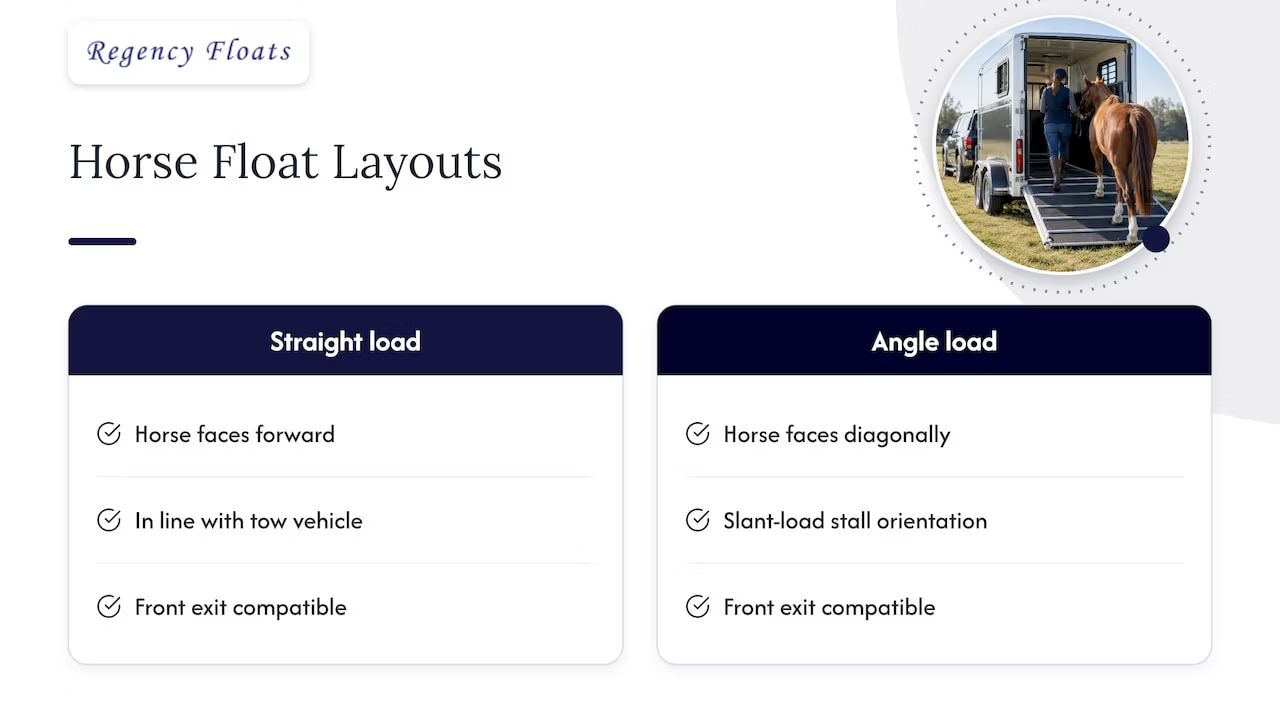
Our 2 horse float range is a good place to compare angle-load and straight-load layouts side by side.
Ramp safety: what to check before you load
The ramp is where most loading injuries start, so look at it closely on any float you consider, new or pre-owned.
Surface and angle
Agriculture Victoria advises smooth, hazard-free interiors and non-slippery flooring on the float and on loading ramps. Wet weather, a wet horse and wet shoes make a poor surface very slippery. A shallow ramp angle is easier on a horse’s confidence than a steep one, and a longer ramp gives a shallower angle. Check the ramp surface by hand and by foot, and check it again when it is wet if you can.
A front ramp is often shorter than the rear one because of the way it fits the float body, so look carefully at its angle. If it is steep, the horse will step down in a more abrupt way. Ask how the manufacturer has dealt with that, for example through ramp length, surface or foot battens.
Edges, latches and hardware
A horse can catch a lead rope or headcollar on any protruding catch. Agriculture Victoria says the interior of the vehicle should be free of obstructions that can cause injury, such as protruding nails and clips. When you inspect a float, run your hand along the inside of the doors and ramp frame and look for exposed bolts, sharp edges and hooks. Latches should be recessed or guarded, and they should open and close without force.
Untie before you lower
One rule applies to any exit: Agriculture Victoria recommends untying horses before lowering the ramp. With a front ramp, make that your routine at both ends. Untie, check the way is clear, then lower the ramp slowly and keep your body out of the swing of the door or ramp.
If you are handling a heavy ramp, a counterbalance or hydraulic assist makes it easier to control. We explain how that works in our guide to a hydraulic ramp horse float.
Headroom at the doorway
Horses lower their heads and lift them again as they step. A low lintel above a front or rear opening can strike a horse’s poll. Good Horsemanship warns that an entrance lip can reduce effective headroom, so measure at the doorway as well as inside. Hold a tape against the lowest point, not only at the roof.
Size and interior layout for your horse
A front exit does not change the size rules. Your horse needs room to stand in a natural position, and Agriculture Victoria says that means adequate head room and enough space between horses for air circulation.
On height, Good Horsemanship reports that interior height in Australia can range from 1.93 m to 2.18 m. It recommends at least 2.23 m for horses over 15 hh, with another 100 mm for each additional 100 mm of horse height. Here is how that works out for some typical horses, using the figures in that guide:
| Horse height | Suggested minimum interior height |
|---|---|
| Up to 15 hh (1.52 m) | Check the float’s rating against your horse’s head carriage |
| Over 15 hh | At least 2.23 m |
| 100 mm taller than that | 2.33 m |
| 200 mm taller than that | 2.43 m |
Warmbloods, thoroughbreds and many sport horses sit in the over-15 hh group, so a taller body is worth looking for. Our horse float size guide takes you through length, width and height measurements step by step, and our article on horse float interior design covers partitions, manger layouts and padding.
Carrying one horse or two
Agriculture Victoria gives specific guidance for two-horse floats. When you carry a single horse, tie it on the driver’s side with the centre partition removed, which improves the balance of the vehicle. When you carry two horses, pen the heavier one on the driver’s side. If your float has a front exit, check that the partition can still be fixed or removed easily, and that a horse on the driver’s side can still leave safely.
For several horses, Agriculture Victoria also recommends adjustable partitions. The Stable Guide, summarising the same state guidance, says partitions should be at least 600 mm high and sit at least 600 mm off the floor when you carry more than one horse. Measure the partitions on any float you look at.
Construction, flooring and brakes
The ramp is only as good as the float it is attached to. These are the build points that matter most.
Flooring
Hoofbeats Magazine notes that any float floor should be checked regularly for cracks or rot. The floor takes urine, moisture, manure and the weight of the horse every trip, so it is the part that decides how long a float lasts. We build our floats with a state-of-the-art flooring system and back it with a ten-year warranty. Read the warranty terms for any float you consider, including what it covers and how it is claimed.
Brakes and towing
The same article says floats over 2,000 kg GTM must have brakes on all wheels, operable from the driver’s seat of the towing vehicle. It also advises you to check axle size and to make sure you do not exceed the towing capacity of your vehicle. Loaded weight is what counts, not the empty weight on the brochure. Add the float’s tare mass, two horses, hay, water, tack and gear, then compare the total to the rating on your tow vehicle’s compliance plate and handbook.
Built for Australian distances
Australian trips are long. The Hoofbeats article quotes a float professional who says Australian-made floats are generally built to handle longer distances and harsher road conditions than imports, even though European floats have some good safety features. We combine both: we have more than 40 years of experience manufacturing floats in Australia, with European-style luxury design and advanced safety technology, and that is designed to give long-haul comfort.
If you are buying a pre-owned float
A pre-owned float with a front ramp needs the same checks, with extra attention on wear. The checklist from Yes Approved says buyers should inspect the ramp and doors for condition, alignment and ease of operation. That means the ramp surface, structure, hinges, springs or assist mechanisms, latches, locks and the non-slip surface. Front and rear ramps both need checking for rust, loose hinges and floor rot where the ramp meets the floor.
What does a front ramp horse float cost?
Prices vary widely with size, load type, finish and extras. Floats advertised in Australia for two to four horses are often listed from the high twenties to low thirties in thousands of dollars before extras, and living quarters models cost more. Treat any figure as a starting point and confirm what the price includes: GST, registration, electric brakes and breakaway system, spare wheel, lighting, ramp assist, delivery and any warranty.
We do not publish set prices for our ranges on the website, because the final price depends on the floor plan, colours and fittings you choose. You can look through the range and arrange a quote, and if you are planning your budget, our horse float finance guide explains how owners and professionals fund a purchase.
Choosing your float: a short checklist
Work through these in order:
- Your horse. Height, length, temperament and how it travels. A horse that dislikes backing out is the classic reason to want a front exit.
- Your towing vehicle. Towing capacity, tow ball rating, brake controller and the loaded weight of the float.
- Your usual venues. Do you load in tight gateways, stable yards or open paddocks? Which sides have the room to lower a ramp?
- The ramps. Surface, angle, weight, ease of lifting, latches and hardware.
- The floor. Material, condition, and the length and terms of the warranty.
- The interior. Headroom, partition height and adjustability, ventilation and a clean, smooth finish.
- Accessories. Tie rings, hay nets, lights, cameras and ramp mats. We list the main ones in our horse float accessories list.
If you are still comparing makers, our guide to Australian horse float manufacturers sets out what to look for when you compare them.
Find the right float with us
We are Australian horse float manufacturers with more than 40 years of experience. Our floats are designed around safety, comfort and durability, with European luxury design, advanced safety technology and flooring backed by a ten-year warranty. You can choose colours and fittings to suit your own preferences, whether you ride for fun or compete.

Look through the Regency Floats range for standard, deluxe, camper, gooseneck, straight load and thoroughbred series floats, and tell us about your horse, your vehicle and the way you travel. We will help you match a float and a layout to them.
Frequently asked questions
Is a front ramp safer than a rear ramp?
Not automatically. The University of Maryland Extension says there is very little research showing that one load type is safer than another, and the same is true of exit position. What counts is a non-slip surface, a sensible ramp angle, hazard-free hardware and a handler who can stay clear. For a horse that struggles to back out, a forward exit can make the whole trip calmer.
Do I need to untie my horse before lowering a front ramp?
Yes. Agriculture Victoria recommends untying horses before the ramp is lowered, and this applies to any ramp. Stand to the side, lower the ramp under control and make sure the horse has a clear path before it moves.
How high should the inside of the float be?
Good Horsemanship recommends an interior height of at least 2.23 m for horses over 15 hh, with 100 mm more for each extra 100 mm of horse height. Also measure the doorway, because an entrance lip can reduce the headroom a horse really has. Our size guide has the full measuring steps.
Do floats need brakes on every wheel?
In Australia, according to Hoofbeats Magazine, floats over 2,000 kg GTM must have brakes on all wheels, operable from the driver’s seat of the towing vehicle. Check your float’s rating and your vehicle’s towing capacity, and confirm the details with your state transport authority.