
A drop down window is a hinged window, usually on the side or front of a horse float, that folds outwards and down so you can reach your horse, pass hay or water, and control airflow without opening a door. The best versions pair that hinge with a sliding glass panel, a fly screen and protective bars on the inside. The right choice comes down to three things: how much air your horse needs on the day, how well the bars and latch keep the horse in, and how well the frame stays sealed against rain and dust. If you are choosing a float, you can settle all three at the order stage. Our range of horse floats for sale is built around customisable fittings, so it is the easiest time to get the window setup you want.
This guide explains how drop down windows work, how they differ from other window types, what to look at when you compare them, and how to look after them.
What a drop down window on a horse float actually is
Picture a small hatch hinged along its bottom edge. A latch at the top lets you release it, and the whole window tilts outwards and down until it is held open. Behind the glass, most designs have a sliding panel with a fly screen so that you can open just a gap for air while the hatch stays up. Inside, a set of bars or a mesh guard sits between the opening and your horse’s head.
The design solves a few jobs at once:
- Ventilation. You decide how much air gets in. Fully dropped, you get maximum flow. Slid open with the hatch up, you get a controlled breeze through a screen.
- Access. Many owners use the opening to check on a horse, offer water or swap a hay net while the float is parked, without untying the horse or walking into the stall.
- Light and outlook. A window at a sensible height lets a horse see out. A calmer outlook matters on a long haul.
- Weather control. Shut the hatch and the stall stays dry and draught-free, which is useful in rain, wind or on cold mornings.
The name sometimes confuses people because you will also see “feeder window” and “feed door window”. These describe the same idea: a hatch low and forward enough to reach the horse’s head and feed area.
Drop down, sliding, push-out and fixed: how they compare
Horse float windows come in a handful of styles, and each suits a different position on the float.
| Window type | How it opens | Best for | What to watch |
|---|---|---|---|
| Drop down | Hinges at the bottom and folds outwards | Reaching the horse, maximum airflow, feeding from outside | Needs a secure latch and a holdback so it does not swing in transit |
| Sliding | Glass panel slides sideways in a track | Steady airflow with little protrusion | Tracks collect dust and need cleaning |
| Push-out | Hinged at the top and pushes out like an awning | Rain-shedding ventilation | Limited access to the horse |
| Fixed | Does not open | Light and outlook only | No airflow control |
Many floats combine them: a fixed or sliding window along the stall for light and a drop down window where you need access to the head. A drop down with a sliding panel built in is the most flexible, because it covers the first two rows of the table in one frame.
Why airflow matters more than most owners expect
Ventilation is a welfare issue, not just a comfort one. Pony Club Australia’s January 2026 welfare article on transporting horses draws on the Australian Animal Welfare Standards and Guidelines for land transport. It says windows, roof vents and other airflow openings should work properly and be adjusted to suit the weather and the number of horses on board. It also says poor airflow raises the risk of dehydration, heat stress and respiratory irritation.
In practice that means the window setting is something you change during the day, not something you set once:
- Hot day. Open the windows and use the screens so air moves through the stall. Park in shade and keep stops short.
- Wet or windy day. Close the hatch and keep air moving through a roof vent or a sheltered slider so rain does not blow onto the horse.
- Cold morning. Leave the hatch up and open the slider a little. You keep the draught off the horse and still keep the air fresh.
- Two horses. More horses produce more heat and moisture, so you will usually need more airflow than a single horse on the same day.
A drop down window with a slider gives you every one of these settings in a single fitting, which is why the combination is so popular on Australian floats.
Keeping the horse in and the hazards out
The opening that gives your horse air also gives your horse a way to put its head out. That is why the bars and the latch matter as much as the glass.
Bars and mesh on the inside
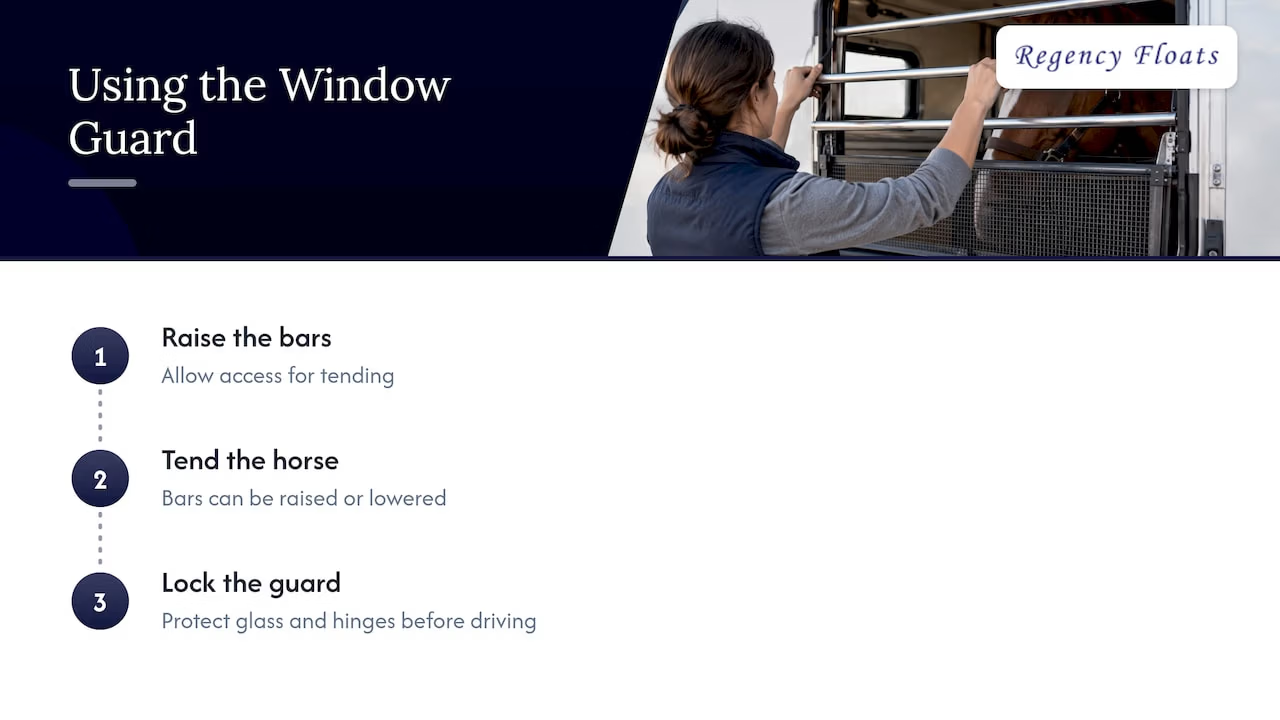
An internal guard of vertical bars, or heavy-duty wire mesh, stops a horse reaching the glass or the hinges. Norm Glenn’s Australian horse float safety guide advises fitting heavy-duty mesh or metal bars inside the window to stop the horse breaking it, and setting the front window so the horse can look out without stooping. Bars that can be raised or lowered let you tend the horse and then lock the guard back in place before you drive.
Screens and unscreened gaps
A fly screen keeps insects and road debris out. It also does a safety job: if a window has no screen and a horse could fit its head through the gap, keep it closed while you are driving. Check the opening size against your horse, especially with a foal, pony or a curious young horse.
Glass, hinges and latches
What to inspect on any drop down window:
- Glass. Toughened or safety glass is the usual standard on float windows. Check for chips or cracks at the corners before every long trip.
- Hinges. They carry the weight of the hatch and any knocks from the horse. Look for movement, rust or loose screws.
- Latch. It should lock positively and be operable from outside. Give it a firm tug after you close it.
- Holdback. When the window is open, it should stay put in the wind and not drop onto a hand or a head.
- Gasket. A soft rubber seal around the edge keeps water and dust out. It is the first part to harden with age.
Treat the window as part of the float’s safety system, alongside the floor, the ramp and the partitions. If you want a closer look at how doors fit into the same picture, our guide to the horse float emergency door explains how to use that exit safely, and the article on storm doors on horse floats covers weather protection at the opening.
Size and position: getting the window where the horse needs it
There is no single standard size. Float windows are cut to suit the panel they sit in, so a window that fits one float may be wrong for another. Think about these points when you compare floats or fittings:
- Height of the sill. The window should sit where your horse can look out comfortably. A window set too low makes a horse stoop, and one set too high gives no outlook. Norm Glenn’s guide links the roof height to this, recommending 2200 to 2250 mm so the front window can sit at a practical height.
- Width and height of the opening. A larger opening gives more air and easier access, but it also means more glass, bigger bars and a heavier hatch.
- Position along the stall. Windows near the head give you access and a view. Windows near the rump give extra air movement through the stall.
- Straight load or angle load. Your layout changes where heads and tails sit, so the best window position changes too.
- Camper and gooseneck floats. These have longer panels and different structures, so window positions are best decided with the floor plan.
Because the choice depends on your layout, it helps to decide on windows as part of the float design rather than as an afterthought. Our straight load range and gooseneck horse floats each suit different transport needs, and window choices follow from those.
Operating windows on the road
A window is only as safe as the routine you use with it. This is a simple pre-trip and in-transit routine:
- Walk the float before loading. Check glass, latches, hinges and screens.
- Set the window for the forecast, not the morning. The temperature at the destination, and at your midday stop, is what counts.
- Lock the bars and latch before you move off. Never travel with a hatch held only by its own weight.
- Check at each stop. Look at the horse’s breathing, sweat and general comfort, and adjust the openings.
- Close up when parked and unattended. A horse that can reach an open window can damage it or hurt itself.
The rules around floats also matter. The WorkSafe Victoria guide on horse stables and track riding safety says floats should be roadworthy, registered with the appropriate authority and regularly maintained for safe operation, and that drivers should be licensed and trained. A damaged window or latch is a maintenance item that belongs on that list. Rules differ by state, so check your own state’s road and workplace safety authority if you transport horses as part of a business.
Maintenance: seals, glass and screens
Most window problems start small. A hardened gasket lets in water. Water lets in rust and rot at the frame. Screens tear, and a slider track clogs with dust.
A simple schedule keeps things sound:
- Every trip: Wipe the glass and track, and check the latch.
- Every few months: Inspect gaskets for cracks, shrinkage or gaps, and look at the frame corners for staining.
- Every year or after a hard season: Re-check hinges, tighten fixings and replace any torn screen.
If you see water marks around a window, treat it as a sealing problem before it becomes a structural one. Our guide on how to reseal a horse float walks through windows, joints and seams. For insects, a fly screen for vents is one of the accessories we stock.
Clean glass also helps you see your horse from the driver’s seat or the tow vehicle mirror. Some owners use ceramic glass coatings on car windows to make rain bead off and cleaning easier. Whatever you use, apply it only to the outer glass, and keep any cleaner away from the rubber seals and the inside of the stall.
Adding or replacing a window versus choosing it at purchase
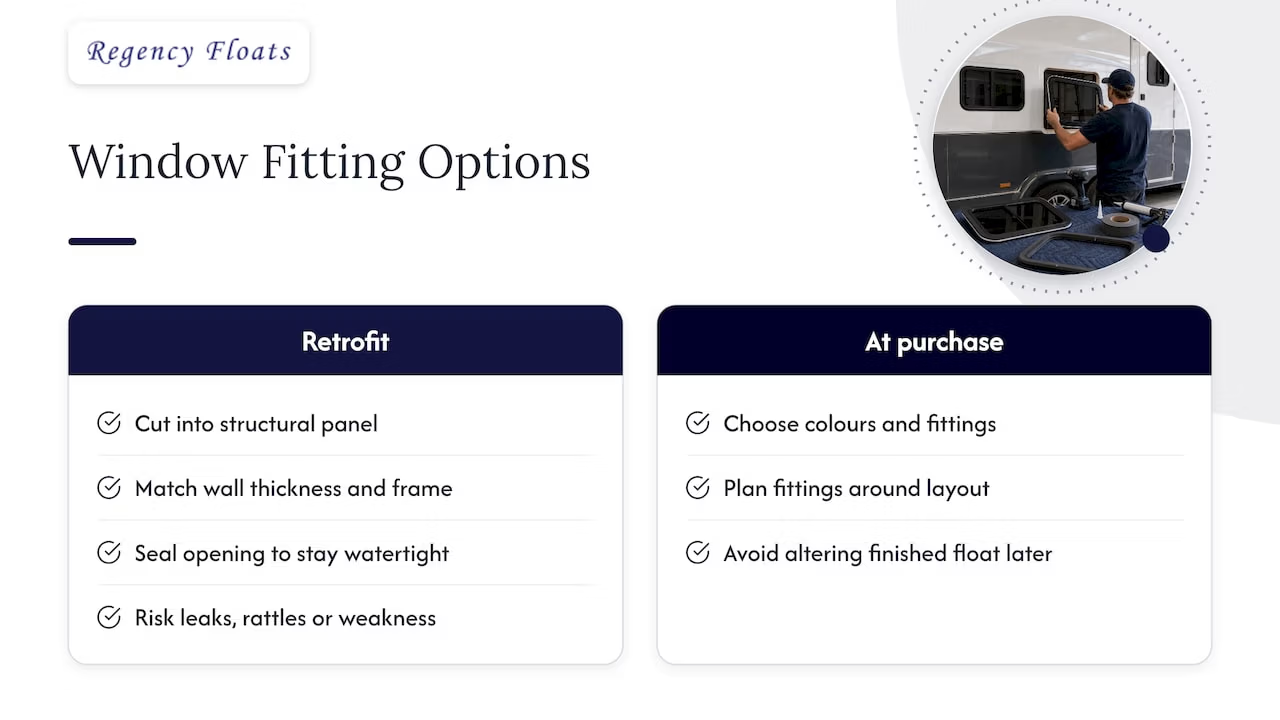
Owners often ask whether they can add a drop down window to a float that does not have one. It is possible on some floats, but it means cutting into a panel that is part of the structure, then sealing and finishing the opening so it stays watertight. The window has to match the wall thickness and frame, and the bars and latch have to hold up to a horse leaning on them. A badly fitted window can leak, rattle or weaken the panel.
That is the practical reason to settle your window setup when you buy. With a customisable float, you choose colours and fittings with your layout in mind, rather than altering a finished float later. We build floats with safety technology, European luxury design and a ten-year warranty on the flooring system, and we have been making floats for over 40 years. If you already own a Regency float and want to change a fitting, contact us first so the change suits that model.
Choosing a float with the windows you want
Here is a short way to decide what you need:
| Your situation | Window setup to look for |
|---|---|
| Short local trips, one horse | A drop down window with a slider and screen at head height, plus a roof vent |
| Long trips in hot weather | Large opening for airflow, screens on every opening, shade planning |
| Two horses, regular competition travel | Windows at each head position and enough airflow for two animals |
| Family float for mixed riders | A simple latch you can operate from outside and a screen that is easy to clean |
| Camper or gooseneck for multi-day trips | Windows chosen with the living area and stall layout together |
When you inspect any float in person, open and close every window, check the bars lock back in place, look at the gasket, and ask about the options for adding screens. Do this with the horse’s height in mind.
Where Regency Floats fits
If you are shopping for a float, the window question is part of a bigger one: how the float protects your horse from the first loading step to the last. Our floats are made in Australia with advanced safety technology, European luxury design and a state-of-the-art flooring system backed by a ten-year warranty. You can choose colours and fittings to suit your horse and your riding. We offer the Standard, Deluxe, Camper, Gooseneck, Straight Load and Thoroughbred Series, and the 2 horse float range for owners with one or two horses.

Tell us how you travel, how many horses you carry and which window layout you want, and we can show you the float that suits. We also carry accessories and parts if you need to maintain or fit out the float you already have.
Frequently asked questions
Are drop down windows safe for horses?
They are safe when the window has internal bars or mesh, a secure latch and a holdback, and when you lock everything before you drive. Keep unscreened windows closed in transit if a horse could fit its head through the opening. Always check the fittings before each trip.
Should I keep the window open or closed while travelling?
It depends on the weather and the number of horses. Pony Club Australia’s welfare article says windows and vents should be adjusted to suit conditions, because poor airflow raises the risk of heat stress and respiratory irritation. On hot days open screened windows, and in rain close the hatch and use a sheltered vent.
How do I stop a drop down window leaking?
Keep the gasket supple and the frame sealed. Inspect them every few months and at the first sign of water marks. Our guide on resealing a horse float shows how to deal with windows, joints and seams before moisture does damage.
What size drop down window do I need?
It depends on the float’s panel, the position of the horse’s head and the roof height. Choose a size that gives good airflow and access but still lets the bars and latch do their job. When you order a float, you can settle the size and position with the layout.
Can I add a drop down window to an existing float?
Sometimes, but it means cutting a structural panel and sealing the new opening well. Fitting it at the build stage is simpler and gives a cleaner result. If you own one of our floats, contact us before making any change.

