For most Australian horse owners, a vehicle with a braked towing capacity suitable for most common 2-horse and 3-horse floats. That figure is your starting point, not your finish line. Before you hitch up, run these three checks:
- Braked tow rating: confirm it from your vehicle’s compliance plate or owner’s manual, not from memory or a dealer’s verbal assurance.
- GVM and GCM: your vehicle’s Gross Vehicle Mass and Gross Combination Mass must not be exceeded once you add passengers, gear, fuel, and the loaded float.
- Towball download: the downward force on the towball counts against your vehicle’s GVM and must stay within both the vehicle manufacturer’s limit and the towbar plate rating.
The KnowMyTow towing calculator cross-checks all four limits simultaneously and flags which one you’re closest to breaching. Run it with your actual numbers before every trip, not just when you buy the vehicle.
Key takeaways
A vehicle with a braked towing capacity suitable for most 2-horse and 3-horse float combinations, although GCM and towball download limits are what actually determine legality once the vehicle is fully loaded.
| Point | Details |
|---|---|
| Target tow rating range | Aim for a braked tow rating appropriate for typical 2-horse and 3-horse floats. |
| Check all four limits | Braked tow rating, GVM, GCM, and towball download must all be within limits — the smallest one is the binding constraint. |
| Loaded ATM varies widely | A 2-horse float typically loads within a usual range; a 3-horse float can reach weights that vary considerably depending on horses and fittings. |
| GCM trap is real | Adding passengers, bull bars, and gear reduces legal towing margin even when the headline tow rating looks sufficient. |
| Regencyfloats spec sheets | Regencyfloats provides ATM, GTM, and towball download figures for every model to support towing calculations before purchase. |
Table of Contents
- How do you calculate what your vehicle can legally tow?
- What are the Australian legal requirements for towing a horse float?
- What does a loaded horse float actually weigh?
- Is your tow vehicle actually up to the job?
- Safe loading and towing practices for horse floats
- Common legal traps and your pre-departure checklist
- Regencyfloats: floats built with towing compliance in mind
- Sources
- FAQ
How do you calculate what your vehicle can legally tow?
Understanding the variables is the only way to know whether your setup is legal. Here is what each term means and where to find it.
| Variable | What it means | Where to find it |
|---|---|---|
| Tare weight | Float weight empty, no horses or gear | Compliance plate on the float |
| ATM (Aggregate Trailer Mass) | Maximum total mass of the loaded float | Compliance plate on the float |
| GTM (Gross Trailer Mass) | Mass on the trailer’s own axles when coupled | Compliance plate on the float |
| Payload | ATM minus tare (horses + tack + water + feed) | Calculate: ATM − tare |
| GVM | Maximum loaded mass of the tow vehicle alone | Vehicle compliance plate |
| GCM | Maximum combined mass of vehicle + loaded trailer | Vehicle owner’s manual or manufacturer spec |
| Towball download | Downward force the float exerts on the towball | Towbar plate; verify by weighing |
| Braked tow rating | Maximum trailer mass the vehicle can legally tow with trailer brakes | Vehicle compliance plate or owner’s manual |
| Towbar/coupling rating | Maximum mass the towbar itself is rated to tow | Towbar compliance plate |
The rule that catches most owners out: your legal towing limit is the smallest of all those figures, not just the headline braked tow rating. KnowMyTow makes this explicit — exceeding any single limit makes the entire setup illegal, regardless of how comfortably you sit under the others.
Worked example: a typical loaded 2-horse float
Assume a straight-load aluminium 2-horse float with a tare of 1,100 kg. You load two 550 kg horses, 80 kg of tack and saddles, and 60 kg of water. Total payload: 1,240 kg. Loaded ATM: approximately 2,340 kg.
Now check the vehicle. Say it’s a dual-cab ute with a 3,500 kg braked tow rating, a GVM of 3,200 kg, a GCM of 6,200 kg, and a towball download limit of 350 kg. The vehicle weighs 2,400 kg with two passengers and a full fuel tank, leaving 800 kg of GVM payload. GCM check: 2,400 kg (vehicle) + 2,340 kg (float) = 4,740 kg, well under 6,200 kg. This setup is legal.
Swap in a 3-horse float at 3,100 kg ATM and the GCM becomes 5,500 kg — still legal, but the margin shrinks fast if you add a bull bar, a toolbox, or a third passenger. That is the GCM trap in practice.
For precise confirmation, weighing a loaded float professionally is the only way to replace estimates with real numbers.
What are the Australian legal requirements for towing a horse float?
Vehicle Standards Bulletin 1 (VSB1) is the primary national standard for trailers up to 4.5 tonnes ATM. It defines horse floats as purpose-designed trailers and sets the mass bands that trigger mandatory equipment. Sections 4.2.6–4.2.7 cover towing component requirements by ATM band, including brakes, breakaway systems, and safety chains.
Brakes and breakaway systems: most horse floats exceed the ATM threshold at which trailer brakes become compulsory in practice. VSB1 specifies that trailers above the relevant mass band must have a breakaway emergency braking system capable of keeping the brakes applied for a defined minimum period if the trailer separates from the tow vehicle. Check the float’s compliance plate and braking configuration after any coupling or electrical changes.
Safety chains: VSB1 references AS 4177.4-2004 for safety chain specifications. The number of chains required (one or two) depends on the ATM band. A float in the 2,000–3,500 kg range typically requires two chains rated to that standard.
State-level rules: Transport WA and the Queensland Government towing guidance both add state-specific requirements around safety certificates, lighting, and registration. Queensland notes that ATM includes horses and tack — not just the empty float — and provides fallback suggested towing figures for older vehicles without a published manufacturer rating. Some states require a safety certificate for trailers in the 751–4,500 kg ATM range before registration.
Pre-departure mandatory checklist:
- Trailer brakes operational and electric brake controller calibrated
- Breakaway switch connected, battery charged, and tested
- Two safety chains fitted and rated to AS 4177.4 for the float’s ATM
- All lights working: brake, indicator, tail, and reverse
- Towbar and towball rated to or above the float’s ATM and towball download
- Float registered and, where required by your state, holding a current safety certificate
Pro Tip: Check your towbar’s compliance plate, not just the vehicle’s tow rating. A towbar fitted to a vehicle with a 3,500 kg tow rating may itself be rated to only 2,500 kg — the lower figure is the legal limit for that setup.

What does a loaded horse float actually weigh?
Float tare weights and loaded ATM figures vary considerably by construction material, size, and fittings. Aluminium builds run lighter than steel; a camper package adds significant mass. These ranges give you a realistic planning baseline.
Per-horse mass is the figure most owners underestimate. A light Thoroughbred might weigh 450 kg; a Warmblood or draught cross can exceed 700 kg. Use the actual weight of your horses, not a breed average. Queensland’s towing guidance explicitly states that ATM includes the horses and all associated gear — a point that catches owners out when they calculate only from the float’s tare.
Water is another overlooked contributor. A full onboard water tank of 100 litres adds 100 kg directly to ATM and shifts towball download forward. Feed, hay, and tack collectively add another 80–200 kg on a typical competition day.
The table above uses conservative midpoint estimates. Actual floats vary, and the only precise check is a weigh-bridge reading with the float loaded as it would be on the road.
Is your tow vehicle actually up to the job?
The headline braked tow rating is the number dealers quote, and it is almost never the binding constraint on its own. What matters is the combination of limits — and whether your vehicle, loaded as it actually travels, still has room for the float.
Specs to confirm before towing:
- Official braked tow rating (from compliance plate or owner’s manual, not the dealer’s brochure)
- Unbraked tow limit (typically 750 kg; relevant only for very light floats)
- GVM and current payload remaining after passengers, fuel, bull bar, toolbox, and gear
- GCM and the combined mass of vehicle plus loaded float
- Towbar and towball plate rating (check the plate physically bolted to the towbar)
- Towbar certification: aftermarket towbars must be certified for the vehicle and the intended tow mass
Many dual-cab utes carry a 3,500 kg braked tow rating, which looks adequate for most 2-horse floats. The problem appears when you add two adults, a full fuel tank, a bull bar, a canopy, and a toolbox. That combination can consume 500–700 kg of GVM payload before the float is even hitched. Analysis from towing specialists confirms this is one of the most common ways owners unknowingly breach their legal limits.
A GVM upgrade increases the vehicle’s payload but does not automatically raise GCM. Owners who upgrade GVM to carry more gear can still be limited by the original GCM when towing a heavy float. Check both figures independently.
If your vehicle consistently sits close to its GCM with a 2-horse float, a 3-horse float is likely out of reach without a heavier vehicle or a professional towing assessment. Consult a licensed vehicle modifier or your state transport authority before relying on an upgrade to solve a GCM shortfall.
Safe loading and towing practices for horse floats
Getting the weight right on paper is half the job. The other half is how you load and drive.
After loading, re-check towball download with a towball scale or by using a weigh-bridge. A shift of one horse from front to rear can move towball download by 50–100 kg, which can push a vehicle over its GVM limit.

Tyre and wheel checks: confirm float tyre pressures match the manufacturer’s specification for the loaded ATM, not the empty tare. Under-inflated tyres on a loaded float generate heat and increase blowout risk. Check the horse float tyre pressure guide for model-specific recommendations.
Hitch and chain security: couple the towball fully and confirm the locking mechanism is engaged before attaching chains. Cross the chains under the coupling so they catch the drawbar if it separates. Test the breakaway switch activation manually before each trip.
Driving adjustments: reduce speed on unsealed roads and in crosswinds. A loaded float raises the combination’s centre of gravity and increases stopping distance significantly. On steep descents, use engine braking and the trailer brake controller rather than relying on the vehicle’s brakes alone. If the combination feels unstable in the first few kilometres, pull over safely and recheck load distribution and tyre pressures before continuing.
Professional weighing: a commercial weigh service can measure loaded ATM, towball download, and individual axle loads in one session. Ask them to weigh the float as it sits for a typical trip, horses included. Many services charge a fixed fee and issue a written record you can keep with the float’s compliance documents.
Common legal traps and your pre-departure checklist
The GCM trap is the most common legal problem horse owners encounter, and it rarely announces itself. A vehicle that legally tows a 2-horse float when driven solo can become non-compliant the moment a second passenger, a full hay load, and a water tank are added. Towing specialists note that many owners compare only the headline tow rating to the float’s ATM and never run the GCM calculation.
Other recurring errors:
- Assuming the vehicle’s braked tow rating applies regardless of how the vehicle is loaded
- Ignoring towball download entirely, then failing a roadside check when the vehicle is over GVM
- Using a towbar rated below the float’s ATM because it was already fitted to the vehicle
- Misreading the float’s compliance plate and using tare weight instead of ATM for calculations
Pre-departure checklist:
- Float compliance plate: confirm ATM and GTM
- Towbar compliance plate: confirm tow rating meets or exceeds float ATM
- Vehicle GVM: subtract current vehicle load (passengers, fuel, gear) and confirm payload remains
- GCM: add loaded vehicle mass plus loaded float ATM and confirm it is under GCM
- Towball download: within vehicle manufacturer’s limit and towbar plate rating
- Trailer brakes: electric brake controller set and tested
- Breakaway system: connected, battery charged, tested
- Safety chains: fitted, rated to AS 4177.4, crossed under coupling
- Lights: brake, indicator, tail, and reverse all operational
- Tyre pressures: float and vehicle checked at loaded ATM
If any figure is uncertain, weigh the float loaded before departure. Enforcement officers can weigh vehicles at roadside, and an overloaded combination risks fines, licence demerit points, and, more critically, a crash.
Regencyfloats: floats built with towing compliance in mind
Knowing your towing limits is one side of the equation. The other is choosing a float whose tare weight and design actually fit within those limits.
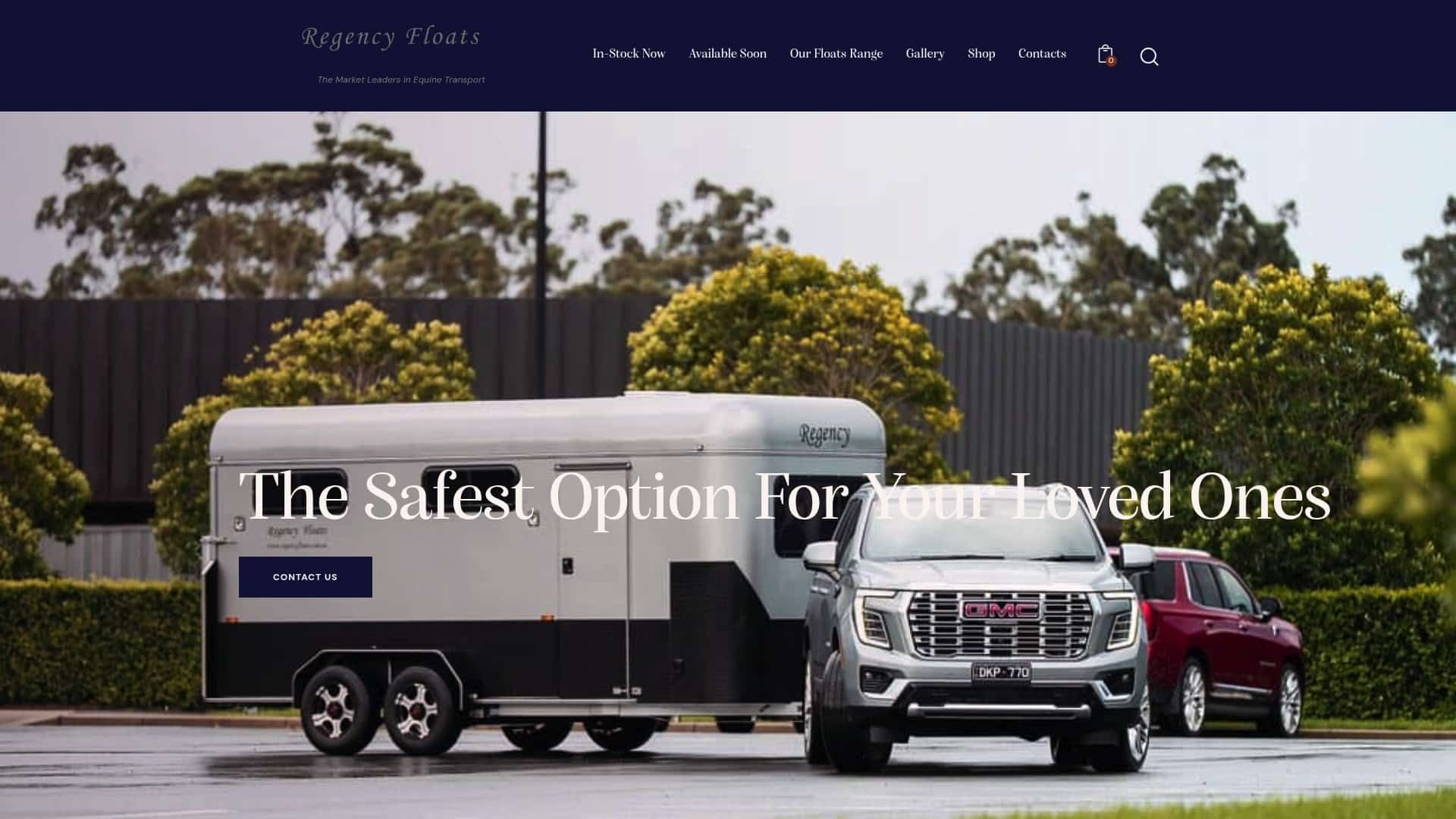
Regencyfloats builds premium aluminium horse floats that are engineered to keep tare weight as low as possible without compromising structural integrity, which directly expands the payload margin available for horses, water, and gear. Every float comes with a full specification sheet listing tare weight, ATM, GTM, and towball download figures, so you can run your towing calculations before you commit to a purchase rather than after.
The range covers 2-horse and 3-horse models, straight and angle load configurations, warmblood sizes, gooseneck designs, and luxury camper builds, each with customisable floor plans and partition layouts that let you optimise weight distribution for your horses and your tow vehicle. Backed by a ten-year flooring warranty and over 20 years of Australian manufacturing experience, Regencyfloats provides the spec documentation and pre-sale guidance you need to match the right float to your vehicle’s actual limits. Browse the current range or contact the team to request a towing specification pack.
Sources
Manufacturer plates and your owner’s manual are the starting point, but Australian regulatory documents and state transport pages fill the gaps that spec sheets leave. VSB1 sets the national baseline for trailer braking, breakaway systems, and safety chain standards. State transport sites add jurisdiction-specific rules on safety certificates, registration, and lighting. A towing calculator ties the numbers together.
- KnowMyTow free Australian tow weight calculator
- Towing, trailers, tilt‑trays and caravans | Transport WA
- Towing vehicles and trailers | Queensland Government
- GVM vs GCM: why your towing capacity might not be what you think
FAQ
Can a HiLux tow a horse float?
A Toyota HiLux with a 3,500 kg braked tow rating can tow most loaded 2-horse floats, but you must confirm the GCM is not exceeded once the vehicle carries passengers, fuel, and gear. Run the numbers through KnowMyTow with your actual vehicle load before hitching up.
What is the best vehicle to tow a horse float?
A heavy-duty dual-cab ute or large SUV with a braked tow rating of at least 3,000–3,500 kg and a high GCM is the practical choice for most 2-horse and 3-horse floats. The GCM figure matters as much as the tow rating, so compare both when selecting a tow vehicle.
Can you tow a horse float without electric brakes?
Only if the float’s ATM falls below the threshold at which trailer brakes are compulsory under VSB1 and your state’s rules. Most horse floats loaded with horses exceed that threshold, making electric brakes and a breakaway system legally required. Check the float’s compliance plate ATM against VSB1 mass bands to confirm.
What vehicles can tow 4,500 kg in Australia?
Heavy-duty trucks, large American-style pickup trucks, and some commercial vehicles are rated to tow 4,500 kg. Most standard dual-cab utes are rated to 3,000–3,500 kg braked. If your 3-horse float with a camper fitout exceeds about 3,100 kg ATM, you likely need a vehicle in the heavy-duty category and should verify GCM with the manufacturer.