
Most horse floats are not built to carry a roof rack, and that should shape your decision before you buy a rack or a roof-mounted tank. A float roof is a light shell over a moving animal. Anything you put up there raises the centre of gravity, adds mass the float’s rating has to absorb and creates a load you are legally responsible for restraining. The better approach is to decide what you need to carry, then choose a float with the storage and fittings designed in from the factory. Our float range is built around that idea, with accessories made to suit each float.
This guide covers what people usually want from a roof rack on a float, the limits and rules that apply in Australia, how to check whether a roof can take a load, and the lower-risk alternatives.
Why owners look at the roof in the first place
Space is the reason. A float with a horse or two, hay, feed, buckets, rugs, saddles, a water supply and a yard setup fills up quickly. A weekend at a competition or a trail-riding camp multiplies the problem. The roof looks like free real estate.
The things owners most often want to put up there are:
- Hay bales or feed bags
- Rugs and bulky bedding
- A water tank, often around 75 litres
- Portable yards, panels or poles
- Tack or storage boxes
- Camping gear for a long weekend away
Each of these has a different weight, a different way of shifting in wind and a different consequence if it comes loose. Water is the heaviest per space used. Hay is light but catches wind and is bulky. Panels are long and can project beyond the float’s body. Treat them separately rather than as “roof stuff”.
How a roof load changes the way a float behaves
Western Australia’s Department of Transport, in its bulletin on roof racks, warns that a roof load raises a vehicle’s centre of gravity and can adversely affect handling and stability (WA Department of Transport, IB-117). That bulletin is written for vehicles, but the physics applies to any tall, narrow body, and a horse float is exactly that.
Now add what is inside. A horse shifts its weight, leans on turns and braces on braking. A float with a high load on top will feel that movement more, because the extra mass sits above the point the float pivots around. Roll-over risk rises with height, not only with weight.
RACV makes the same point for car roofs: exceeding the roof limit can damage the roof, affect handling and braking, increase rollover risk, or void insurance or warranty (RACV). Its example is easy to remember: with a 75 kg roof limit and a 20 kg rack, only 55 kg is left for gear. The rack counts toward the limit. The same arithmetic applies to a float, with one difference: the float’s limit comes from its manufacturer, not from a general rule.
How to check whether a float roof can take a load
There is no universal figure for a horse float roof. Roof construction differs between floats: the material, the framing, the roof height and whether the structure is designed with mounting points. So the check is about the manufacturer’s rating, not a rule of thumb.
Step 1: Find the manufacturer’s maximum roof load
The WA bulletin states that a roof load generally should not exceed 50 kg unless the rack manufacturer has strength-tested that rack type and rated it higher. It also states that the vehicle manufacturer’s maximum roof load must never be exceeded, whatever the rack is rated for (IB-117). Two limits apply at once, and the lower one wins.
For a float, ask the float’s maker in writing what roof load, if any, the roof is rated for and where mounting is allowed. If the answer is none, that is your answer.
Step 2: Count the rack and every accessory
A rack, crossbars, fittings and straps are all part of the load. Weigh the rack itself and subtract it from the rating, as in the RACV example above.
Step 3: Check the mass of the whole float
The federal Vehicle Standards Bulletin 1 defines tare mass as the trailer’s mass with all standard equipment and any options fitted, ready for service, and ATM (aggregate trailer mass) as its total mass at the manufacturer’s maximum recommended load (Department of Infrastructure, VSB 1 Revision 6). Anything you add to the roof comes out of the payload between tare and ATM, alongside the horses, hay and gear inside. Our guide to what a loaded float actually weighs walks through the sums, and the towing capacity guide shows how that total relates to your tow vehicle.
Step 4: Measure the overall height
The same federal bulletin notes that a float’s total height includes protrusions such as a roof-mounted air-conditioner. A rack, a tank or a stack of hay counts the same way. RACV advises measuring total height, including rack and cargo, before setting off and watching for low-clearance structures such as servo canopies, carparks and bridges. RACV also states that the maximum vehicle height in most states is 4.3 metres. Float roofs are far below that, but the clearance problems in practice are at fuel stops, farm gateways and tree limbs along rural roads.
Step 5: Look at the inside of the float
A horse’s head sits high. Norm Glenn’s float safety paper recommends a roof height of 2,200 to 2,250 mm as ideal so the horse’s head does not hit the roof (Norm Glenn, horse float safety). Drilling through a roof for a rack fixing can leave screw tips, bolts or edges inside the float, exactly where a horse’s head and ears are. Glenn’s paper argues floats should be free of protruding objects, sharp edges and gaps where a lead rope, headstall or hoof could catch. A roof fitting that breaks that rule works against the whole purpose of the float.
What the law expects once something is on the roof
A roof load is a load, and Australian road rules treat it as one. The rules sit with each state and territory, so check yours, but the pattern is consistent.
Restraint. Transport Victoria states it is an offence to carry a load that is not properly restrained and could fall from a vehicle or trailer (Transport Victoria). It advises checking the owner’s manual for mass limits, using rated restraint equipment (webbing straps meeting AS/NZS 4380:2001 are more effective than ropes, and chains suit heavy loads) and keeping the load stable, evenly distributed and non-protruding.
Tasmania. Regulations in force from 25 June 2024 require loads on light vehicles and light combinations to meet the National Transport Commission’s Loading Performance Standards and be fastened so they cannot fall, move unnecessarily, or flap or sway dangerously. First offences carry up to 20 penalty units and subsequent offences up to 40 (Tasmanian Legislation Online).
Fines and demerits. RACV states that loose or poorly secured loads can attract fines and demerit points (RACV).
Projections. The WA bulletin sets out limits for loads that stick out. Projection is limited to 1.2 m in front of the headlamps and 1.2 m rearward, and to 150 mm each side, with overall width not exceeding 2.5 m. A projection that is not readily visible needs a conspicuous flag at least 300 mm square, and a red light at the rear extremity at night (IB-117). That is WA guidance for vehicle roof racks, so confirm what applies in your state, but it shows how quickly poles and panels run into trouble.
Width. The federal bulletin sets a maximum trailer width of 2,500 mm, including side-mounted racks and awnings. A side-mounted fitting counts toward your width.
The WA bulletin also asks that racks be structurally sound, adequately secured and designed for their intended load, with no sharp corners or jagged edges, and that they do not obstruct the driver’s vision or lamps. It prefers aluminium tubing over steel because it is lighter and more ductile.

How to secure anything that does go on top
If you carry something light on a rated mounting point, restraint is where most failures happen. The sources above point to the same routine:
- Use rated restraints. Webbing straps or ratchet straps meeting the Australian standard, not rope or bungee cords. Chains for heavy items.
- Spread the load. Keep it centred, low and stable, and avoid anything that overhangs.
- Cover or bag loose items. Hay and rugs act like sails. A load that flaps or sways is itself an offence under Tasmania’s rules.
- Follow the load restraint guide. The WA bulletin requires roof-rack loads to be secured in line with the NTC Load Restraint Guide.
- Re-check after the first few kilometres. Transport Victoria advises driving carefully and regularly checking restraints once loaded.
- Know what to do if something falls. Transport Victoria advises calling 13 11 70 if a fallen load is too unsafe to pick up, or to report a road hazard.
Never put a wheelbarrow, trolley or similar on the front or rear as a projection: the WA bulletin prohibits it as a dangerous projection.
Better places than the roof for the things you carry
Most of what owners want on the roof has a safer, lower home on a purpose-built float.
| What you want to carry | Roof-mounted approach | Lower-risk approach |
|---|---|---|
| Saddles and bridles | Roof box (adds height) | Swing-out tack box with a saddle rack inside the float’s tack area |
| Rugs | Strapped in a bag on a rack | A dedicated top rug rack fixed to the float |
| Hay | Bales on the roof | Inside storage or the front compartment, kept dry |
| Water | Roof tank, high and heavy | Low-mounted storage so weight stays near the axle |
| Yards and panels | Long poles overhanging | Yard mounting bars fitted to the float |
Water deserves the most thought. At around 75 litres a tank adds 75 kg of water alone, before the tank, brackets and plumbing. That is above the 50 kg figure the WA bulletin gives as a general ceiling for a vehicle roof load, and it sits at the highest point of the float. Weight carried low behaves far better than weight carried high.
Tack and rugs
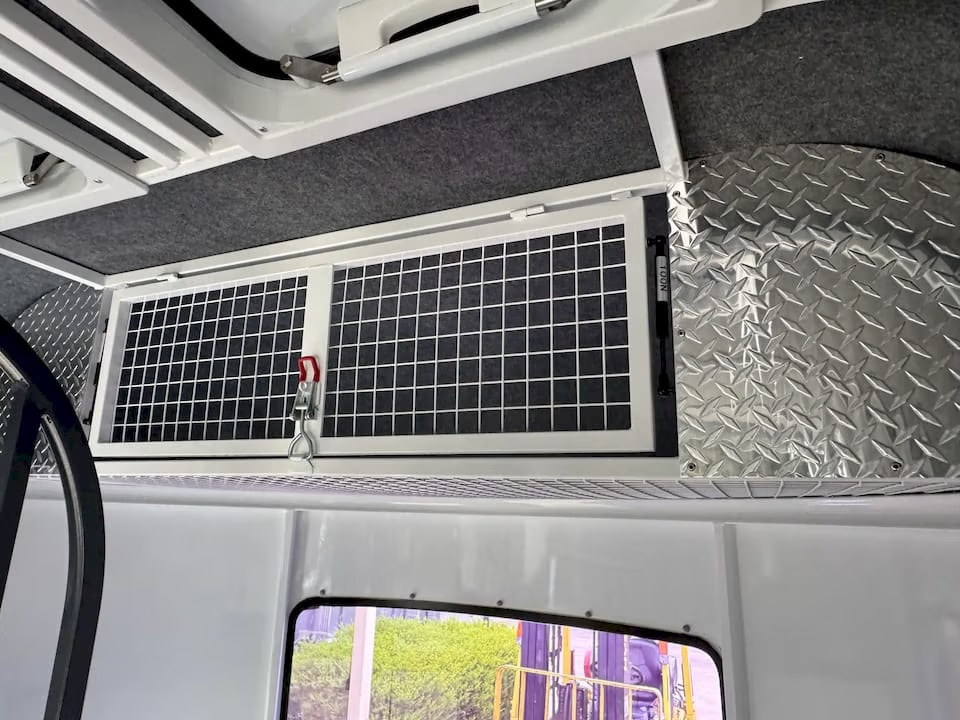
Two accessories of ours cover the most common reasons people reach for a roof rack. The saddle rack for a swing-out tack box keeps saddles off the floor and inside the float’s own storage, and the top rug rack gives rugs a fixed place so they are not strapped to the roof in a bag.
Portable yards
If the roof was going to carry yard panels, the horse yard mounting bars (retrofit) are a more stable alternative: the load is fixed to the float’s structure rather than strapped on top, and it stays inside your width limit when the bars are fitted correctly.
For the wider picture of what is available, our complete horse float accessories list sorts fittings by what they do, so you can plan your storage before you order.
Choose the storage before you choose the float
Retrofitting a roof rack is the harder path because every decision, from drill points to load rating, has to be made after the float is built. Ordering the layout you need from the start is simpler. Regency Floats offers customisable floor plans, colours and fittings, so a family that carries a lot of gear and a competition rider who needs space for tack can each specify a float around their load.
The length and layout of the float matter here too. A larger float gives you more storage inside, but it also raises the towing demand. Our horse float size guide covers dimensions and what each size means for how you tow, and the towing capacity guide shows how to calculate what your vehicle can legally pull once the float is loaded.
Our floats are made in Australia with advanced safety technology, European luxury design and a flooring system backed by a ten-year warranty, after more than 40 years of manufacturing. For a roof or storage question specific to a model, the sensible step is to tell us what you carry and let us show you how a float in the range handles it.
Seeing the range
If you are comparing floats partly on storage, start with the range that suits how you travel. The Standard, Deluxe, Camper, Gooseneck, Straight Load and Thoroughbred Series ranges cover everything from casual weekends to competition, and the 2 horse float range is the place to look if you are weighing a compact setup that is easier to tow.

Bring your list of what you carry, and we will help you match it to a float with the storage you need and the fittings to suit it.
A pre-departure check for any float with extra load
Whether or not anything sits on the roof, run this before you leave. Our pre-departure checklist and legal traps goes into more depth.
- Total weight is within the float’s ATM and your vehicle’s towing capacity.
- Every item outside the float is on a rated fixing and restrained with rated straps.
- Nothing projects beyond the float’s width or length, and the overall width stays within 2,500 mm.
- You know the float’s full height, including anything on top.
- Nothing inside the float can catch a lead rope, headstall or hoof.
- Restraints are re-checked after the first stretch of driving.
FAQ
Can you put a roof rack on a horse float?
Only if the float’s manufacturer says the roof is rated for it and where the mounting points are. Most float roofs are not designed as load-bearing structures, and a roof load raises the centre of gravity. Ask the maker for the rated roof load in writing before buying a rack.
How much weight can a horse float roof carry?
There is no standard figure. The WA Department of Transport says a vehicle roof load generally should not exceed 50 kg unless the rack has been strength-tested and rated higher, and the vehicle maker’s limit is never to be exceeded. For a float, the manufacturer’s rating is the number that counts, and the rack’s own weight is part of it.
Is it legal to carry hay or gear on the roof of a float?
It is legal when the load is properly restrained, stable and not projecting dangerously, and loads that fall can lead to fines and demerit points. Rules differ by state, so check your own transport authority. The safer habit is to carry hay and gear inside or in fixed storage.
What is the safest way to carry saddles and rugs?
In fixed storage on the float, such as a swing-out tack box with a saddle rack and a top rug rack. They keep weight low, inside your width and out of the wind, and they do not need straps on the roof.

