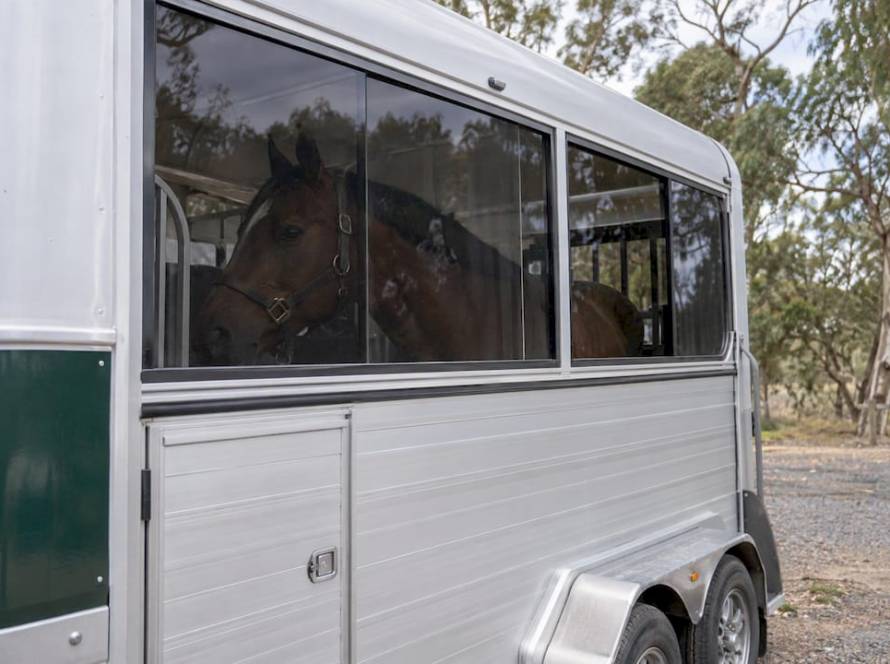
A tapered front horse float is one whose front end narrows towards the nose, instead of finishing in a flat, square wall. The shape changes how the front of the float looks, how the weight sits ahead of the axle and how much room you have for a tack area. It does not decide whether the float is safe for your horse. That comes down to bay size, height, flooring, ventilation, brakes and a tow vehicle that can genuinely handle the loaded weight. This guide explains the layout in plain terms, then walks through the checks that matter before you buy. If you would rather talk a layout through with a manufacturer, our float range is built in Australia with a ten-year warranty on the flooring system.
What a tapered front actually means
Picture the float from above. A square-front float has a straight front wall running across the full width of the body. A tapered front pulls the two side walls inward as they approach the nose, so the front wall is narrower than the bays behind it. Many floats with this shape are angle loads, where the horses stand on a slight diagonal. Others are straight loads with a shaped nose.
The terms are used loosely between sellers, so ask for the inside measurements rather than relying on the name. Three numbers describe how the layout will work for your horse:
- Bay length: the distance from the breast bar to the rear bar or tailgate, measured along the floor where the horse stands.
- Bay width: the room at shoulder and hip height, not just at floor level.
- Internal height: measured from the floor to the roof at the point where the horse’s poll sits.
A tapered nose can shorten the usable length in the front corners of the bay. If the float is an angle load, the diagonal stance can make up for some of that. Either way, you want to see a horse of your horse’s size standing in the bay, or take the numbers to the float with a tape measure.
Why the front shape matters to buyers
The front of the float is where most of the practical choices sit: the tack area, the storage, the window, the weight over the hitch. A tapered nose can be a good fit when you want a smooth, streamlined look and a roomy rear section. A square front is often chosen because it gives a flat wall for a full-width tack room or a camper layout. Neither is right for everyone. The right one is the one that matches your horses, your tow vehicle and the trips you actually make.
Before you compare shapes, settle three questions:
- How many horses do you carry, and how tall are they?
- What do you need to carry besides horses: saddles, feed, water, rugs, a second set of gear for competition?
- What does your tow vehicle’s compliance plate and manual say it can tow?
Those answers narrow the field faster than the shape of the nose.
Angle load or straight load: how the layout changes space
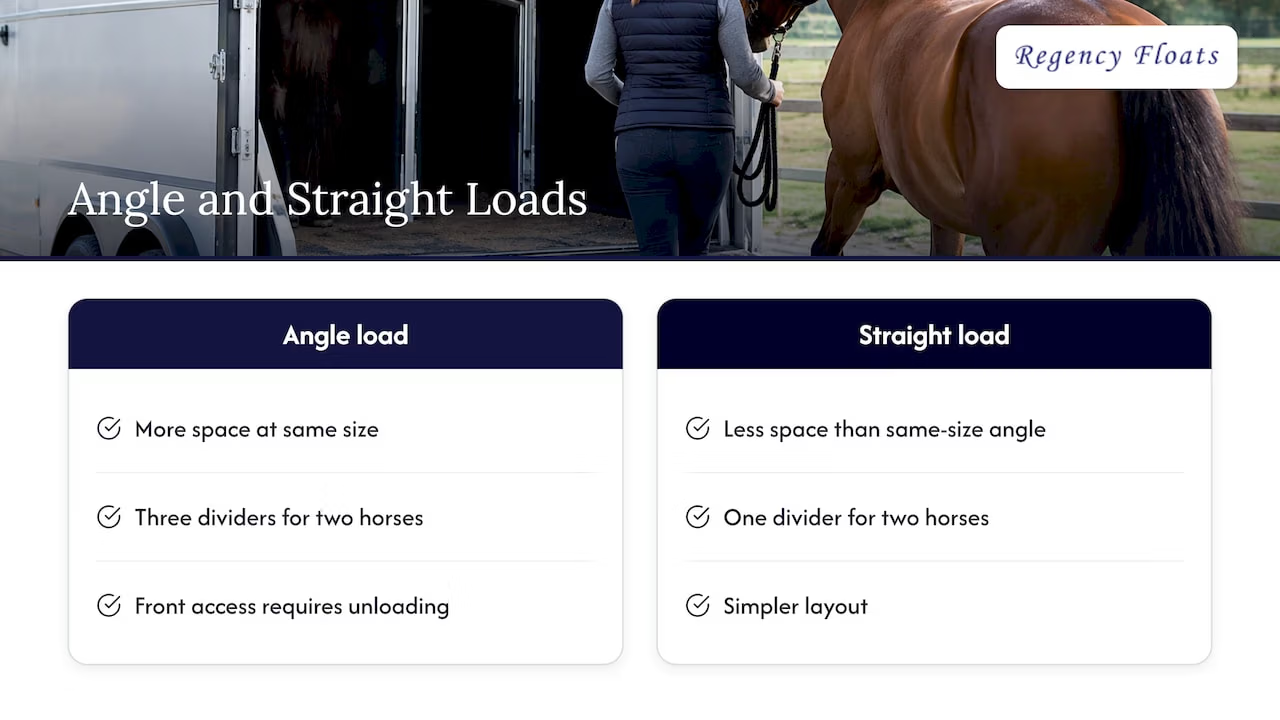
Angle loading is the most common reason people ask about tapered fronts, so it helps to know what it changes. Hoofbeats Magazine reports that an angled float gives more internal space than a straight float of the same size because of the way the bays sit, which is handy if you want to add a rug rack or storage. The same article notes that an angle float costs more to build, since a two-horse angle float needs three dividers where a straight float needs one.
It also describes the loading trade-offs. In an angle load, the horses have to be unloaded to reach the one at the front unless the float has a front unload ramp, which is not common on Australian floats. Some owners find an angle entry more inviting, because the horse walks into the full width of the tailgate with no divider in the way. Others prefer the straight load for its simplicity. There is no single answer, and your horse’s habits matter more than a rule.
MC Equestrian makes the same point: some horses prefer angle loading because they feel they have more room, some travel better beside a companion and others travel better alone. Practise loading before an outing to see what suits yours.
Big horses and bay length
Australian floats are limited in overall width, which caps how much diagonal you can give a bay. Good Horsemanship explains that for taller horses, the bay length on an angle layout can end up too short for comfortable clearance at the nose and the rump. Lengthening the bays can mean a float that carries one horse fewer than the label suggests. If you ride a tall warmblood or a Thoroughbred, ask the seller for bay length and height figures, then measure your horse from chest to rump and from the ground to the top of the poll.
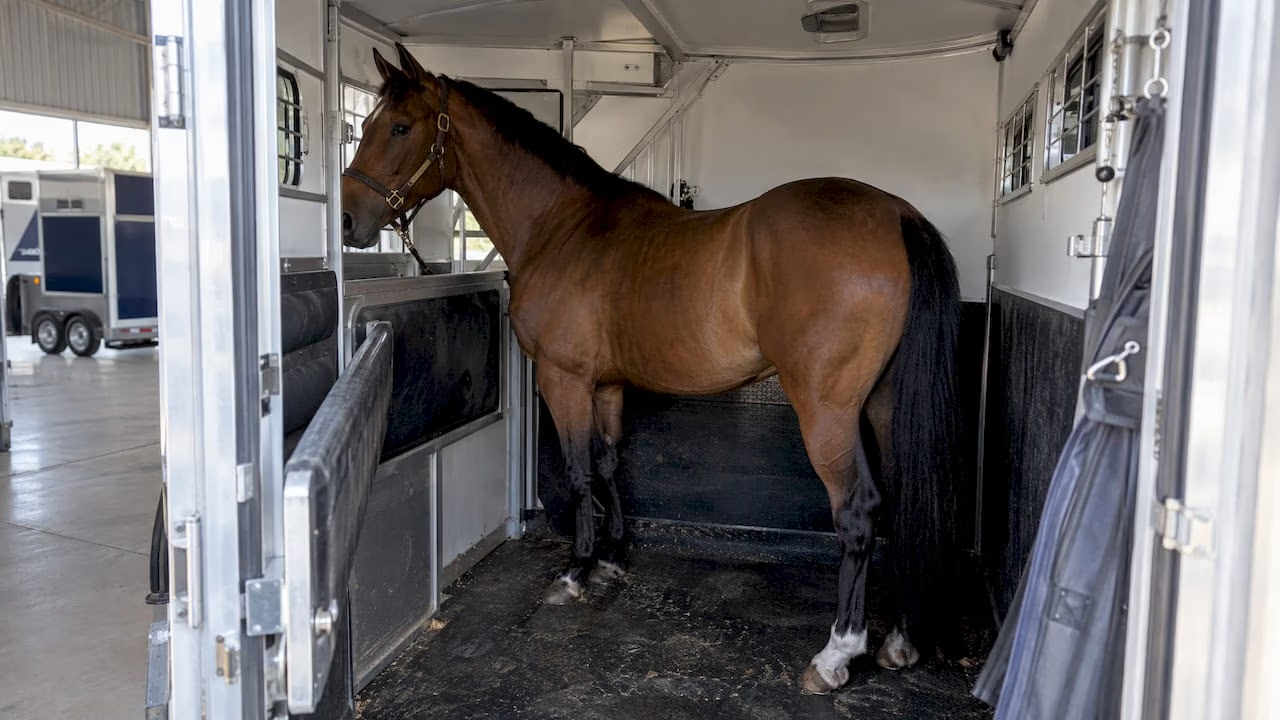
As a guide on height, Good Horsemanship recommends more than the common minimum for horses above about 15 hh. Norm Glenn’s float safety paper frames roof height as a welfare matter: a taller roof gives a horse a feeling of space and lowers the chance of a knock on the head. If you travel big horses, a taller interior is worth asking for at the order stage.
Our Thoroughbred Series and other ranges include floors and layouts that can be customised, so the bay sizes can be matched to the horses you carry. For more on how the inside is arranged, see our guide to horse float interior design.
Storage and the tack area
The front of any float is prime real estate. On a tapered-front float, the narrowing walls can limit the width of a front tack room, while a rug rack or a mounted saddle rack can still fit above the horse’s head line or along the side walls. Think through what you carry:
- Saddles and bridles for each horse
- Rugs, boots and grooming kit
- A hay net or feed bag
- Water containers
- Wet-weather gear and a first aid kit
Storage you add is weight you tow. A full tack room, water drums and feed can add up fast, which is why you should size the tow vehicle for the loaded float and not the empty one. Our horse float accessories list is a handy way to plan what goes in and what stays at home.
Safety features to check on any float
Whatever the shape of the nose, the same safety features apply. The Pony Club Australia welfare guidance says the Australian Animal Welfare Standards and Guidelines for land transport expect vehicles to be designed and maintained to limit injury and stress. That includes solid flooring with good grip, smooth internal surfaces without sharp edges, secure partitions and padding, doors and latches that close properly and a sound structure free from corrosion.
Walk through the float with that list in hand, and add these checks from Good Horsemanship and Hoofbeats:
- Protruding parts and sharp edges. Run your hand along the inside walls, around the dividers and near the door frames.
- Tie-up rings. They should be strong and flush with the wall.
- Door handles and latches. Recessed ones are less likely to snag a horse or a rug.
- Access doors. You should be able to reach each horse without stepping into the bay.
- Brakes. Electric brakes on all four wheels, with a separate manual control and a good-quality controller.
- Ventilation. Good airflow matters in Australian heat. Good Horsemanship recommends open rear or slatted sides plus a front roof vent.
- Chest bars. Hoofbeats advises bars that are adjustable in height, held by a true quick-release catch and preferably padded. A bar set too low can let a horse climb over, and one set too high can let a smaller horse slip under it.
On a tapered-front float, also look at how the front corners are finished, because that is where the walls come together and where a padded, smooth surface matters.
Flooring and the emergency exit
The floor takes the most abuse in a float. Look for a solid, grippy surface, and look under the mats if you are buying second-hand. The flooring in our floats is a state-of-the-art system backed by a ten-year warranty. If you want to understand how a horse gets out in a hurry, read our guide to the horse float emergency door.
Towing: the part that decides what you can buy
The float’s shape matters less than its weight. A float you cannot tow safely is the wrong float, however good it looks.
Know the compliance plate
Weigh My Ride explains the terms you will see on the plate:
| Term | What it means |
|---|---|
| Tare | The empty weight of the float |
| ATM | The most the float and its load can weigh when detached |
| GTM | The most weight the float’s axles can carry when attached |
| Tow ball mass | The downward weight on the tow vehicle’s ball |
| GVM | The maximum fully loaded weight of a vehicle |
Subtract tare from ATM to find your legal payload, then remember that horses, tack, feed and water all come out of that figure. Our guides on horse float weight and what a loaded float actually weighs take you through a worked example.
The tow vehicle rule
For vehicles up to 4.5 tonne GVM, Horses and People explains that the loaded trailer mass must not exceed the lowest of the towbar or coupling rating, the vehicle’s maximum towing capacity and the trailer’s own maximum carrying capacity. The same guide sets out typical braking requirements by loaded weight: no brakes up to 750 kg, brakes on both wheels of at least one axle from 751 to 2,000 kg, and brakes on all wheels plus an automatic breakaway system from 2,001 to 4,500 kg. Safety chain rules also vary by weight. Rules are set by each state and territory, so confirm them with your local transport authority before you buy.
Pony Club Australia adds a pre-trip checklist: towing capacity, tow bar rating, correct tow ball size, a locked coupling, safety chains attached and a working breakaway system. The Horse Sports Association also tells owners to check that the float is registered and that its lights work.
For a deeper look at whether your vehicle is up to the job, see our towing capacity guide and the section on common legal traps and a pre-departure checklist.
Pull-along or gooseneck
Hoofbeats says a traditional pull-along float is usually a good choice for three horses or fewer, while a gooseneck suits larger loads because it hitches closer to the tow vehicle’s centre of gravity, giving more stability and less sway. If you carry more horses or travel long distances, look at our gooseneck horse floats.
New trailers and compliance
If you are buying a new float, note that the Queensland Government states that from 1 July 2023 all new trailers must fully comply with the relevant Australian Design Rules. The same page says the driver is legally responsible for towing safety, and that the trailer must be roadworthy and registered. Other states have their own registration and inspection rules, so check yours.
How to decide if a tapered front suits you
Work through this in order:
- Measure your horses. Take chest-to-rump length and the height to the top of the poll, and compare them with the float’s inside bay length and height.
- Pick your load type. Decide between angle and straight load, based on how your horse loads and who handles unloading.
- Check the tow vehicle. Read its manual and plate. Work out the loaded float weight, with horses, water, feed and gear.
- Plan your storage. List what must travel with you, then check the front tack space and rug racks can hold it.
- Walk the float. Look for sharp edges, flush tie rings, adjustable chest bars, ventilation and access doors.
- Practise loading. Take your horse for a trial, and see how it behaves in the bay.
Looking after the float once you own it
Cavalletti suggests a visual inspection at least monthly of lights, brake fluid, the underside and suspension, tyres, the flooring beneath the matting, latches and any sharp objects. It also recommends an annual service covering wiring and lights, brake checks and adjustment, bearing inspection or repacking, and lubrication of the hitch and jockey wheel.
On the trip itself, MC Equestrian advises tying horses so they can lower their heads below the chest, avoiding feeding inside the float where you can, and never floating a sweaty, tired or unwell horse.
Choosing a float built for your horses
The best float is the one that fits your horses, your vehicle and your trips. At Regency Floats we have more than 40 years of experience building horse floats in Australia, with European-inspired design, advanced safety technology and floor plans and fittings you can customise. We make standard, deluxe, camper, gooseneck, straight load and Thoroughbred Series floats, plus a dedicated 2 horse float range.

If you are ready to compare layouts, start with our full float range, or read our guide on how to choose the right float for you and your horse. We also have display locations and can talk you through the options for Perth, Brisbane and Tasmania, so see our pages for Perth, Brisbane and Tasmania.
FAQ
Is a tapered front float better than a square front?
Neither is better in every case. A tapered nose suits owners who like a streamlined shape and a roomy rear, while a square front gives a flat wall for a full-width tack room or camper layout. Choose on bay size, storage and towing weight, then confirm the dimensions suit your horse.
Will my tall horse fit in a tapered front angle float?
It depends on the bay length and height, not the nose shape. Good Horsemanship notes that bay length on an angle layout can be too short for taller horses. Measure your horse, and ask for the inside dimensions before you decide.
Do I need a front unload ramp?
In an angle load, you usually unload the horses at the rear, which means the horse at the front comes out last unless the float has a front unload ramp. Hoofbeats notes these ramps are not common on Australian floats. Think about how you will handle an emergency exit, and read our guide to the horse float emergency door.
What should I check about towing before I buy?
Check the compliance plate for tare, ATM and GTM, then compare the loaded weight with your vehicle’s towing capacity and the towbar rating. Confirm the braking and breakaway requirements for your float’s weight with your state transport authority.
How often should I service my float?
Cavalletti recommends a visual check at least monthly and a full service each year, covering wiring, brakes, bearings and the hitch. Check the float before each trip as well.