A balanced horse float puts roughly 10% of its loaded weight on the tow ball, keeps the heaviest horse over or just ahead of the axles, and stays within every rating on the compliance plate. Get those three things right and the float tows straight, brakes predictably and rides easier for the horse. Get them wrong and the rig can sway, lose steering grip or overload the tow vehicle’s rear end. Our floats are built with advanced safety technology and customisable floor plans, so you can match the layout to the horses you carry. This guide covers the loading side: the numbers, the positions and a routine you can run before every trip.
Why weight distribution matters more with horses
A float with two horses aboard can put well over two tonnes behind your vehicle, and one Australian guide puts it at up to 2+ tonnes of weight that moves every time the horses shift. Unlike a box trailer, your load is alive. It leans into corners, steps back under braking and changes position mid-trip.
That is why placement matters twice. The static balance (how the weight sits when you hitch up) decides how the rig steers and brakes. The dynamic balance (how the horses stand and move) decides how stable it feels when something goes wrong.
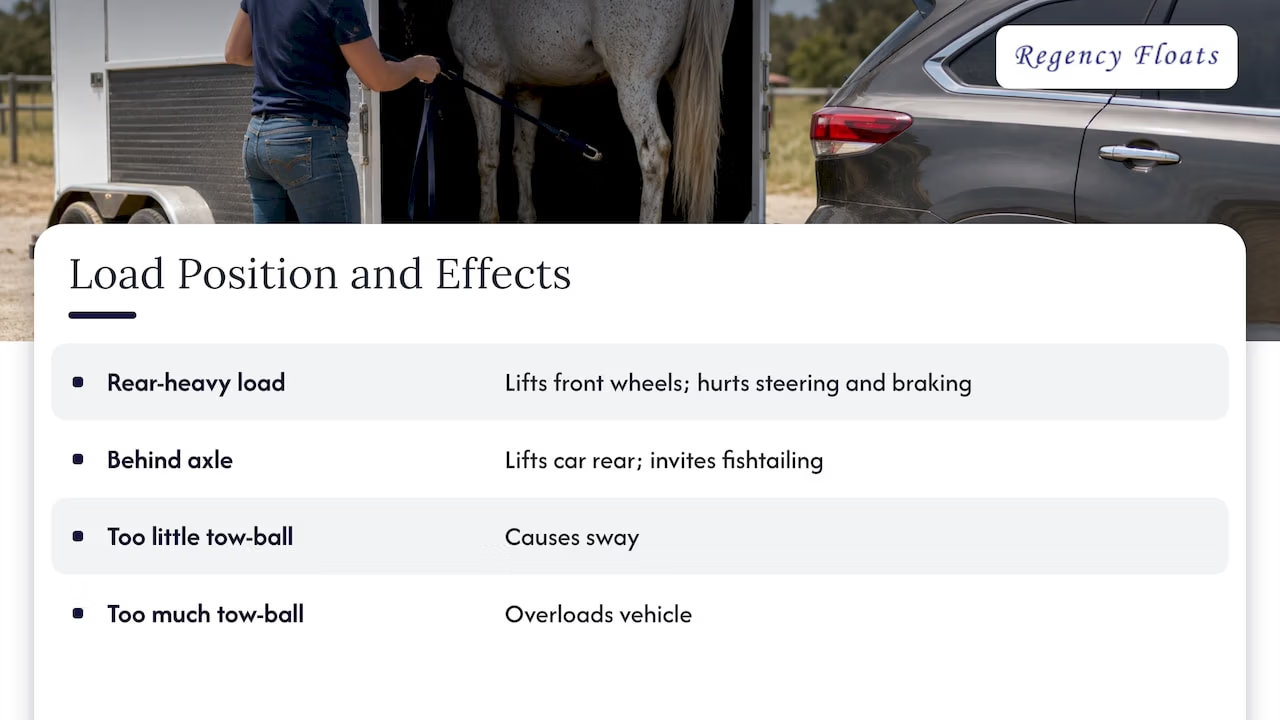
The mechanics are simple. Norm Glenn, an Australian horsemanship expert, explains that too much weight at the back of the car tends to lift the front wheels, which hurts steering and braking. If the centre of the load sits behind the trailer’s axle line, it lifts the rear of the car and invites unstable handling and fishtailing. Too little weight on the tow ball causes sway. Too much overloads your vehicle.
Know your numbers first
Before you think about where anything goes, you need to know what the float is allowed to weigh. Everything starts with the compliance plate, a metal plate fixed to the float. It carries the critical weight information: tare, GVM, ATM, GTM and tow ball weight.
In plain terms:
- Tare is the empty float’s weight.
- ATM (aggregate trailer mass) is the maximum the float can weigh fully loaded, including the weight on the tow ball.
- GTM (gross trailer mass) is the weight the axles carry when the float is hitched up.
- Tow ball weight (also called download) is the downward force the coupling puts on your vehicle’s tow ball.
If the ATM and GVM labels blur together, our guide to what each trailer rating actually means sorts them out. For the full legal side, see what a loaded horse float actually weighs.
Your payload is smaller than you think
Subtract the tare from the ATM and you have the payload: the most you can add. Weigh My Ride’s five-step check counts horses, tack, feed, water and extras all against that figure.
A worked example, using round numbers for illustration only. Take a two-horse float with a tare of 800 kg and an ATM of 2,000 kg, a combination similar to one described in an Australian towing guide. The payload is 1,200 kg.
| Item | Weight (kg) |
|---|---|
| Two horses (e.g. 550 kg each) | 1,100 |
| Saddles, rugs, bridles | 40 |
| Hay for the day | 30 |
| Buckets, grooming kit, extras | 20 |
| Total | 1,190 |
That leaves 10 kg to spare. Add a full water tank and the float is over its ATM. This is the creep that Weigh My Ride says is widespread: extra gear added trip by trip until the float is overloaded without anyone noticing. Your own figures will differ, so use your plate and your horses’ actual weights.
Tow ball download: the number that sets stability
Tow ball download is the single best indicator of whether a float is balanced front to back. In Australia, 10% is the common limit, and that download helps dynamic stability as you travel. Weigh My Ride gives the same target: about 10% of the actual ATM.
On the 2,000 kg ATM example above, that means a target of around 200 kg on the ball. Three points follow from this.
- Download counts against your vehicle. It is part of the vehicle’s GVM, meaning it eats into what your car or ute can carry. A 200 kg download plus passengers, a loaded tray and a bull bar can reach the vehicle’s limit quickly.
- Too little is as risky as too much. Light download tends to let the float wander and sway at speed.
- Too much is visible. AutoExpert warns it is particularly bad if the trailer begins lifting the back wheels or unloading the rear suspension, which puts everyone in a precarious position.
The only reliable way to know your real figure is to measure it with a tow ball scale or weigh the loaded rig. Horses and People advises a stop at a local weighbridge with the vehicle and float fully loaded to check the real weight.
Where each horse should stand
The principle is the same across layouts: keep the weight low, near the axles and as level as the float allows, with the heavier horse towards the driver’s side.
One horse in a two-horse float
A single horse in a large float is the classic balance problem, because all the weight sits to one side and one end. Agriculture Victoria’s guidance is that a single horse in a two-horse trailer should be tied on the driver’s side, with the centre partition removed to improve the vehicle’s balance. Check your float’s design and manual before removing any partition, and make sure the horse is comfortable with the extra room.
Two horses
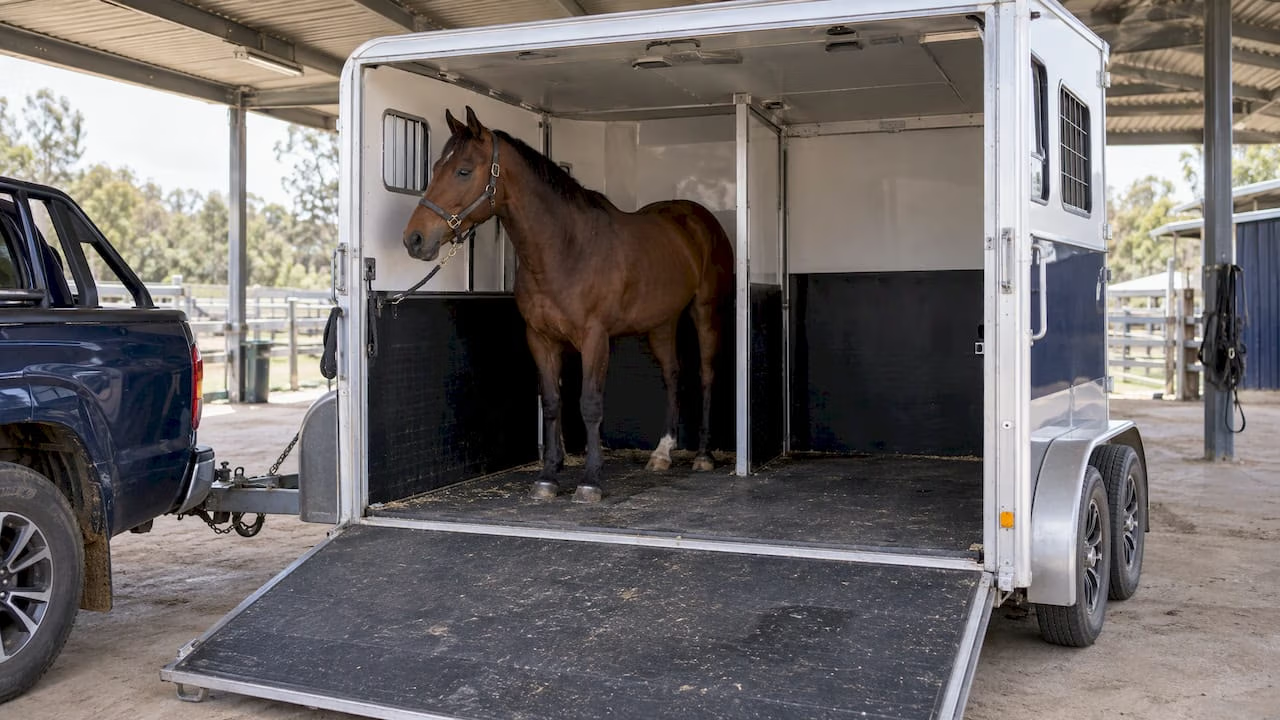
The same Agriculture Victoria page says that with two horses, the heavier horse goes on the driver’s side. Why? Australian roads are crowned, sloping towards the left gutter. The float’s weight naturally drifts left, so loading the heavier horse on the right counters it.
In an angle-load float, the aim is also to keep the heaviest animal near the wheels, which holds the centre of mass close to the axle line. Keep the float as level as you can once loaded, because a nose-high or nose-low float changes the tow ball download.
Why the left-hand lean matters
John O’Leary of Horseproblems Australia points out that almost all angle floats in Australia angle to the left. If a left tyre drops off the bitumen, the driver swerves right and the horse’s weight swings left through its shoulder, which can help a float spin out. The lesson for loading: do not put a light horse alone on the left and expect the float to stay settled. Place weight deliberately, drive smoothly and keep wheels on the seal.
Dividers and room to balance
Horses brace with their necks and shoulders. Dr Sharon Cregier explains that a horse keeps sixty percent or more of its weight on its forequarters and uses its neck as a balance rod. A horse that can spread its legs and use its head tends to travel more calmly, and a calmer horse moves less, which helps keep the load steady. Choose a floor plan with space for the horse you actually carry.
Loading everything else
Horses are not the only weight in the float. Where the rest goes can shift your tow ball download by tens of kilograms.
- Saddles and tack: keep them in the front compartment, fixed in place, and low rather than stacked high. Heavy items forward of the axles add download, so check the figure after you load.
- Hay: a full hay net adds weight, and its position matters. Hay bales belong near the axle line, not at the extreme rear.
- Water tanks: water is heavy (one kilogram a litre) and Weigh My Ride notes that the position and fill level of tanks can have a significant impact on tow ball mass and balance. Fill what you need rather than a full tank by habit.
- Rear storage: keep it light. If the centre of the load drifts behind the axle line, handling becomes unstable.
The general rule from the research is to place heavier items over the axles, as noted in widely repeated towing advice. Then weigh and adjust.
Limits you must stay inside
Balance is no substitute for staying within the ratings. Horse SA’s transport page sets out that the loaded trailer mass, with horses, saddlery, feed and water, must not exceed the vehicle’s towing capacity or the tow bar’s capacity, whichever is lower. Horses and People adds that the loaded mass cannot exceed the lesser of the towbar and coupling rating, the vehicle’s towing capacity or the trailer’s maximum carrying capacity.
Brakes are part of the picture. On the same page, a trailer over 750 kg GTM needs brakes, and above 2,000 kg it needs electric breakaway systems. Horses and People summarises the tiers: 751 to 2,000 kg needs braking on both wheels of at least one axle, and 2,001 to 4,500 kg needs braking on all wheels plus an automatic breakaway system. Pony Club Australia adds that tow bars, balls, couplings, safety chains and breakaway systems must all be rated for the weight being towed, and that observing limits is a legal and welfare responsibility.
Rules differ between states and change, so confirm your state road authority’s current requirements. For a step-by-step on checking your vehicle, see how to calculate what your vehicle can legally tow and the Australian legal requirements for towing a horse float.
Signs your float is out of balance
You do not need a scale to notice a problem on the road, though a scale confirms it. Watch for these:
- The tow vehicle’s rear sits low and the headlights point high. That points to too much download.
- The float sways or snakes at highway speed, or the rig feels light and floaty at the steering. That points to too little download or load behind the axles.
- The nose of the float sits visibly high or low when hitched. Adjust the load or hitch height.
- Braking feels long or the float pushes the vehicle. Check loaded weight and brake function.
- The horse scrambles or stomps. The Problem Horse notes a horse behaving this way may be struggling for balance. Review how it is standing, the room it has and your driving.
Weigh My Ride warns that overloaded or unbalanced floats raise the risk of sway, braking failures and tyre blowouts. If you see any of the signs above, stop somewhere safe, adjust and re-check before continuing. If the problem persists, have the tow vehicle, coupling and brakes inspected by a qualified mechanic or a licensed vehicle inspector.
A pre-departure routine
Run this before every trip, especially when you change horses, gear or vehicle.
- Read the compliance plate for tare, ATM, GTM and tow ball weight. Work out your payload.
- Add up the load: horses, tack, feed, water, extras. Use real weights, not guesses.
- Check the vehicle: towing capacity, tow bar rating and the GVM allowance after download.
- Load the horses with the heavier one on the driver’s side and the partition set as your float’s design allows.
- Position the gear: heavy items low and over the axles, water tank filled only as needed.
- Check the level and download: the float should sit level, with download near 10% of ATM.
- Test the connection: couplings, chains, breakaway and brake controller. See our pre-departure checklist.
- Weigh the whole rig at a weighbridge when you first set up, and again whenever your load changes noticeably.
For wider habits, our safe loading and towing practices section goes further, and the overall horse float weight guide covers the figures by float type.
Choosing a float that makes balance easier
Good distribution starts with the float itself. Regency Floats has been manufacturing horse floats for over 40 years, and our designs combine advanced safety technology, European luxury styling and a state-of-the-art flooring system backed by a ten-year warranty. Floor plans are customisable, so you can choose a layout and fittings to suit the horses you carry, whether that is one pony, two Thoroughbreds or a competition team.

If you tow a pair most weekends, look at the 2 Horse Float Range. For other layouts, our full float range includes Standard, Deluxe, Camper, Gooseneck, Straight Load and Thoroughbred Series floats. Whichever you pick, check its compliance plate against your tow vehicle before you buy, and we can help you match the two.
FAQ
Where should one horse stand in a two-horse float?
On the driver’s side. Agriculture Victoria advises tying a single horse on the driver’s side and removing the centre partition to improve the vehicle’s balance. Check that your float’s design allows the partition to be removed.
How much weight should be on the tow ball?
About 10% of the float’s actual ATM is the common Australian target. On a 2,000 kg ATM float that is roughly 200 kg. Remember the download counts toward your vehicle’s GVM, and check the figure with a scale rather than guessing.
Do I need a weighbridge?
It is the most reliable way to know what a loaded rig really weighs. Weigh the float and vehicle fully loaded, with horses, tack, feed and water aboard, and compare the readings with the compliance plate and your vehicle’s ratings.
Does the heavier horse go on the left or right?
On the driver’s side, which is the right in Australia, when you carry two horses. That counters the road camber and the left lean common in angle floats. Keep the float level and the heaviest horse near the axles.
Does water in the tank change the balance?
Yes. Water is heavy, and the tank position and fill level can significantly change tow ball mass and balance. Fill only what the trip needs, then re-check the download.